
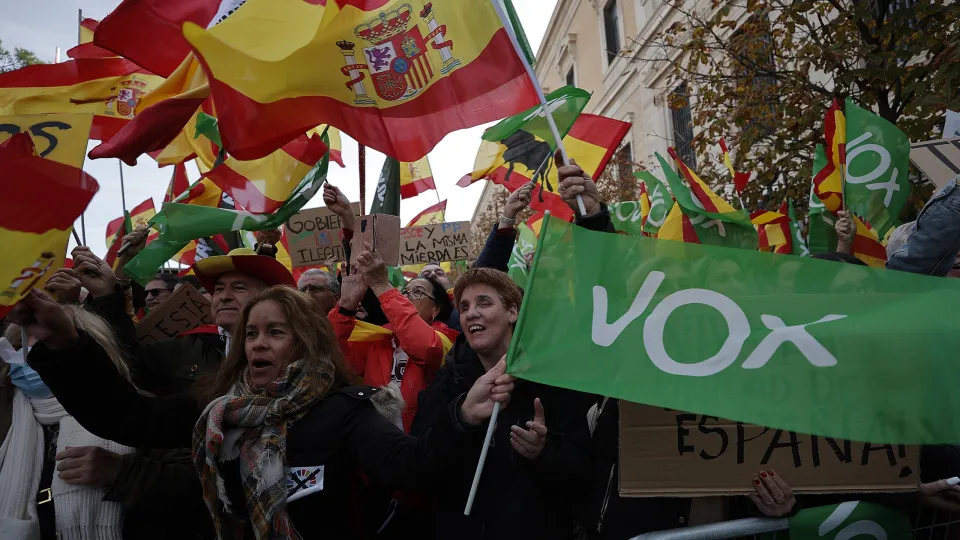
The most recent polls published in Spain, which will have early elections on November 29, all give victory to the Popular Party (PP, right), but without absolute majority, while the Vox (extreme right) would double the number of deputies.
© Getty Images
05/10/2026
by
Lusa
O PP has already won the previous elections in July 2023, and attempted to reach the Government in an alliance with Vox, but the two parties were left to six deputies of an absolute majority in parliament and socialist Pedro Sánchez eventually reinvested Prime Minister in November of that year by a contraption of eight political forces, including some right-wing, nationalists and independentists.
Sánchez called today early elections on November 29 and the latest polls, made before this announcement, estimate that PP and Vox now, together, achieve an absolute majority, which will be around 200 MPs in a parliament with 350 seats.
The same studies show that the PP would have a similar percentage of votes to the elections of 2023 (33%), when it elected 137 Members, and that Vox could reach 18% and almost double the number of current Members (33).
The left forces, the Spanish Socialist Party (PSOE), of Sánchez, and the Somar platform, which integrates several parties, would lose votes and deputies.
The PSOE and Somar are in the current coalition of government and, according to the polls, the socialists would fall to 25% of the votes (they had 31.6% in 2023).
In contrast, Somar increased from 12.33% from 2023 to about 6%, according to the same studies.
Pedro Sánchez, Prime Minister since 2018, will again be the PSOE candidate, while the Somar platform does not currently have a leadership and is more divided, after the departure of Podemos and the still Labor Minister, Yolanda Díaz, the candidate in 2023, have announced that it withdraws from politics.
The parties that are in Somar today announced that they will reveal on October 17 who will lead the candidacy of the new left-wing platform, which should be called “Front Ample” (“wide Front” or “wide Front”).
As for the PP and Vox, their leaders, Alberto Núñez feijóo and Santiago Abascal, welcomed today that “finally” there should be elections in Spain and said they should be prepared for legislative and governing.
The two parties, which had been calling for elections for months, have joined this year to form governments in four autonomous regions and have made themselves available to form a coalition in the national executive.
The Vox leader today reiterated that the party intends to take to the national government coalition what it negotiated in regional executives, namely the application of a polemic “priority principle” in access to public services and support, with discrimination of immigrants.
Sánchez decided to anticipate the national elections after, on Friday, the Spanish parliament rejected government measures for housing and after more than a week of daily protests with thousands of people on the streets because of evictions and difficulties in accessing a house.
Measures for housing were rejected by PP, Vox and the right-wing independent party Together by Catalonia (JxCat).
The housing crisis has removed in the last week and a half the media focus in Spain from the issues of immigration and the situation in Cauta, where more than 70,000 people illegally entered within 24 hours at the end of July, an episode that has been the cause of widespread criticism of the government.