
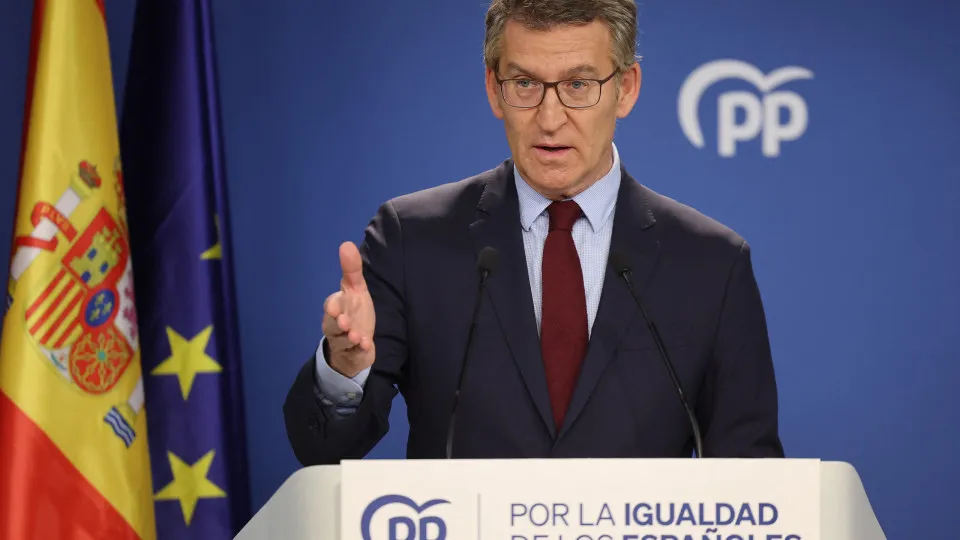
The opposition leader in Spain, Alberto Núñez Feijóo, today began the election campaign in Ceuta, accusing the government of Pedro Sánchez of corruption and mismanagement.
© THOMAS COEX/AFP via Getty Images
07/10/2026
by
Lusa
O opposition leader in Spain today started the campaign for early elections on November 29 in Ceuta, where it considers there to be a crisis resulting from the decline, corruption and lie of the Socialist government Pedro Sánchez.
Ceuta, a Spanish enclave in North Africa, where at the end of July more than 70,000 people entered illegally in 24 hours, “is the symptom of the decline, corruption and lie that the country plunged” with the management of Sánchez, said Alberto Núñez Feijóo, president of the Popular Party (PP, right).
Feijóo considered that the approximately 80,000 Spaniards living in Ceuta “had to defend themselves practically alone from an attack on their territorial integrity that has been dragging on for more than two months.”.
Ceuta was the destination today of the “first visit as a candidate” of Feijóo in the elections on November 29 and will be “the first dossier on the table of the Council of Ministers” if the PP wins the elections and reaches the Government, he promised, in a statement alongside the president of the executive of the autonomous city, Juan Jesus Vivas, of the same party.
Feijóo considered that “Ceuta did not recover normality” and the only solution is that “the 15,000 people who invaded the city illegally” at the end of July and continue in the enclave leave Spain.
“ That is the only solution and that is my commitment”, he added.
Most of the people who entered Ceuta on 30 and 31 July illegally left the city on a voluntary basis, but thousands remain in the enclave, with the Spanish Government saying they cannot be repatriated without a temporary accommodation process, registration and official decision on asylum applications, as imposed by the European Migration Pact, in force since June.
More than two months after the mass entry, there are still people sleeping on the streets of Ceuta, by high places in reception centers.
The Prime Minister and leader of the Spanish Socialist Party (PSOE), Pedro Sánchez, this week called early parliamentary elections on 29 November, at a time when protests for the housing crisis withdrew, after more than two months, the outbreaks of all the media attention of Ceuta and the widespread criticism of the management that the government made of the situation in the enclave.
Ceuta and immigration, where the right-wing and far-right speeches focus, and the housing crisis, where the left is focusing, should be the central themes of the election campaign on 29 November.
Pedro Sánchez has been Prime Minister since 2018. Even if worn out internally by several confirmed and suspected cases of corruption of people close to him and by a legislative paralysis dependent on an eight-party contraption in parliament that prevented him from presenting a single proposal for the State Budget since 2022 or by acting in Ceuta, he had consistently repeated in recent months that the current legislature would go to the end (mid 2027).
Until Monday announced the dissolution of parliament and early elections, after right-wing parties had failed parliament decrees with measures for housing with which the government had urgently advanced against the pressure of thousands of people on the streets since the eviction, on 23 September, of Maricarmen Abascal, an elderly 87 years old.
“To make in-depth the outstanding reforms, which we need to reduce the levels of inequality, we must mobilize and we must get parliament to dovetail us with a much wider, progressive majority, to double the elites and win new rights and continue to transform Spain,” said Sánchez.
The analyses of polytologists, analysts and media today coincide with Sánchez and PSOE on the subject of housing “a window of opportunity” when the whole context seemed unfavorable to the left, as all surveys reveal.
The most recent polls published in Spain all win the PP, but without an absolute majority, while the Vox (extreme right) would double the number of Members, with the two parties reaching an absolute majority in parliament.
The PP would have a similar percentage of votes to the previous elections, of 2023 (33%), when it elected 137 Members, and that Vox could reach 18% and almost double the number of current Members (33).
The left forces, the PSOE, Sánchez, and the Somar platform, which integrates several parties, would lose votes and deputies.
The PSOE and Somar are in the current government coalition and, according to the polls, the socialists would fall to 25% of the votes (they had 31.6% in 2023). Somar increased from 12.33% from 2023 to about 6%, according to the same studies.