
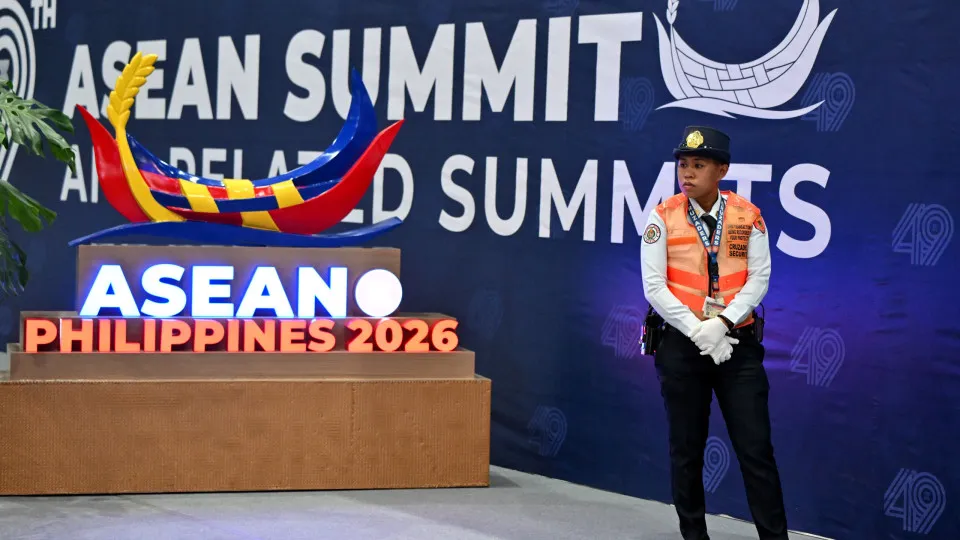
ASEAN today admitted that the code of conduct for the South China Sea, negotiated over two decades ago with Beijing, will not be concluded at the summit in Manila. Philippine diplomacy leader Theresa Lazaro announced progress in negotiations, but the document has not yet been finalised.
© Nhac NGUYEN / AFP via Getty Images
15/11/2026
by
Lusa
A ASEAN today admitted that the code of conduct for the South China Sea which has been negotiating with Beijing for more than two decades will not be concluded at the summit in Manila.
The chief of diplomacy of the Philippines, a country holding the annual presidency of the Association of Southeast Asian Nations, announced the “substantial conclusion of negotiations on the code of conduct between ASEAN and China”.
Theresa Lazaro said that the Filipino presidency of ASEAN, which had undertaken to finalise the document this year, achieved a substantial advance in negotiations.
“ We delivered this document to Singapore in almost 80%”, a country that presides over ASEAN in 2027, Lazaro said.
Progress in the code of conduct negotiations, pending since 2022, has taken place in a scenario of tensions with Beijing in the South China Sea.
The maritime space is claimed almost entirely by China and collisions between Chinese ships and vessels from ASEAN countries, especially the Philippines, are frequent.
The bloc ensured that it will continue to “work constructively” to conclude negotiations on a code “effective and substantive as soon as possible,” Lazaro said during a press conference, quoted by the Spanish agency EFE.
Lazaro said that at least one of the four points that presented difficulties in the agreement has already been resolved, without specifying which.
He said that in the coming months the final terms of the agreement could be decided, which was halfway through when the Philippines started the annual rotational mandate of ASEAN.
The document will serve as a platform for maritime cooperation between China and ASEAN, which will work for “peace and stability in the region,” he added.
The South China Sea includes the Spratly and Paracel archipelagos among the most contested by China and countries such as the Philippines, Malaysia and Vietnam.
One third of world maritime traffic passes through the South China Sea.
The importance of the South China Sea is also due to the concentration of 12% of the world's fishing areas as well as potential deposits of hydrocarbons.
China claims, for historical reasons, almost all of that sea, a claim that conflicts with the positions of countries such as Vietnam, Malaysia, Brunei and the Philippines, as well as Taiwan.
Manila hosts from today until Tuesday the meeting of ASEAN leaders, formed by Brunei, Cambodia, the Philippines, Indonesia, Laos, Malaysia, Myanmar, Singapore, Vietnam, Thailand and East Timor.
Created in 1967 and with a population close to 700 million inhabitants, ASEAN also invited partner countries, including the United States and China.
While awaiting the arrival of American President Donald Trump, Manila on Tuesday, Beijing sent Prime Minister Li Qiang.