
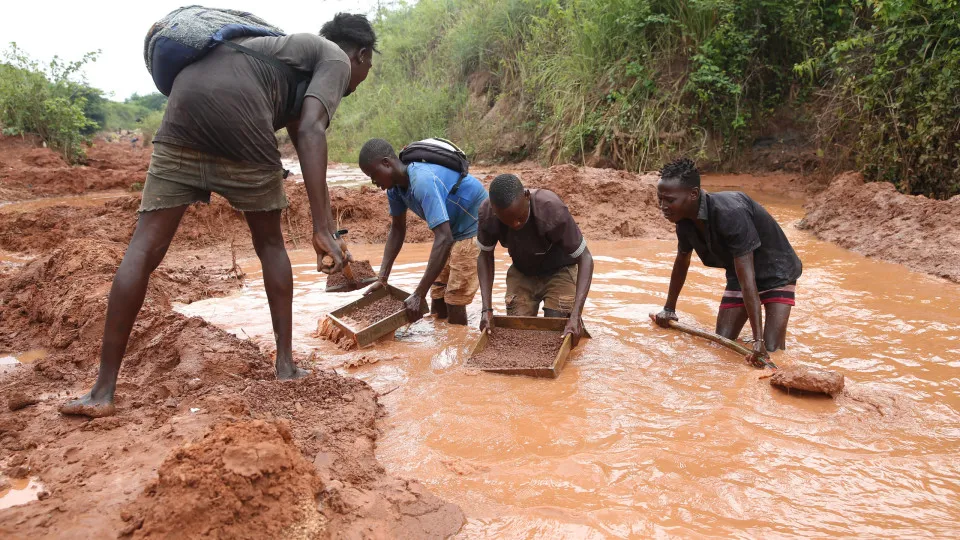
Analyst Rui Verde warns that Angola may be replacing the oil cycle with another mineral-based one, a process of diversification that is still not deep, with foreign non-oil investment concentrated on mining and Lobito Corridor.
© Lusa
13/11/2026
by
Lusa
O analyst Rui Verde warns that Angola may be replacing the oil cycle with another based on minerals, a process of diversification still not deep, with foreign non-oil investment concentrated in mining and Lobito Corridor.
The analysis consists of a study entitled “Diversification of the Angolan economy: A critical reading of the figures of foreign investment and non-oil GDP in Angola”, published today by the Centre for Studies for Economic and Social Development of Africa (CEDESA), an organization dedicated to researching southern Africa's political and economic issues, in particular Angola.
Non-oil direct investment in Angola increased from US$353.5 million in 2024 to US$959.4 million in 2025, an increase of more than 170%, and in the first half of 2026 it reached US$971.8 million, exceeding the total recorded in the previous year.
However, Rui Verde stresses that these figures do not necessarily correspond to the entry of new productive investments, since the concept of IDE includes not only the creation of companies or new industrial units.
According to the vice-president and director-general of CEDESA, also a researcher at the Paris-Cité University, the increase in non-oil investment also reflects reinvestments in profits and financial operations between companies, while flows focus on mining and logistics.
“An increase in the IDE does not automatically mean an equivalent increase in real productive investment,” notes Rui Verde, giving as an example a foreign company already installed in Angola that decides to keep in the country the profits that would otherwise transfer abroad.
This operation would be accounted for as a foreign direct investment, although it does not necessarily represent the creation of a new productive unit.
The researcher also draws attention to the concentration of investment in mining, transport, logistics, energy and infrastructure associated with the Lobito Corridor. While recognising the strategic importance of these sectors, it considers that their growth does not necessarily represent a profound diversification of the Angolan economic structure.
For decades, Angola has depended on oil, but an increasing part of the investment now seems to go to minerals such as copper, diamonds, gold and rare earths, as well as to infrastructures intended to serve these activities.
“ There is an important difference between economic diversification and diversification of extractive sectors,” warns Rui Verde, considering that the country may be gradually replacing one oil-based cycle with another based on the exploitation of mineral resources.
The development of the Lobito Corridor, which links this Atlantic port of Angola to the Democratic Republic of Congo by an railway of over 1,000 kilometres, is seen as an alternative to the transport of minerals from Angola and Zambia and supported by the United States, the European Union and international financial institutions.
Rui Verde points out that part of the investment flows may be associated with the anticipation of future yields linked to regional logistics and the value chain of critical minerals, in a context of growing Western demand for alternative sources of supply.
Although sectors such as agriculture, transport, trade, telecommunications, construction and some segments of the manufacturing industry have performed well, this does not necessarily mean that structural change has taken place, it stresses.
Part of the increase in the relative weight of non-oil GDP results from the loss of importance of oil, whose production has decreased due to the ageing of fields and the lack of new exploratory investments.
The author considers, however, that it would be wrong to state that nothing has changed in the Angolan economy, recognizing the growth of non-oil activities and an investment in new sectors more expressive than ten or 15 years ago. But it also considers it hasty to conclude that the country has solved the historical problem of dependence on raw materials.
In order to talk about real structural change, Rui Verde argues that it will be necessary to monitor the evolution of the indicators after 2026 in order to observe whether high levels of non-oil investment and growth of non-oil exports remain.
If flows return to levels prior to 2025 and remain concentrated in mining and logistics associated with the export of natural resources, the results of 2025 and 2026 may correspond only to a specific investment cycle linked to the Lobito Corridor, critical minerals and geopolitical competition between the West and China in Africa, concludes.