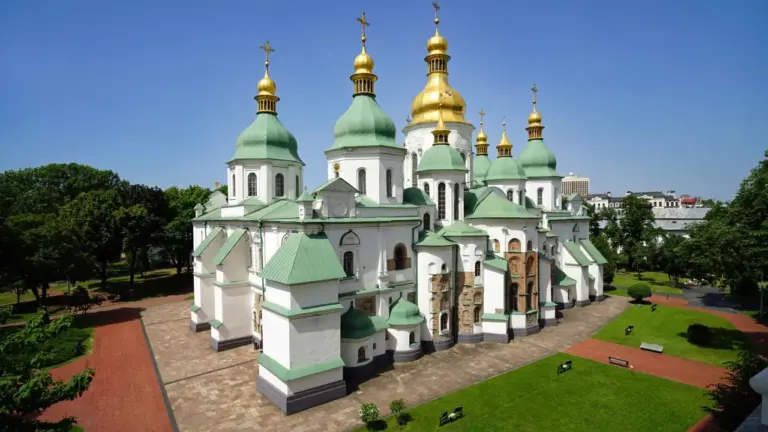
Portuguese artist Nelson Ferreira was invited to create a work for the permanent collection of the Cathedral of Santa Sofia in Kyiv, Ukraine, and seeks funding for the project that is proposed to take place this Christmas.
© Shutterstock
25/11/2026
by
Lusa
O portuguese artist Nelson Ferreira was invited to create a work for the permanent collection of the Cathedral of Santa Sofia in Kyiv, Ukraine, and seeks funding for the project that is proposed to take place this Christmas.
The invitation, advanced by the digital newspaper 7Margens, was made by the director of the Santa Sofia National Reserve of Kyiv, Nelya Kukovalska, an institution protected by the Ukrainian Ministry of Culture, to create a painting in the cathedral, inspired by the image of Oranta, one of the most emblematic mosaics of Ukrainian national identity.
“ It was an absolutely incredible honor because my piece will enter the permanent collection of the most important monument of the Ukrainian nation,” Nelson Ferreira, contacted by the Lusa agency, stressing the symbolic and institutional significance of the invitation, which emerged after a first contact with the Ukrainian embassy in Portugal a few years ago.
The artist had presented a proposal to expose at the Kyiv Grotto Monastery, which aroused interest, but had not followed for some time, and was now again contacted for a larger project, aimed at the Cathedral of Santa Sofia, classified World Heritage by UNESCO.
The work will be inspired by the Oranta, representation of Our Lady with her arms raised in prayer, in Byzantine mosaics of the 11th century, located in the central apse of the cathedral, “whose image is associated with a tradition according to which, as long as the mosaic exists, Kyiv and Ukraine will remain standing”.
“It is one of the most important artistic testimonies of the entire history of art worldwide, and it is one of the most relevant mosaics of the Byzantine period,” he said, considering that the invitation has a particularly strong symbolic burden at a time when Ukraine is going through “a very complex historical phase” due to the war with Russia.
The creation of the work should take place on site, during the night, according to the method developed by the artist, which provides for the realization of paintings without using photographs, seeking a direct dialogue with the architecture and the elements existing in the monument.
“ I want the work to dialogue with the architecture that is there. My works are not an imposition, they are a dialogue, and the idea is that the paintings are founded with the very architecture of the building ", explained the artist to Lusa.
Nelson Ferreira estimates that he will remain for about a month in Kyiv, during which time he will perform the painting, although the movement and the beginning of the work depend on the fundraising, and the specific space of the cathedral where the work will be installed is still to be determined.
“ I will only go when the funding is active, through sponsorship,” he said, admitting that he would like to travel already at Christmas, because he considered that the realization of the work at that time would have a special meaning: “the Ukrainian Orthodox Church has recently changed the celebration of Christmas from January to December 25”.
The painting will be performed with the technique PlatiGleam, developed by the artist, which uses materials such as platinum and does not resort to conventional pigments, making the image appear or disappear according to the conditions of light, being designed specifically for heritage classified by UNESCO.
The technique was born from a morning writing experience, inspired by Julia Cameron’s book “The Path of the Artist”, which the artist began to practice during the covid-19 pandemic, when he was out of work for about two years.
“ When I reviewed the morning pages, the entire technique of PlatiGleam was there described and I was perplexed”, he explained, explaining that he began to experiment and perfect the method, which gave rise to the first paintings dedicated to the Monastery of the Battle, where he held an artistic residence.
The exhibition at the Battle, which had 126,000 visitors, paved the way for other international projects, particularly in Nepal and Indonesia, where he was invited to work in historical temples, having works his integrated permanent collections of world heritage.
The artist has developed projects in monuments such as the Battle Monastery, the temples of Borobudur, Sewu and Pambanan, Indonesia, and in temples of the Kathmandu Valley, Nepal, among others.
For the realization of the work in Kyiv, Nelson Ferreira estimates to need between 10 thousand and 25 thousand euros, depending on the size of the painting, money intended to cover the costs of production and travel, with the stay assured by the Cathedral of Santa Sofia.
“ We are not creating this for profit, sponsorship will be just to cover costs, I will donate my time and I will donate my effort because it is something worth doing”, I told Lusa, defending that the project may also be a symbol of the relations between Portugal and Ukraine.
The artist appealed to the Lisbon City Council to join the initiative, recalling that in 2023, the municipality supported the restoration of the central cross of the Cathedral of Santa Sofia, and that the director of the monument in Ukraine suggested the continuity of this collaboration.
“ I also appeal here to the Lisbon House to continue this protocol with Kyiv Cathedral,” he said, considering that the project could also involve European institutions as an offer of diplomatic and cultural support to Ukraine.
Nelson Ferreira lives in London, but maintains a regular link to Portugal, where he currently presents an exhibition in the National Pantheon, entitled “Narrative Affections”, in homage to Eça de Queiroz and Paula Rego, patent until February 21, 2027, curated by Emilia Ferreira.
The Cathedral of Santa Sofia, built in the 11th century, has been part of the UNESCO World Heritage list since 1990, along with associated monastic buildings, constituting one of Ukraine's most important historical and religious ensembles, recognized by medieval mosaics and frescoes.