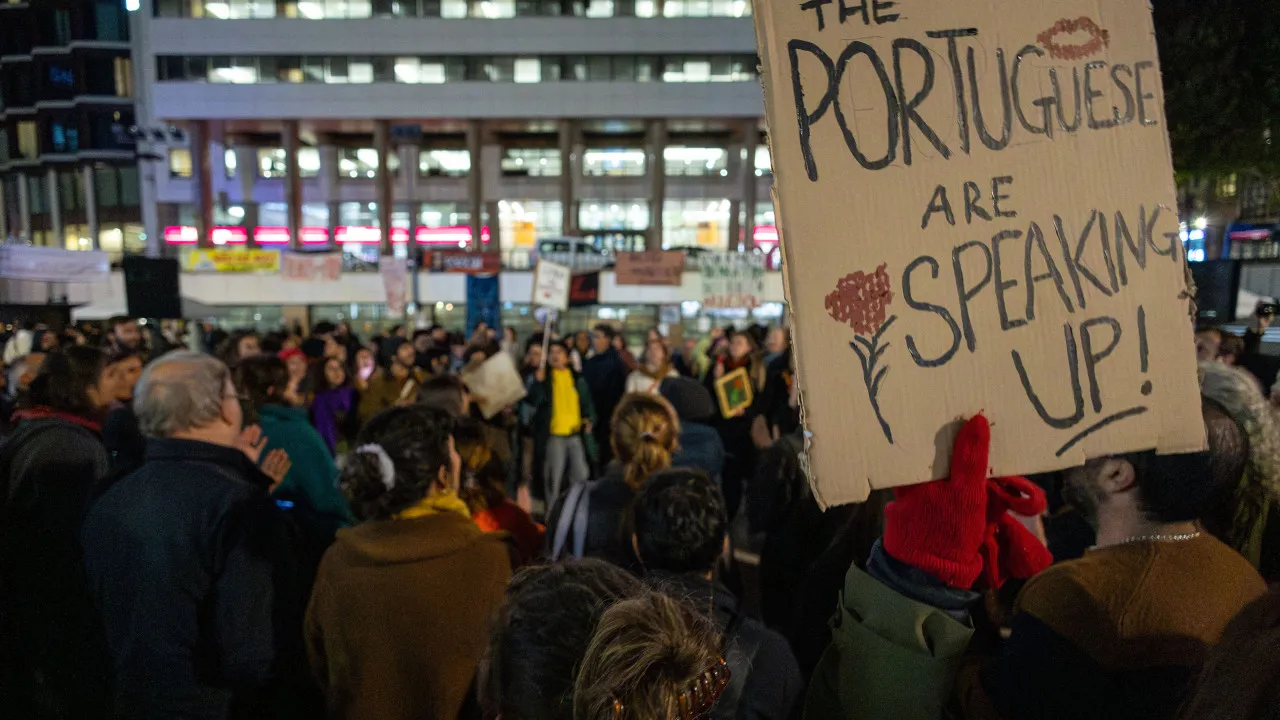
A four-metre Christmas tree was installed in D. João I Square in Porto, where there are protests and camped by the right to housing since October 10.
© Diogo Baptista/SOPA Images/LightRocket via Getty ImagesLusa
21/11/2026
by
Lusa
Uthe Christmas tree about four meters high was today installed in the square D. João I, in Porto, where since October 10 there have been protests and camped by the right to housing.
About 70 tents were protected from the rain today with blue waterproof capes and green troops in D. João I Square, where a Christmas tree was placed to mark the approaching Christmas season.
The work of planting the tree was peaceful, as described to Lusa two men who are sleeping in this square in the center of Porto.
Alexandre Silva, 24 years old, has the 9th year of schooling, is unemployed and without housing, and participates in the camp of Porto from the beginning, on October 10. Bruno Esteves, 38 years old, unemployed, receives the Social Income of Insertion (RSI), 240 euros per month, but states that he cannot rent a room for that amount and is also sleeping in Praça D. João I.
The two men told Lusa this afternoon, on the camping site, that the Christmas tree was placed in D. João I Square, on Friday, the 20th, around 17:00 and that there was no conflict.
“The Christmas tree doesn’t bother, what bothers us is the violence we are sometimes treated with and the fact that people don’t know how to resolve conflicts with more diplomacy,” said Bruno Esteves.
According to Alexandre Silva, the placement of the Christmas tree does not constrain people's struggle to the right to housing.
However, the 24-year-old thinks that there is a “force game” between the authorities and the demonstrators.
“ I think this is a game to go removing the tents ", said to Lusa, recalling that in the Porto Municipal Assembly it was decided that a Christmas train was placed in the square, beyond the Christmas tree.
The Porto camp approved, in a popular assembly on Thursday, meeting with the Government, which had announced the reception to two groups associated with that movement.
The current protests against the housing crisis began in Porto on October 10 and expanded to Lisbon and other locations in the country.
The PSP's action to disperse the camp and remove the tents in Rossio, Lisbon, and in Praça D. João I, caused dozens of wounded and arrests.
On October 15, the PSP claimed that “the meetings and demonstrations in public places could not extend beyond 00:30” and that the protesters in Porto adopted “resistance behaviors”, which led to police action, causing “some injured people”.
The prosecutor has, however, asked the Constitutional Court to assess the constitutionality of the 1974 rule that states that a demonstration has the time limit at 00:30.
The protesters demand, among other things, the reversal of the new rental law and a stop to housing acquisition by real estate funds.
The campsites of Porto and Lisbon and the platform Casa Para Viver have already met with the President of the Republic, António José Seguro.