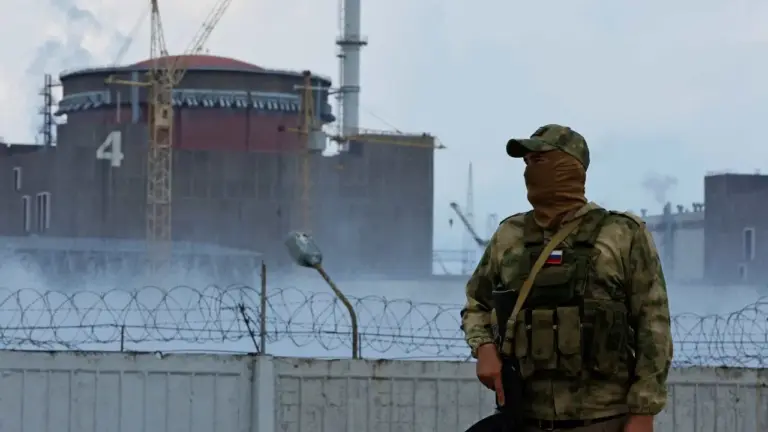
Russia’s mass attacks on infrastructure near Ukraine’s nuclear power plants are increasing the risk of a radioactive escape, according to Ukrainian and international experts, calling for firm action.
© Reuters
22/11/2026
by
Lusa
Orussia's mass attacks on infrastructure near Ukraine's nuclear power plants are increasing the risk of a radioactive escape, according to Ukrainian and international experts, calling for firm action.
Nuclear power plants currently cover most of the electricity consumption in Ukraine as all other major power plants have been destroyed or damaged by Russian attacks. Isolating them represents the main axis of Moscow's strategy to leave the Ukrainians lightless during the winter, refers to Eph.
The attacks against substations responsible for the distribution of electricity produced by the nine Ukrainian controlled nuclear reactors require risky procedures that were not foreseen, according to Ukrainian specialist Volodymyr Omelchenko.
In statements to the Spanish news agency, the expert at the Razumkov Centre in Kyiv pointed out that if there was a radioactive leak at Rivne or Khmelnytskyi power stations, less than 200 kilometres from the territory of the European Union (EU), “millions of people could be affected, which would lead to an escape from the population”.
Earlier last week, nuclear regulators from 38 countries – including all EU, United States, United Kingdom, Canada and Japan – showed similar concerns.
In the declaration signed on 16th, the members of three international associations (WENRA, HERCA and NORA) warned that Russian attacks were becoming “even more reckless.”.
“ A deterioration of nuclear conditions could ultimately lead to incidents with release of radioactive material, which could affect the population and the environment throughout Ukraine and possibly beyond its borders,” they added.
The statement also underlined the “urgent need for Russia to cease attacks on Ukrainian nuclear installations and against the energy infrastructure essential to their safe operation”.
Four days later, Ukrainian nuclear installations were forced to reduce their energy production, as a result of the high damage suffered by the power grid in Russian attacks with over 100 missiles and 400 long-range drones.
The first attacks on key infrastructure close to nuclear power plants took place in 2022, according to experts, which indicate that Ukrainian engineers have managed to mitigate the danger and avoid serious consequences for nuclear safety.
Nevertheless, Volodymyr Omelchenko and Olga Kosharna, the association of nuclear experts and the national section of Greenpeace, accuse control bodies of not reacting to Moscow's continuing disregard for nuclear safety measures.
“ The UN structures demonstrate a special form of disregard for international law by naming representatives of the terrorist state – Russia – to occupy leadership positions,” Kosharna noted, after the director of the International Atomic Energy Agency (IAEA), Rafael Grossi, confirmed his intention to appoint the deputy director of the Russian nuclear company Rosatom, Alexei Feraponov, as his deputy in charge of this issue.
Experts criticise the appointment of this person, sanctioned by Ukraine for his role in the takeover of the occupied Zaporijia nuclear power plant, for his work in the company involved in the arrests and tortures of dozens of Ukrainian workers at the plant.
The Russian-occupied power plant lost its connection to the power grid on 27 occasions, using reserve mechanisms for the supply of electricity needed to keep the nuclear fuel refrigerated.
“ It is totally unacceptable and incomprehensible that a person belonging to the nuclear industry, who plays a key role in Russia’s war against Ukraine, should be appointed to such a high office,” said Greenpeace expert in Ukraine Shaun Burnie.
On the Ukrainian side, the Ministry of Energy indicated that the restoration of production at these plants at their normal level should take place gradually, with the completion of repairs of damaged substations and transmission lines.