
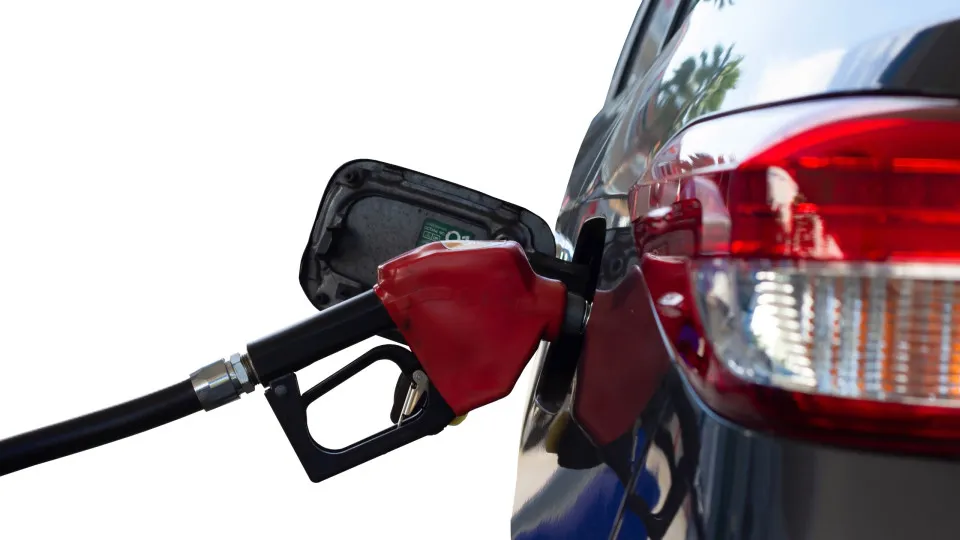
Next week brings a relief from fuel prices. Source of the sector told News to the Minute that the estimates point to a reduction of three cents both in the case of diesel and gasoline, already counting the right in the ISP.
© Shutterstock
04/10/2026
by
News to Minute, Lusa
Sand you need gas, wait for tomorrow: Fuel prices are going down for the second week in a row. Source of the sector advanced to News to Minutes that the estimates point to a reduction of three cents both in the case of diesel and gasoline, already counting the hit in the ISP.
This at a time when simple diesel is costing EUR 2,180 per litre and simple petrol 95 is costing EUR 2,096 per litre, according to the average prices updated by the Directorate-General for Energy and Geology (DGEG) on the Online Fuel Prices website.
Changing taxes on cars can save millions on fuels
The progressive elimination of ISV and the transformation of IUC could represent an annual saving of 3.2 million litres of fuel and avoid the emission of 10,800 tonnes of carbon dioxide, according to a published study.
The study of the Automobile Association of Portugal (ACAP), developed by EY, analyzes the association's proposal for a reform of automotive taxation.
The conclusions were presented at the ACAP Auto’26 Forum, which takes place in Lisbon under the theme “Driving the Future Automobile”.
The study examined the impact of a three-pillar reform proposal: a progressive elimination of the Vehicle Tax (ISV), the increase and reformulation of the Single Circulation Tax (IUC), and its redistribution.
The authors point out that the progressive elimination of the ISV “is an opportunity to modernise the Portuguese tax system, align with European best practices and actively contribute to the ecological transition”.
In addition to reducing fuel consumption and reducing carbon dioxide emissions, the study argues that it would bring economic and fiscal benefits.
At the economic level, it would promote a boost in the automotive sector and an increase in tax revenues, create employment and reduce sinisterity, while the tax benefits identified go through greater tax justice, align with German and Spanish practices and guarantee fiscal neutrality.
In the case of the ISV, the proposal focuses on a cumulative annual reduction of 10% and total elimination by 2036, while proposing a gradual elimination of the impact of the cylinder and replacement by environmental parameters.
In the case of the IUC, the proposal is to update the emission levels of carbon dioxide, fuel and age, as well as gradual increases in new vehicles, to compensate for the reduction of the ISV.
At the same time, it is suggested the redistribution of the IUC through the compensation of the loss of ISV revenue with the increase of IUC and transfer of IUC revenue from municipalities to the State.
Currently, the IUC Code establishes that municipalities receive the revenue generated by the IUC incident on vehicles of categories A, E, F and G, as well as 70% of the component related to the cylinder accident on category B vehicles.
The idea is to achieve a zero balance in these components, while responding to what the authors consider to be the structural problems of the car park in Portugal: the ageing and import of used ones.
In the case of the first, ACAP points out that in 2024 there were 1.6 million vehicles over 20 years of age in Portugal, the equivalent of 27% of the total, while in the second average age of imported vehicles it reached 8.2 years.
The import of those used has, moreover, increased over the years, from 10.7% of enrollments in 2010, to 50.7% in 2024.
As a consequence, the study points to old vehicles that do not meet the standards Euro 6/6d and points to a loss of 936 thousand euros in ecotaxes in 2025. At the same time, the authors point out that sinistrality is above the EU average.
The study also identified limitations to the slaughter program, pointing out that it cannot meet the costs of electric vehicles, limits the quantity for natural persons, restricts the eligible financing modalities and allows distortions through the slaughter of imported vehicles only to obtain the incentive.
Thus, he highlighted the need to redefine the eligibility criteria, as well as an increase in support and the requirement for information of origin, seniority and ownership.
According to the study, there is a slow renewal of the car market resulting from the slaughter of older and older vehicles.
Between 2006 and 2024, the number of vehicles slaughtered per year increased more than five times, from 20,000 to 107,000. At the same time, the average age at slaughter also increased from 15.6 years to 24.7 years – an increase of 58%.
ACAP has advocated the revision of taxation applied to the sector, which had the last tax reform in 2007 and now, in a context of increasing the electrification of the sector in Portugal and in the face of economic, technological and environmental challenges, believes that this is the right time to bring back changes to the table of these taxes.