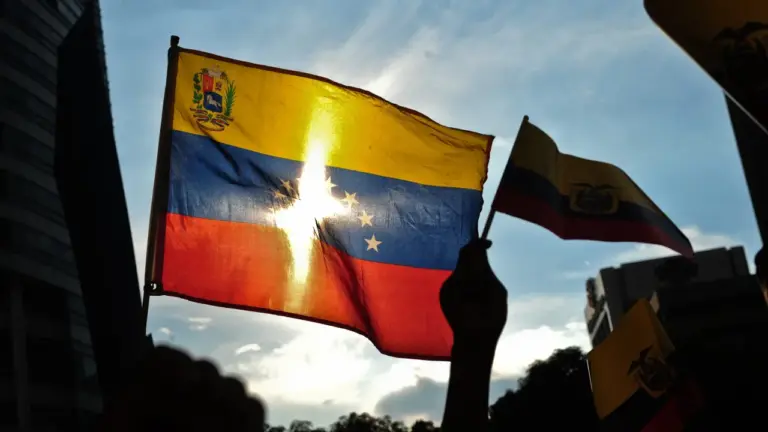
The lawyer and human rights activist Linda Loaiza challenged the candidacy of 26 aspirants to judges of the Supreme Court (TSJ) of Venezuela, allegedly linked to irregularities in her judicial process, which has been dragging on for 25 years.
© MIGUEL GUTIERREZ/AFP via Getty Images
29/11/2026
by
Lusa
A lawyer and human rights activist Linda Loaiza challenged the candidacy of 26 aspirants to judges of the Supreme Court (TSJ) of Venezuela, allegedly linked to irregularities of her judicial process, which has been dragging on for 25 years.
The complaint arises in the middle of a period of citizen objections (initiated on 21 November and opened until 5 December) in the context of the current process of renewal and extension of the maximum court of Venezuela, led by the Committee of Judicial Postulations of the National Assembly.
“26 applications to the TSJ are linked to my lawsuit. After 25 years, I still demand justice and accountability. The Constitution requires recognition of honorability [to aspirants]. Who checks it? ", questions the activist on social network X.
On the same platform, the activist publishes a list of the names of the 26 lawyers targeted.
According to the local press, Linda Loaiza's initiative is added to the challenges posed by family members of political prisoners and non-governmental organizations against other aspirants of a total of 1,066 candidates admitted to the 32 positions of magistrates, whose final designation is scheduled for December 11.
On Tuesday, the Inter-American Commission on Human Rights (IACHR) urged the Venezuelan State to ensure the political independence of the process and to verify possible links of candidates for human rights violations, warning “serious questions” about the impartiality of the evaluating committee.
Today at 44, Linda Loaiza became a reference in the defense of women's rights in Latin America after leading the first case of gender violence against the Venezuelan state to reach the inter-American justice system.
On March 27, 2001, when she was 18 and recently moved from Mérida to Caracas to study veterinary medicine, she was kidnapped by Luis Antonio Carrera Almoina, the son of a well-known Venezuelan academic.
For almost four months (114 days), he remained in captivity in a capital apartment, where he was subjected to physical and psychological torture, mutilation and sexual slavery, while the police refused to register the disappearance complaints submitted by the sister, claiming to be a “couple problem”.
Also according to the local press, Loaiza was rescued on July 19, 2001, after being able to ask for help through the window from neighbors, having been hospitalized in critical condition and subjected to 15 reconstructive surgeries (some of them facial), during which time she decided to study Law to assume her own legal representation.
The judicial process in the Venezuelan courts was marked by successive suspensions, changes of judges and political pressures, culminating in 2006 in the conviction of Carrera Almoina for crimes of illegitimate deprivation of liberty and offenses to the most serious physical integrity, but in his absolution for the crime of rape.
Faced with partial impunity, Loaiza appealed in 2007 to the Inter-American Court of Human Rights, which in September 2018 condemned the Venezuelan State for serious omissions, lack of due diligence and institutional victimization, ordering investigating and sanctioning officials responsible for failures in the process.
Although the international sentence remains unfulfilled, a judicial decision taken in August this year reactivated the internal criminal case in Venezuela, ordering the preventive detention of Carrera Almoina and the execution of a third trial specifically for the crime of rape, which currently takes place in Caracas.