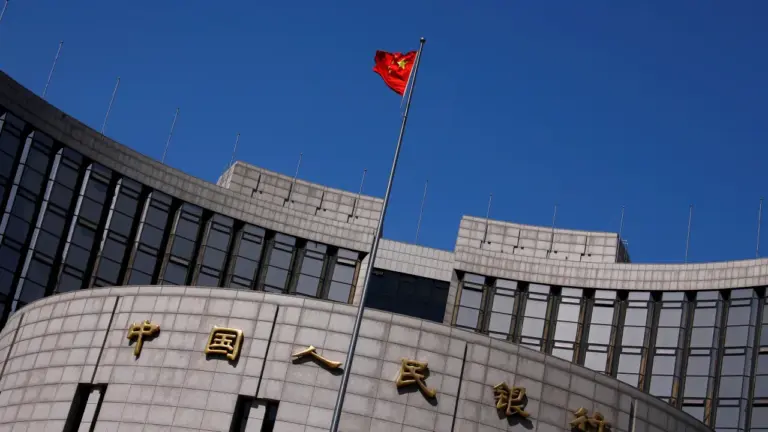
Chinese state banks accelerated funding to listed companies to buy back shares with contracts exceeding EUR 82,000 million after Beijing to promise new stock market support measures.
© Reuters
27/11/2026
by
Lusa
Othe large Chinese state banks have accelerated funding for listed companies to buy back shares, with contracts exceeding EUR 82,000 million, after Beijing has promised new stock market support measures.
According to state television CCTV, the four major banks in the country – ICBC, Agricultural Bank of China (ABC), Bank of China and China Construction Bank – have already committed to granting more than 600,000 million yuan (about EUR 82,000 million) in loans for stock repurchase and the acquisition of additional shares by shareholders.
Some 700 companies have so far concluded financing agreements under this mechanism.
Bank of China indicated that it is channelling resources to expanding sectors such as semiconductors, advanced manufacturing and new energies, while China Construction Bank has revealed that more than 70% of the customers covered by the programme are industrial and private sector companies.
According to data from the specialized platform Wind, Chinese listed stock exchange companies have already carried out stock buyback operations worth more than 160,000 million yuan (nearly 22,000 million euros) this year, above the amount recorded in the year as a whole and close to the record of 165,800 million yuan (EUR 2,690 million), reached in 2024.
These operations are mainly concentrated in the high-tech and consumer goods sectors and are, according to experts, aimed at conveying a sign of confidence to investors in view of the trend of Chinese stock exchanges falling.
Repurchase of shares is a usual practice among companies in periods of market correction, which use part of their financial availability to support their respective stock exchanges.
One of the main factors that penalised Chinese stock exchanges in recent weeks was the investors’ fear of the profitability of investments in artificial intelligence (AI), a sector that strongly boosted markets in previous months, with several companies recording valuations above 100% in the stock exchange debut.
The CSI 300 index, which follows the evolution of the 300 major companies listed on the Shanghai and Shenzhen stock exchanges, fell by 8.5% in October alone, the worst monthly performance in more than a decade.
Since the beginning of the year, the index has accumulated a fall of 17.1%, in contrast to the appreciation of 4.7% of the North American index S&P 500.
In view of the situation, the Chinese authorities announced several support measures, including the transformation of a temporary refinancing programme into a permanent mechanism and the reduction in the interest rate applied, from 1.25% to 1%.
The authorities also announced an increase in the volume of asset exchange operations, aiming to encourage the acquisition of shares by institutional investors.
According to Bloomberg news agency, the so-called “national team” – a set of state entities that usually intervene in the markets in periods of fall – was behind the record volume of transactions recorded last Friday by several stock exchange-listed investment funds, reflecting Beijing’s determination to halt losses in stock markets.
Experts, however, rule out a reversal of the downward trend unless structural problems are resolved, namely the ability of companies to generate profits.