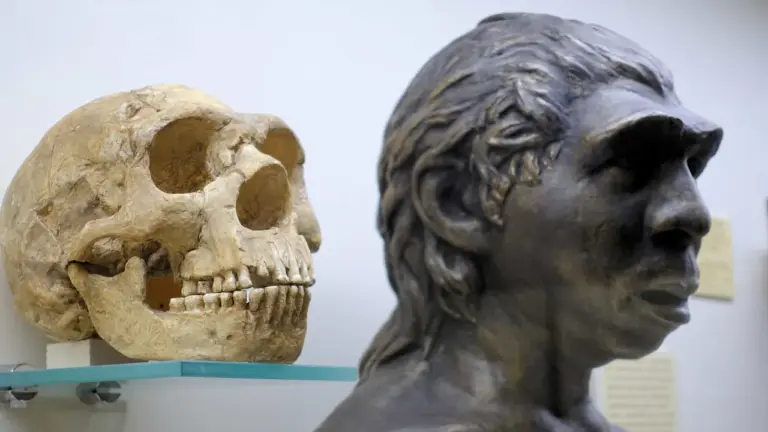
Belgium will restore the skull of the “child of Engis”, the first Neanderthal fossil discovered in the world, after more than a century of waiting for its identification, since the discovery in 1829 on the outskirts of Liège.
© Shutterstock
26/11/2026
by
Lusa
Neanderthal
A Belgium will restore the skull of the “child of Engis”, the first Neanderthal fossil discovered in the world, although it was necessary to wait more than a century for it to be identified, after the discovery in 1829 on the outskirts of Liège.
The skull won first place in the Walloon region, in a popular vote that allows Belgian National Lottery users to decide which pieces of historical or archaeological heritage should be restored.
The remains are preserved at the University of Liège in the east of the country, and its restoration will have up to EUR 150,000.
The remains were discovered in 1829 by Philippe-Charles Schmerling, a physician from Liège who, intrigued by fossils found in a quarry, began to explore the caves of the region.
Among the bones found, the skull of the “Engis child” stands out, which turned out to be the first Neanderthal fossil discovered.
This human species disappeared about 40,000 years ago after Homo sapiens arrived in Europe, probably due to a combination of demographic factors, climate change, resource competition and hybridization with modern humans.
At that time, three decades before Charles Darwin published, in 1859, “The Origin of Species”, the biblical interpretation of history still influenced the scientific debate, and it was discussed whether the “fossil men” were antediluvian or post-diluvian.
Schmerling realized that the fossil, currently known as Engis 2 and that it splattered in his hands at the time of extraction, was extremely old.
However, he did not understand the true importance of those bones and died in 1836, unaware of the real nature of their discovery.
In 1856, quarry workers found strange fossilized bones in a cave in the German valley of Neander near Düsseldorf; naturalist Johann Carl Fuhlrott and anatomist Hermann Schaaffhausen identified these bones as belonging to a primitive human form.
In 1864, British geologist William King formalized the denomination Homo neanderthalensis to refer to a new species of the genus Homo, a branch of the tree of human evolution that inhabited Europe and part of Asia.
The “child of Engis”, in turn, remained in the background. It was necessary to wait until 1936 for the Belgian paleontologist Charles Fraipont to study thoroughly the remains preserved at the University of Liège and identify the skull as a Neanderthal.
The fossil is about 50,000 years old, according to the University of Liège.
French paleontologist Yves Coppens, one of those responsible for the discovery in 1974 in Ethiopia of the skeleton of the famous Australopitecine Lucy, came to suggest, during a lecture at the University of Liège in 1995, that Homo neanderthalensis should actually be called Homo leodiensis, in reference to the Latin name of the city of Liège.