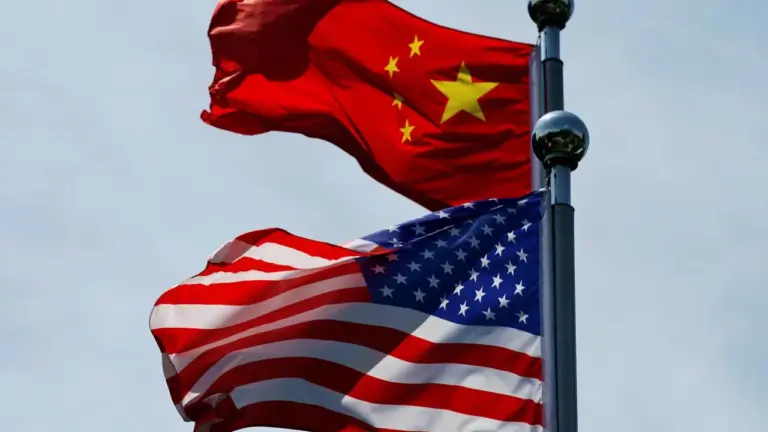
The difference in power between China and the United States in Asia has reached the lowest level since 2018, according to a report by the Australian Lowy Institute, assigning the US 78.9 points and China 73.6 points.
© Reuters
26/11/2026
by
Lusa
A power gap between China and the United States in Asia has reached the lowest level since 2018, mainly due to Washington's strategic errors, according to a report from the Australian Lowy Institute.
The 2026 edition of Asia Power Index, published this week, awarded the United States 78.9 points, on a scale of 100, against 73.6 points to China, the smallest difference since the index began to be drawn up eight years ago.
“The reduction of this difference is due more to Washington’s mistakes than to Beijing’s advances,” wrote the authors of the study, Hunter Marston, director of the Lowy Institute’s program for Southeast Asia, and Jack Sato, researcher at the same institution.
The United States has suffered losses in terms of economic and military capacity, defence networks and diplomatic influence, while China has strengthened military capabilities, cultural influence and ability to withstand external pressures.
Researchers attributed evolution to the concentration of resources and attention of the administration of US President Donald Trump in the Middle East following joint attacks by the United States and Israel against Iran in February.
The conflict reduced US reserves of long-range missiles and affected the perception of Washington's diplomatic leadership capacity at both regional and global levels.
The United States also performed fewer joint military exercises and defense dialogues with major allies in the region, including Australia, Japan and South Korea.
In contrast, the modernisation of the Chinese Armed Forces has helped to strengthen Beijing’s power, especially in the naval field.
Although the US military budget remains almost three times the Chinese budget, the difference between the military capabilities of the two powers has reached the lowest level since the beginning of the study.
“In the Pacific, China’s military stance and its ability to mobilise forces quickly and on a large scale surpass those of the United States,” said Marston and Sato.
Washington maintains, however, significant advantages in terms of air power, the ability to project forces worldwide and the long-range naval means.
The two powers are also practically equated in terms of economic capacity.
The United States maintains an advantage in the number of large business groups and in the role of the dollar as an international reserve currency, while the Chinese economy continues to grow at a higher rate in terms of purchasing power parity.
The report also highlighted China's technological progress, whose number of research and development professionals is more than three times that of the United States, and the growing competitiveness of Chinese artificial intelligence models.
The diplomatic approach between Trump and Chinese President Xi Jinping was well received in the region, but it also aroused fears among Washington's allies about a possible reduction in the US military presence in the Pacific.
India consolidated the third position in the index, followed by Japan, Russia and Australia.
The strengthening of military and economic cooperation between Beijing, Moscow and Pyongyang did not, however, lead to the formation of a cohesive bloc capable of replacing the United States, according to researchers.
The index assesses the relative power of 27 Indo-Pacific countries and territories, based on 131 indicators, divided into eight categories.