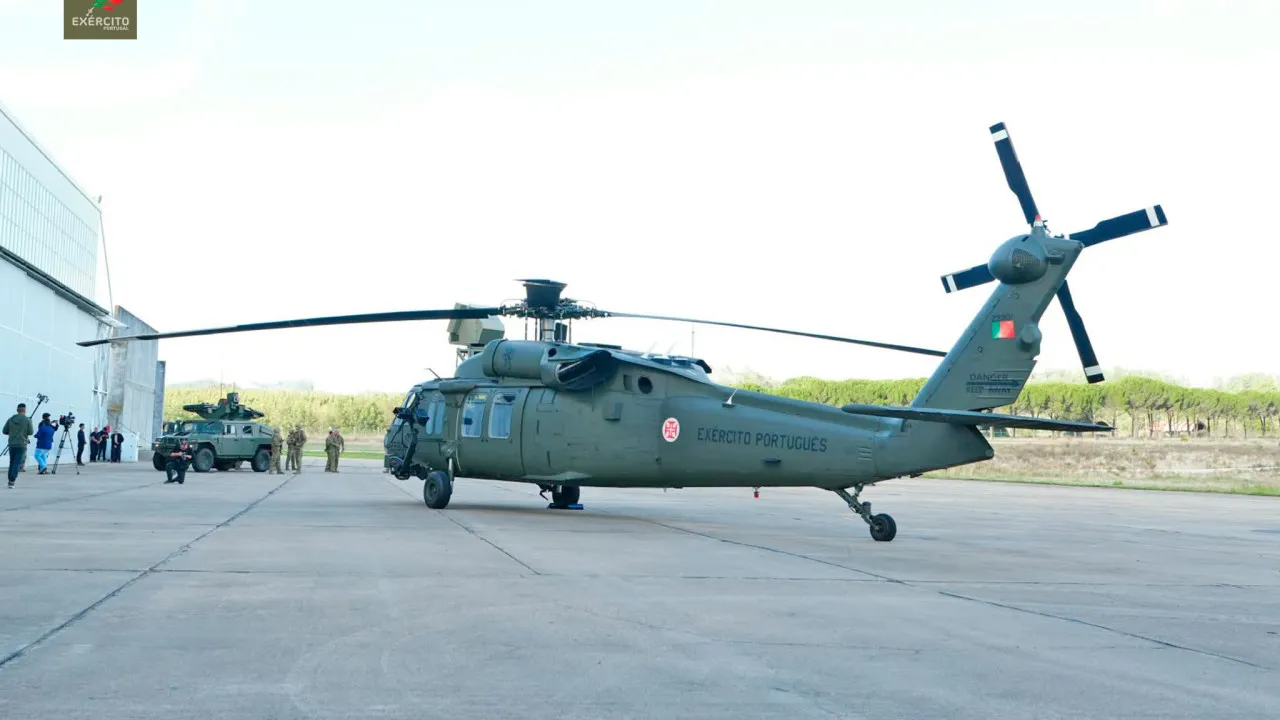
The Army today presented at Tancos, the first of four Black Hawk helicopters, which the Defense Minister framed in the recovery of a lost capacity.
© Portuguese Army/ Facebook
19/11/2026
by
Lusa
O Army today presented, in Tancos, the first of four Black Hawk helicopters and new anti-aircraft defense systems, which the Defense Minister framed in the recovery of a lost capacity.
“It is the beginning of the recovery of a capacity that Portugal had, which was lost due to obsolescence and lack of investment”, said Nuno Melo, in the Rapid Reaction Brigade, in the municipality of Vila Nova da Barquinha, Santarém district.
The Minister classified the presentation as a “historical day for the Armed Forces”, with the Army preparing to have its first helicopter fleet, 74 years after its air component passed to the Air Force in 1952.
The acquisition of the four UH-60L Black Hawk for the Support, Protection and Evacuation Helicopters Unit implies an investment in the order of EUR 50 million (ME), including VAT. The first arrived at Tancos on October 25, in an Air Force KC-390, and the rest will arrive by 2028.
The fleet realizes an ambition of decades that had already led to the creation, also in Tancos, of the Army Light Aviation Unit, extinguished in 2015 without receiving the scheduled helicopters.
Nuno Melo highlighted the mobility of land forces, the ability to operate with allies and the support for populations in emergencies.
According to the unit commander, Lieutenant Colonel Gilberto Lopes, helicopters are intended for tactical transport, reconnaissance, logistical support and aeromedical evacuation, and can also transport rescue teams and essential goods, evacuate people in disasters and support the fight against rural fires.
"Today we are achieving. We have achieved capabilities that have been an ambition for decades,” said the Chief of Staff of the Army (CEME), General Eduardo Mendes Ferrão, recalling years of planning, investment, infrastructure preparation and personnel training.
The general defended cooperation with the Air Force in the formation and maintenance of the Black Hawk and the articulation of the anti-aircraft media with those of the other branches.
According to the Army, the acquisition of the new anti-aircraft means EUR 70 million, plus VAT, in four RapidRanger launchers, two GM200 radars and two simulators.
For the first time, the Army will have a capability that combines detection and monitoring of aerial radar threats with their very short-range neutralisation.
The exhibition included the SICCA3, command and control system already existing in the Army, which integrates anti-aircraft artillery into the national air defense.
According to the EMCDDA, the new means will be able to protect critical infrastructure and housing agglomerations and enhance security in ‘high visibility events’ against threats such as drones.
To journalists, Nuno Melo said that investment in the Lufthansa pilot school will finance the modernisation of the runway and other airfield infrastructure.
"This is an Army military base. He said, stressing the priority of military use and the possibility of training civilian pilots and supporting firefighting. The CEME said that the review of the master plan already contemplates the school.
For the minister, investments will benefit the region and the country, attracting population, boosting trade and businesses and requiring better accessibility.
Asked about the connection between the Polygon of Tancos, which brings together the Rapid Reaction Brigade and the Paratroopers and Engineering regiments No. 1, and the Military Camp of Santa Margarida, in Constance, Nuno Melo referred the question to the Minister of Infrastructure, Miguel Pinto Luz, without making a commitment on the crossing.
The railway bridge between Praia do Ribatejo and Constância Sul has a single road, with alternating traffic by traffic lights and restrictions on heavy traffic. In June, the CEME advocated a new crossing of the Tagus to facilitate military mobility.