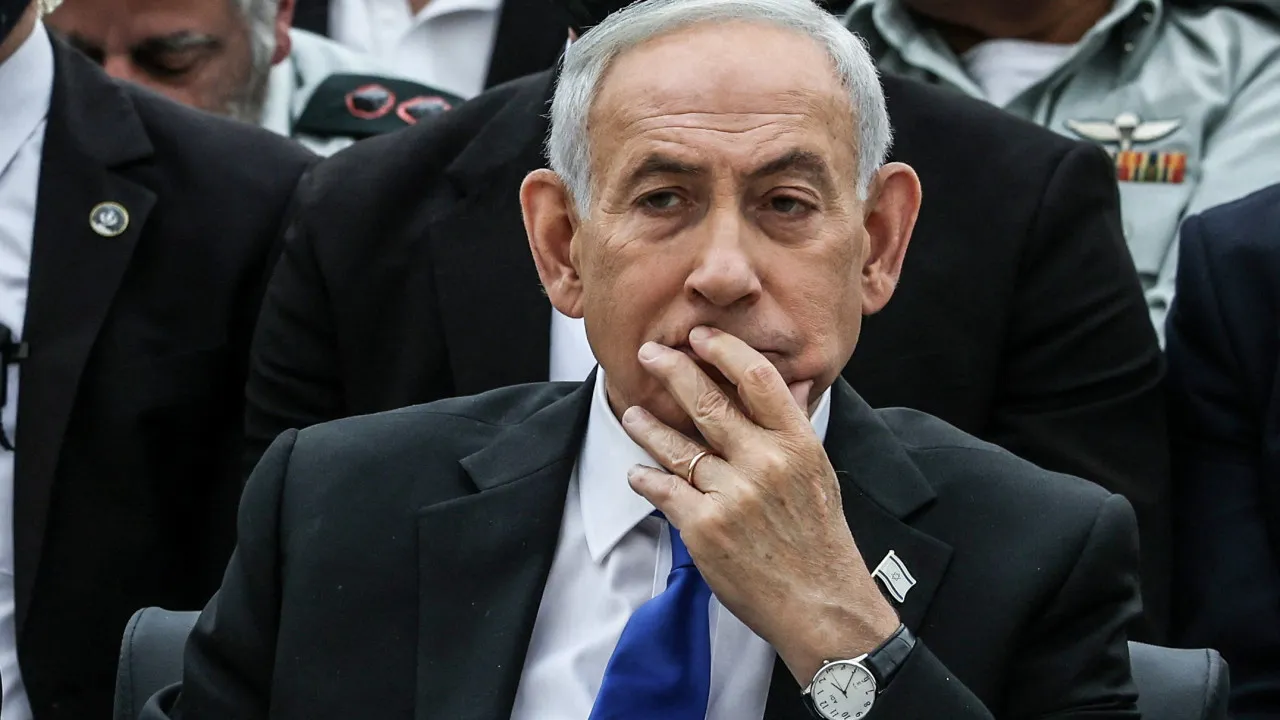
Israel's outgoing prime minister Benjamin Netanyahu asked Mossad's chief to prepare a secret operation against Iran without informing the chief of the armed forces, according to The Washington Post and the Israeli press.
© ILIA YEFIMOVICH/Pool via REUTERS
19/11/2026
by
Lusa
O israel's outgoing prime minister, Benjamin Netanyahu, asked the head of foreign intelligence services (Mossad) to prepare a secret operation against Iran, reported today The Washington Post and the Israeli press.
According to the U.S. newspaper, which cites four anonymous sources with knowledge of the case, the head of government approached Mossad's director Roman Gofman, leaving Eyal Zamir to the sidelines.
The Jerusalem Post daily confirmed this information today.
The Israeli press reported in recent weeks that Zamir halted Netanyahu's alleged intention to resume attacks on the Islamic Republic in the process of the legislative elections in Israel, which took place on 27 October and resulted in the appointment of his main opponent, Gadi Eisenkot, to form government.
The Washington Post states that, shortly before the elections, Gofman was asked to prepare a covert operation without informing the Prime Minister's office or Zamir, which, however, eventually became aware of this plan, the details of which are unknown before it could be executed.
Roman Gofman, a man close to Netanyahu, met last week with CIA counterpart John Ratcliffe in Washington before traveling to Miami for a meeting with White House envoy to the Middle East, Steve Witkoff, reported last week's Axios portal.
The trip of Gofman, whose details were not revealed, took place after Qatar's Prime Minister, Sheikh Mohammed bin Abdulrahman al-Thani, met with US President Donald Trump in the White House in an attempt to bring the United States and Iran back to the peace negotiating table.
On Wednesday, the director of Mossad and Eyal Zamir received the head of U.S. Central Command (Centcom), Admiral Brad Cooper, during a visit to Israel, according to a statement from the U.S. military.
The Axios portal also reported that Donald Trump asked the US Department of Defense and intelligence services to prepare scenarios for Iran's response to further attacks.
Almost nine months after the start of the Israeli-American offensive against the Islamic Republic, the leader of the White House has left contradictory messages about his next steps, stating that new attacks are highly unlikely, while sending a third carrier and thousands of additional soldiers to the Middle East.
Last week, the office of Israel's outgoing Prime Minister denied news of the Israeli portal Ynet, which saw a heated discussion during a phone call between Netanyahu and Trump about the conflict with Iran.
“Fake news, complete nonsense,” Netanyahu’s office commented, following anonymous sources familiar with the content of the call, cited by Ynet, who reported a particularly tense conversation and one of them describing it as an “infernal discussion.”.
The possibility of a resumption of the offensive against Iran does not have a consensus in Israel, where the laws of October 27 resulted in a political stalemate.
Although Netanyahu's Likud won the vote, oppositionist Gadi Eisenkot, leader of Yashar! (Integre!), received the highest number of recommendations during the post-election consultations of Israeli President Isaac Herzog to form government, with the support of the four Jewish base forces of the so-called bloc of change and the two Arab formations.
However, the former chief of the armed forces did not signal how it will make an executive possible, since it does not yet have a majority of 61 deputies in the new parliament (Knesset), between divisions of the Jewish parties that form its basis of support.
Speaking on 10 November at the inaugural session of the Knesset, the head of the outgoing government insisted on creating a “government of national unity” to confront the “darkness” that represents Iran.
“ In the very near future, we will face international pressures to accept an Iran with nuclear weapons,” Netanyahu warned, noting that the new parliament has only one way, which is “put aside all other considerations and form a government of national unity,” including the Jewish opposition and without the Arabs.
Gadi Eisenkot, who proposes alternatively a “national emergency government” that pushes Netanyahu away, warned, for his part, in a letter to the Israelites, that Israel’s security “is above all other considerations and should never be used for political gain”, in particular in a “delicate transition period”.
Eisenkot has 28 days, counting since November 7th, to present a viable government solution in parliament, extended for another 14 days.
If not successful, the decision returns to Isaac Herzog, who will indicate another candidate and count back to zero for another 28 days, without possibility of extension and under threat of further elections.