
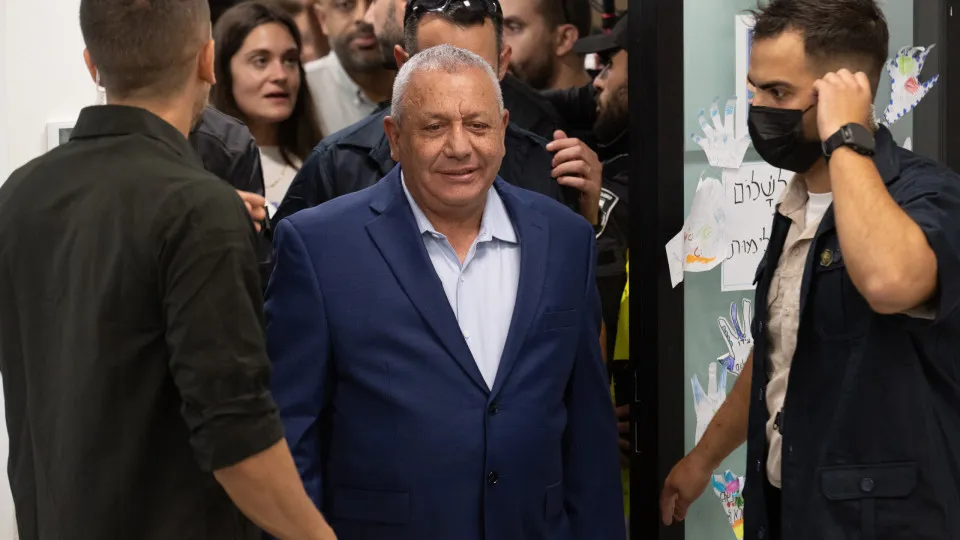
Former commander of the Gadi Eisenkot army led a coalition that obtained sufficient support to drive Netanyahu away from power in Israel after the legislative elections on 27 October.
© Noam Galai/Getty Images
07/11/2026
by
Lusa
O former head of the Gadi Eisenkot army, now appointed to form government in Israel, shook Israeli politics with the foundation of the Yashar party! and led a coalition that got enough support to drive Netanyahu away from power.
The coalition led by the Likud party, of the outgoing Prime Minister Benjamin Netanyahu, in practice was defeated in the legislative elections of October 27, although its party was the most voted
Since the founding of the Yashar party!, about a year ago, centrist Eisenkot quickly became the prime opponent of the Prime Minister, Benjamin Netanyahu, in the legislatives of October 27.
Although seen on many occasions as a man devoid of political experience and the league of the charism of the current head of government, the rapid rise of this reputed 66-year-old former general has become the most credible possibility to overthrow Netanyahu and his alliances with the far right and the ultra-Orthodox, involved in yet another curtain of suspicions that have grown in recent weeks before the elections.
The vote was accompanied by a series of corruption scandals targeting Netanyahu and elements close to his cabinet, as well as recent revelations about his behaviour before and during the attacks of Hamas Islamists on October 7, 2023, which triggered the war in the Gaza Strip.
Chief of the Armed Forces between 2015 and 2019, Gadi Eisenkot is one of the most critical of the Israeli leader on his management of the 7th October and the way he led the war in the Palestinian enclave, where his son Gal died at the age of 25 in combat in December 2023, as well as two nephews.
It was one of the most active voices within the opposition to demand the creation of a commission to investigate Hamas attacks, refused by the Prime Minister, despite the pressure of Israeli society, in particular the relatives of the victims and the former hostages taken by the Palestinian militias that morning of October 2023.
At the same time, Eisenkot assumes himself as a defender of a hard line towards Hamas, accusing the Prime Minister of “fully failing” the goal of eliminating the threat posed to Israel by the Islamists of the enclave.
Consistently, it recognises that it will have a policy of continuity on the need to remove Hamas from the equation in the territory before continuing the peace roadmap proposed by the United States. Last week, you said you expect to do it in a year and a half.
“ I make this commitment publicly: within 18 months of taking office as Prime Minister, Hamas will no longer be ahead of the Gaza Strip,” he said at a press conference on the border with the territory
Similarly, it follows a strong approach towards the Lebanese Shia group Hezbollah, Iran's ally, which in turn cannot pursue its nuclear programme in order to obtain an atomic bomb against Israel.
In Lebanon, where he served during the 2006 war against Hezbollah, he was one of the architects of the Dahieh doctrine, in reference to the attacks against the Hezbollah bastion on the outskirts of Beirut and civilian facilities suspected of harboring fighters and weapons from the Shia group, and which would later gain a maximum expression in Gaza.
While a defender of military muscle, Eisenkot condemns Netanyahu for creating “a growing and dangerous distance between American interests in the Middle East and Israeli interests,” proposing alternatively an involvement of Washington and Arab countries signatories to Abraham’s Agreements and others who might be so.
“ There are immense risks in the Middle East, but there has also been a unique opportunity to build a ‘multitheatral’ initiative with the U.S. Government: to analyze the whole region, what has happened in the last three years and opportunities,” he said in a recent interview with The Times of Israel.
On the Israeli-Palestinian conflict, the newly-political, who briefly performed the functions of a pasteless minister between October 2023 and June 2024 alongside the leader who now intends to overthrow, chose to cultivate ambiguity during the campaign and states that he does not want to govern about three million Palestinians. But he also does not agree with a “state without a state” or with the presence of foreign forces in the territory.
“ I never said that the solution is two states for two people,” the former general warned during the election campaign, adding: “There is a very deep religious-national conflict and anyone who thinks that an agreement can be reached is now deeply deluded.”.
More clearly, it wants the army to take responsibility and end the “anarchy” caused by violent settlers in the West Bank, as it contests the expansion of Israeli settlements in the areas under the control of the Palestinian Authority.
His ten - point program, which he presents as a centrist, also advocates a mandatory military service law that would apply to Israeli Arabs and ultra-Orthodox Jews, who are currently exempt.
This issue is central to the Israelites, who do not understand the controversial exception granted to the Haredim community, while secular reservists have been performing consecutive periods of military service since 2023.
“The government that chooses to weaken the army in the midst of a ceaseless war, while the best and brightest sons and daughters of this country are mobilized on all fronts,” Eisenkot criticised, aiming personally Netanyahu, who “can speak of patriotism until he is tired”, but “his sons have avoided military service.”.
Descendant of Moroccan immigrants, Gadi Eisenkot grew up in Eilat, southern Israel, before following his military formation, as a small soldier to the commander of the Golani Brigade, on a journey that contrasts with Benjamin Netanyahu, heir to a wealthy family of the Ashkenazi elite (a Jewish community originally from Central and Eastern Europe), who spent part of his childhood in the United States.
Now, it follows the long tradition of former leaders of the armed forces who migrated to politics, such as Yitzhak Rabin and Ehud Barak, or Benny Gantz, his predecessor in the leadership of the army and with whom he came to live in the National Unity party, before disbanding and resigning the mandate of deputy.
Then he founded Yashar!, which means just or upright, and quickly gained popularity as an incorruptible man, frontal but also appeaser, and fame as “anti-Netanyahu”.
In less than a year, he overcame the parties already consolidated in the Israeli system in the polls, including the majority Likud, by seducing his moderate disgruntled electorate.
“If, God forbid, the present right-wing coalition wins again, it will lead Israel to darker paths that we can already see unfolding before us,” he commented in the interview with The Times of Israel.