
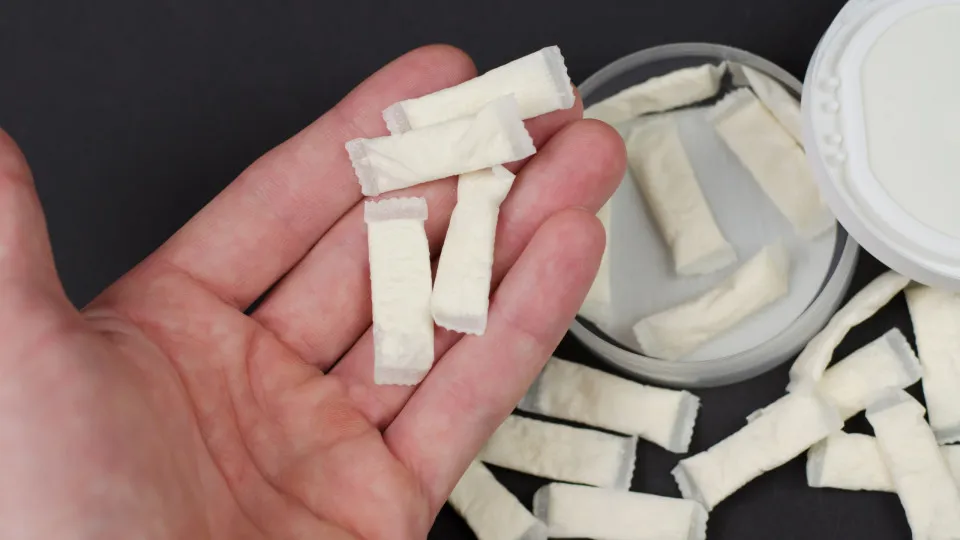
The regulation of nicotine bags goes to parliament on Wednesday, a matter that divides experts, who both consider them a bridge to quit smoking as a gateway, warning that permitted concentrations exceed those of medication.
© Shutterstock
06/10/2026
by
Lusa
ANDm statements to Lusa, pulmonologist Daniel Coutinho, from the Portuguese Pneumology Society's smoking work group, admits that the ideal would be to ban, acknowledges that it is important to end the “legal hole”, but warns that the permitted nicotine concentrations are much higher than those of tablets/gums to quit smoking.
“ The primary need would be not to allow there to be another new nicotine product, when it is a market that does not have few alternatives, on the contrary”, laments Daniel Coutinho, who says that the government’s strategy did not go through banning “because there is always a possibility of another financial return on tax”.
Saying that the current situation “is the worst possible”, because these products are on the market and are sold “as if it were a food supplement”, regrets that the possibility of mint or menthol products has also been left, rather than completely banning the flavors, which are more attractive.
“ It seems a great job done by the players who are interested in putting this type of products on the market, because without any flavor or with neutral flavor they became very unattractive ", says.
This attractiveness of the flavors is recognized by some health professionals who sign one of the contributions received by the diploma at the time of the public consultation, including former Secretary of State for Health António Lacerda Sales, who look at the nicotine bags as a less risky alternative to the traditional cigarette.
“ By making the product unattractive or unavailable for adult smokers, the measure can reduce the migration capacity of cigarettes to alternatives without combustion,” these professionals wrote, who argue that, before adopting measures with potentially prohibitive effect, the consequences for public health, adult consumers, competition, small businesses, tax revenue and illicit trade should be assessed.
They recall that the State Budget for 2026 created a fiscal category suitable for nicotine bags and that the product is on the market and is taxed.
They therefore believe that if the government were now to come forward with a proposal to withdraw the product on the market it would mean that the State would take two opposing positions – decide to tax what it would then ban – which they consider inconsistent from the point of view of public policy.
They also consider that regulation – the path followed by the European Union – should be based on three pillars: prohibition of selling to children under 18 years of age and practices that make the product appealing to minors, as well as the existence of clear information to the adult consumer, with labelling criteria, health warnings and maximum levels of nicotine.
As for the fact that they can function as an alternative to traditional cigarettes, Daniel Coutinho recalls that “marketing is not being directed towards this fringe of population [smokers]”.
In summer, nicotine bags came to the public debate due to a complaint about the advertising of these products at music festivals.
“I talk to many smokers and, until then, none of them knew that this [nutine pockets] existed,” says the expert, adding: “the sponsorship of summer festivals for young layers, the attractive packaging available in stationery stores, on the edge of schools, in a completely deregulated consumer market, I think we can see what the ‘target’ is.”.
It also insists on the concentration of nicotine allowed in these bags (up to 12mg), which it considers excessive, and warns of the argument that it intends to confuse this nicotine with that which is used to quit smoking.
“There is here, purposely by industry”, a use almost to confuse. “In the practice of a smoking cessation consultation we use nicotine substitutes, prescribing pharmacological nicotine, of completely synthetic origin, not derived from tobacco,” the expert explained, saying that “they are completely different products.”.
It also recalls that the dosages allowed in this medication are scientifically studied, adding that the maximum allowed reaches 4 mg per tablet/goma and 21 mg in transdermal patches (seals), which release the substance over 24 hours.
Actually – he adds – nicotine bags are “a product that has a relatively fast, extremely high dosage and absorption”. By comparison, it says that nicotine concentrations per cigarette vary between 2.4 and 2.8.
“Allowing 12 mg of nicotine in the bags is unnecessary and scandalous,” says Daniel Coutinho, adding that the government’s diploma is “an attempt to minimize market damage, which is a western, but allowing it to remain a semi-faroeste.”.
Parliament discusses on Wednesday the proposal for a law authorising the Government to approve the legal regime applicable to the manufacture, import, distribution, placing on the market, marketing, labelling, advertising, tax regime, supervision and sanctioning of nicotine bags.