
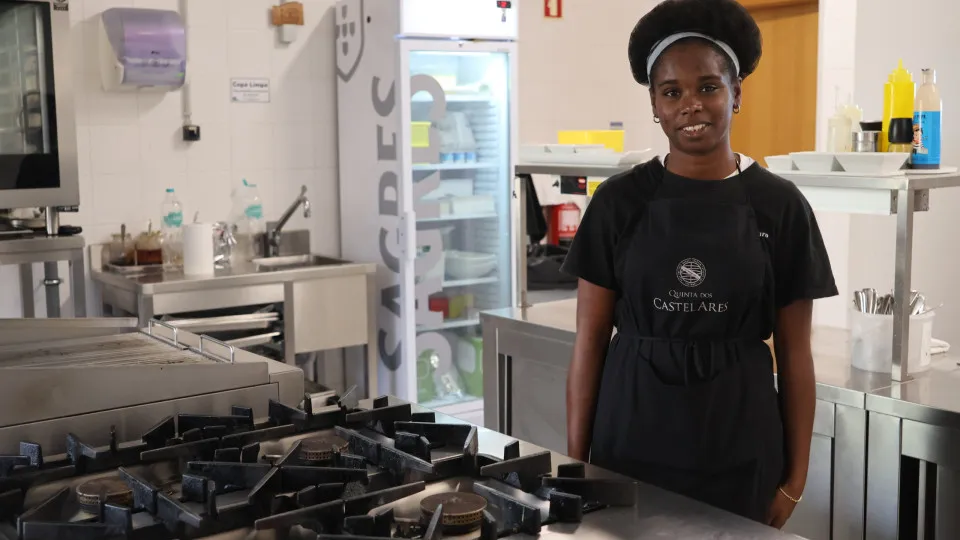
Young people from Cape Verde consider the lack of skilled labour in various sectors of activities in Freixo de Espada à Cinta, after completion of the first vocational secondary education courses promoted by the municipality and other entities.
© Lusa
08/11/2026
by
Lusa
Jovens from Cape Verde cover the lack of specialized labor in various sectors of activities in Freixo de Espada à Cinta, after completion of the first courses of vocational secondary education promoted by the municipality and other entities.
The first 20 Cape Verdean students arrived four years ago to Freixo de Espada à Cinta, in the district of Bragança, and in the following years 21 more Portuguese-speaking African students came with dreams of future and longing for their homeland, but with desire to stay.
Fifteen of them are already in the local labor market, such as in Private Social Security Intuitions (IPSS), hotels, restaurants or services after completing professional courses in the areas of kitchen, pastry, tourism, viticulture or geriatrics.
Aleida Lopes, a 21-year-old Cape Verdean girl, told Lusa that she arrived in Freixo with a sword in Cinta at the age of 17, with some difficulty of integration, due to lack of knowledge of people and the village, to which she missed her country, because she was in a different environment, but everything changed in four years.
The difficulties of integration did not cause the young woman to accept the proposal to work in a restaurant of a hotel unit of this village, just after the completion of her internship.
“For now I think about staying here. It's been a good experience. I'm learning a lot. We managed to overcome the initial obstacles and now we move on, never giving up, because that's why I came here. I want to go back to Cape Verde, but on vacation, because my work is here”, he stressed.
Belany da Veiga, 23 years old, said that she completed her course in cooking and pastry and is working in a restaurant in Freixo de Espada à Cinta and with a desire to learn, because she is in a space where she is well treated and already with the freedom for her creations, in the context of her training. The difficulties in adapting were the same as those of your colleagues.
“ Here I do many things, especially desserts, I learn a lot about gastronomy. For now I want to stay here and the future will soon be seen. I feel at home because I'm well treated. This challenge and in these conditions is good to work ", indicated.
From the restoration to the IPSS sector, Lusa spoke with Marleny Tavares, who performs in the Santa Casa da Misericórdia de Freixo de Espada à Cinta (SCMFE), in the area of geriatrics, who said he is working in a pleasant environment and the return to Cape Verde is postponed despite having left much behind, as the parents, friends and culture of his country.
“ I'm working with old people, which for me is a new experience, which requires a lot of care. At first there were fears, I was accompanied and now everything is normal. I have a job and I'm going to continue. My most striking memento was the end of my course. As for the future nobody knows, but for now it is to stay here”, explained the young Cape Verdean.
For those who welcomed these young professionals in their companies or intuitions, such as José Araújo, a restaurant manager, this specialized workforce arrived in good time, because it is difficult to find in the labor market.
“ Having specialized labour is an asset, because it is difficult to find. Marleny did her professional internship at our restaurant and then we ended up hiring her, since she's very professional at what she does. When people are good professionally, we have to take advantage of them”, he said.
Susana Santos, technical director of SCMFE, considers that this workforce comes to refresh the labor market in the village because they are young and have a lot of desire to work.
“ The fact that these young people are trained in our area and qualified for their duties is an added value. In the course of geriatrics that is now ending, the 12 Cape Verdean students are here interning, divided into four buildings, most of them want to stay in Freixo de Espada à Cinta, there is another one that has prospects of continuing their studies ", explained the responsible.
According to the mayor of Freixo de Espada à Cinta, Nuno Ferreira, these courses began to value sectors where there was less job offer to complement the flaws of the labor market in the region.
“ The establishment of these young people is helping to boost the local economy and add to the resident population. We were always careful to promote curricular internships in our municipality and neighbors. The person who stayed to work is because he has adequate training ", he called the mayor.
According to Nuno Ferreira, there are agreements with Cape Verdean municipalities of the islands of Fire, Santiago and São Nicolau, so that every school year 10 vacancies can be made available at a time for these Portuguese-speaking students.
“ These courses and their complements are seen as an example at national level,” he said.
The first courses to be taught were cuisine and pastry, tourism, wine and more recently geriatrics and restaurant and bar, which includes Portuguese and Cape Verdean students.
These vocational secondary education courses are the result of a tripartite protocol between the municipality of Freixo de Espada à Cinta, Institute of Employment and Vocational Training (IEFP) and the Directorate-General for School Establishments.