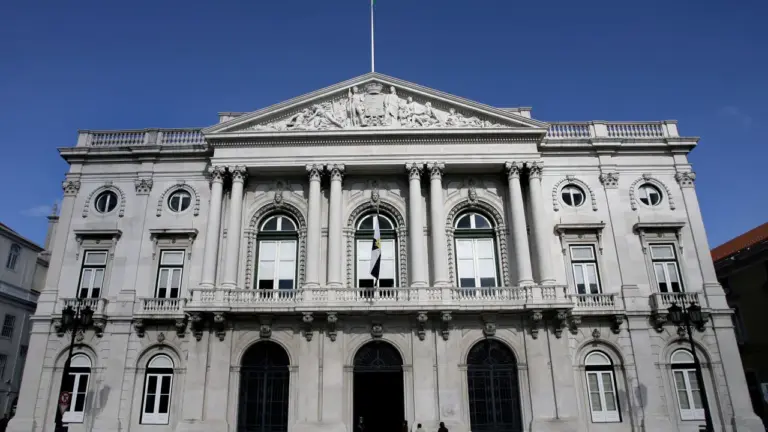
The Lisbon City Council today approves the budget for 2027, with an 8.8% increase in expenditure, to EUR 1,463 million, without relying on the opposition to approve the document.
© Lusa
27/11/2026
by
Lusa
A Lisbon City Council today discusses the budget for 2027, with an 8.8% increase in expenditure, to EUR 1,463 million, without the PSD/CDS-PP/IL government relying on the opposition to approve the document.
This is the second budget of the current mandate (2025-2029), proposed by the government led by Carlos Coins (PSD), which for the feasibility of the budget document for this year 2026, with an expenditure of 1,345 million, had the support of the See of the Ajuda, since it ruled without an absolute majority, with eight of the 17 mandates of the City of Lisbon (CML).
In February of this year, Carlos Coins began to rule with an absolute majority by delegating powers to independent councilwoman Ana Simões Silva, elected by the Aquira and who marched from the party three months after the local elections of October 12, 2025.
Thus, the budget proposal for 2027 should have guaranteed approval in the CML, but the same does not happen in the Municipal Assembly (AML), a deliberative body where PSD/CDS-PP/IL has no absolute majority.
Currently, in the opposition are four councilors of the PS, one of the Free, one of the BE, one of the CFP – who have already expressed a position against the document – and one of the Enough, who said that “surely” would not vote in favor.
“O Enough, not reviewing the PSD’s programmatic line, cannot vote for a budget that misapplys expenditure and does not solve the city’s basic problems,” Councilman Bruno Mascarenhas told Lusa.
If the CML does not interfere with the approval, in the AML the case changes the figure: with the vote against the municipal deputies of the PS, PCP, BE, ENP, PAN and Livre, it is necessary to vote in favour of the Enough for the document to pass, and its abstention is not enough.
In the presentation of the proposal, the vice president of the CML, Gonçalo Reis (PSD), responsible for the Finance Board, said that this budget “ensures fiscal competitiveness” and announced that the return of the Singular Income Tax (IRS) remains, a measure that has been criticized by the opposition, which points to a loss of revenue in the order of the 90 ME.
In tax revenue, it provides for the collection of 292 ME of Municipal Tax on the Onerous Real Estate Broadcasts (IMT), 163 ME of IMI – at a minimum rate of 0,3 % – and 155 ME of spill – at a rate of 1,5 % – as well as 19 ME of Single Circulation Tax (IUC).
As for the five municipal companies, the budget provides a total of 352 ME for operation and 268 ME for investment, especially Carris (public transport), with 216 ME + 114 ME, followed by EMEL (parking and mobility), with 51 ME + 22 ME, Gebalis (inhabitation in municipal districts, with 29 ME + 43 ME, SRU – Urban Rehabilitation Society (8 ME + 84 ME) and EGEAC – Lisbon Cultura (47 ME + 3 ME).
The workers of EGEAC will concentrate, from 10:00 am, in the Praça do Município, in front of the Paços do Conselho, where the private meeting of the councilors will take place, to demand better wage conditions.
As for expenditure by area, CML proposes 167 ME for housing and urbanism, plus 12.9% compared to 148 ME for this year, and 203 ME for infrastructure and maintenance, including the Lisbon General Drainage Plan (PGDL), minus 12.7% compared to 232 ME for 2026.
It also provides 85 ME for education (+8.8%), 49 ME for urban hygiene (+3.1%), 48 ME for culture (+21%), 40 ME for public space and public lighting (+52.4%), 28 ME for economics, innovation and modernisation (+6%), 24 ME for environment and green spaces (+6.7 %), 16 ME for social rights (+35 %), 6 ME for sport (+10.9%) and 4 ME for accessibility (+472.6%).
It also targets 99 ME for the 24 parishes (+8.1 %), 80 ME for mobility of the company Carris (+4.6 %), 34 ME for mobility of the chamber (+61.6%) and 30 ME for security and civil protection (+8.5%), joining 407 ME for human resources (+8.4 %), 107 ME for central services and finance (+10.9%) and 16 ME for information systems (+15 %).