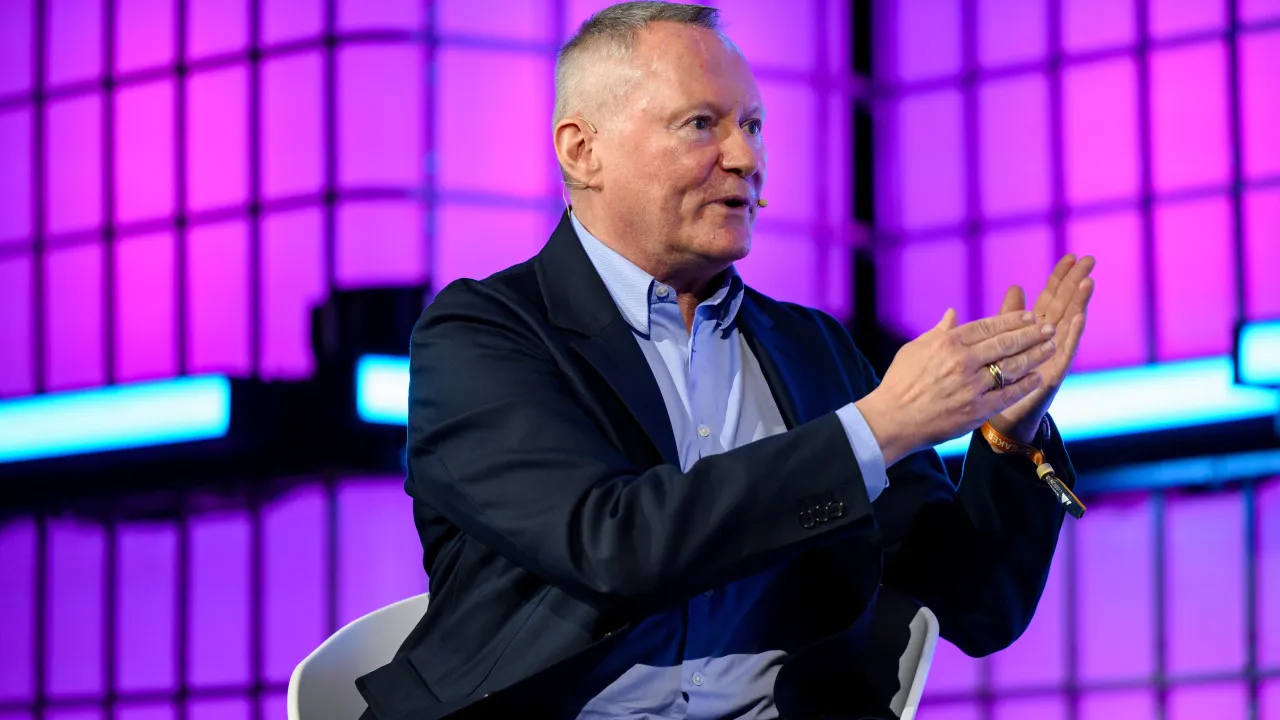
Council of Europe Human Rights Commissioner Michael O’Flaherty states that this year there has been a “great change” in the AI’s desire for external governance and regulation.
© Alex Broadway/Sportsfile for Web Summit via Getty Images
21/11/2026
by
Lusa
O commissioner for Human Rights of the Council of Europe considers, in an interview with Lusa, that there has been a “great change” this year as regards the desire for governance and external regulation of the AI.
“ I think there's been a big change this year. In fact, there has been a radical change in the desire for governance and external regulation,” says Michael O’Flaherty, when asked about whether self-regulation in artificial intelligence (IA) is being achieved.
The commissioner attended this year's edition of the Web Summit in Lisbon and gave an interview to Lusa together with Irish bishop Paul Tighe, who is secretary of the Dicastery for Culture and Education (Vatican).
Michael O’Flaherty added that he sees this change “in many different contexts.”.
In fact, “Just to give an example of the United States, I see this as one of the messages that are drawn from the recent election results.”.
“ It was at least to some extent to control the AI sector, to give it some order or, to use the expression of Pope Leo, to ‘disarm’ the AI’, the Human Rights Commissioner of the Council of Europe continues.
The person responsible also notes that he sees “a growing interest” that the extent of the effectiveness of human rights is integrated into governance.
“ I now see a much greater emphasis on putting people at the center of the project, on protecting them, and on understanding that ultimately everything comes down to human dignity, as well as how human rights can serve as a roadmap for this, as they cover all the dimensions of our well-being,” Michael O’Flaherty said.
In other words, it is all about freedoms such as voting, circulating, protesting, but also all socio-economic guarantees “so that we are not pushed to the margins of society”.
So, “at this moment there really is an opportunity, what we need is for people to take advantage of this opportunity and make significant advances,” he points.
It also stresses that there has always been “a greater provision for regulation in Europe than in the United States”.
However, “I think that now is the time when we can, in a way, rekindle the flame of this issue”, the Commissioner considers.
Paul Tighe states that there are issues in the AI industry related to self-regulation.
“ I think that companies, individually, are trying to do what they can, even if only to protect themselves in the long term, are interested in doing this”, but “I think what is really more interesting” is the equivalent of peer review, the bishop continues.
That is, “each laboratory needs to know what the other laboratory is doing and to create groups that have the neutrality needed to be able to analyze and ensure compliance with the highest standards that have been respected by all”.
Therefore, “I think there is a desire for regulation, even if it is only to ensure a level playing field, so that everyone follows the same rules”, he points out.
However, “there is still no such total trust”, says the secretary of the Dicastery for Culture and Education.
The other question is “there is an incentive to investment that keeps people in a race”.
The amount invested in these AI companies “makes them see themselves under pressure to be the first to launch the new product, to put it on the market, even if there may still be some outstanding security issues,” says Paul Tighe.
Therefore, “I think this is a cultural issue: although there is enormous commitment on the part of individuals, it is difficult for them to maintain this commitment in an environment marked by competition and geopolitical, commercial and individual rivalries”.