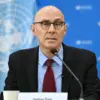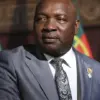
Irish bishop Paul Tighe and European Human Rights Commissioner Michael O’Flaherty point out that the responsibility of artificial intelligence lies with humans, not with machines.
© Shutterstock
21/11/2026
by
Lusa
O irish bishop Paul Tighe takes away the idea that AI machines can do something on their own and Human Rights Commissioner Michael O’Flaherty calls for action to build a better and different future.
Paul Tighe, who is secretary of the Dicastery for Culture and Education, and the Commissioner for Human Rights of the Council of Europe, Michael O’Flaherty, address, in an interview with Lusa, the fears about general artificial intelligence (IA), in which machines take control, the importance of regulation and the hope they share about the future.
Michael O’Flaherty argues that 2026 is the time to act around a better and different future and that “nothing is inevitable.”.
Asked about the idea that often goes from an AI almost as a higher entity that will solve all the problems and what advice would give to those who are concerned about it, Paul Tighe says that one of the issues is about control.
That is, “what machines could do on their own” and “I am not convinced that machines can be able to do something on their own,” he says.
The machines will perform autonomously, “but where is the will? Where's the decision-making? All this occurs, at some level, due to a programming — whether it fails or deliberates — that allowed the existence of a gap,” the bishop continues.
“There is no conscience there to make decisions to cause harm, what there may be are failures in the implementation of protections that would prevent the occurrence of this damage,” he points out, pointing out that, in his view, “it all comes down to the responsibility of human beings.”.
This, in fact, “connects to your broader question: where do I find hope for the future: a ‘god ex machina’, a God somehow inserted into the machine that magically will solve all human problems? No, I don’t think that’s going to happen,” emphasizes the Irish bishop.
“ Where I really see hope is what human beings individually accomplish through their ability to transcend their own limitations, put the other at the center of their lives” in a simple way, “it is heroic being in care, generosity and kindness toward others”, that is “the true hope resides”, so that “the Pope [Leon XIV] gave this title to the encyclical [Magnifica Humanitas (Magnificent Humanity)], it is about (...) the greatness of humanity”, he stresses.
Despite all human weaknesses and flaws, which he classifies as “many,” Paul Tighe says that “there is hope in the ability of humans to do something better.”.
Often, when observing the vision behind technologies, one asks: what would be the ideal future they propose? “It’s about having more to consume, more efficiently and faster” and “I’m not sure if this responds to the real needs of the human heart,” he adds.
The Commissioner for Human Rights of the Council of Europe admits to being frightened “with the existential prophecies of industry”, saying he has no competence “to assess whether the terrible dystopic future” that they warn will materialise.
However, “I don’t want to be distracted by it, it’s a bit like a rabbit on the road, paralyzed in front of the headlights of a vehicle. We cannot afford to be paralyzed,” says Michael O’Flaherty.
As for the problems that the AI brings, “we can regulate them, just as Bishop Tighe said, after all, it is about regulating the people who control the machines”.
Therefore, “we know that we can now define the directions and the way machines are made available through regulation,” he adds.
Michael O’Flaherty shares the hope expressed by the bishop, but argues that it is necessary to act on it.
“That’s why I appeal to everyone” in society, regardless of their role — whether in the family or in the workplace, in the technology sector, in the human rights area, or simply as a concerned citizen, it doesn’t matter – we need to exercise our ability to act”, to “take an attitude” and to say “just,” he points out, giving the example of what voters have done recently.
“They reminded us that we all have power of action. Nothing is inevitable. And together, we can build a better future. There was never a more favourable moment than this, in 2026, for us all to unite and call for the construction of this better and different future”, the Commissioner of Human Rights said.
Michael O’Flaherty and Paul Tighe attended this year’s Web Summit in Lisbon.