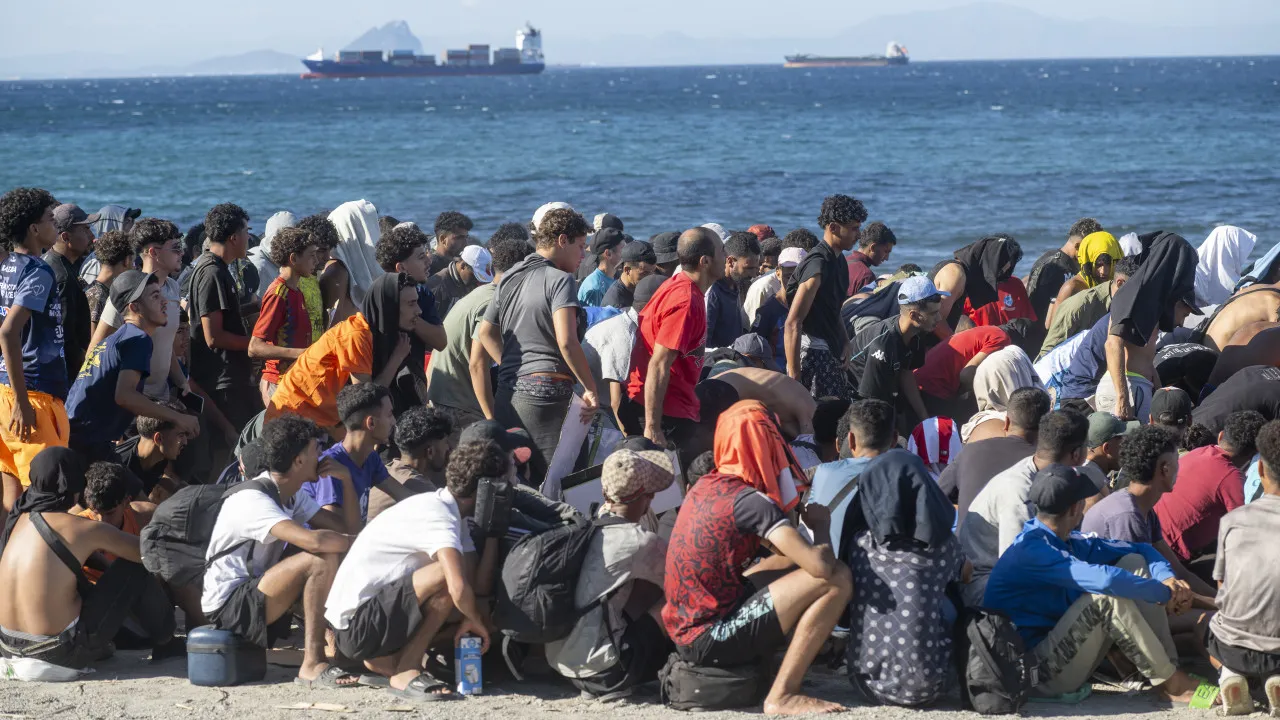
Kadi, Asita and Marouane swam into Ceuta in July and, despite the days that passed without eating and sleeping in the streets, do not repent and maintain hope of coming to work or study in Spain.
© Marcos Moreno/Europe Press via Getty Images
21/11/2026
by
Lusa
Migration
Kadi, Asita and Marouane swam into Ceuta in July and, despite the days that passed without eating and sleeping on the streets, do not regret and maintain the hope of coming to work or study in Spain.
The 27-year-old Senegalese Kadi, the 28-year-old Maliana Asita, and the 17-year-old Moroccan Marouane, are three of the more than 90,000 people who illegally entered Ceuta, a Spanish enclave in North Africa, bordering Morocco.
According to the Spanish Civil Guard, more than 88,000 people have returned to the Moroccan side of the border since then on their own initiative or following expulsions.
In the city, according to the Spanish Government, there are at least 3,500 adults and more than 4,000 unaccompanied minors staying in temporary reception centers, such as camps.
Adults expect decisions on asylum applications and minors, under Spanish legislation and international treaties, cannot be repatriated without an individual evaluation process, which ensures, among other things, that they will be delivered to families in the countries of origin and with a number of socioeconomic conditions guaranteed.
Moroccan adults do not, at the outset, have the right to asylum, with the exception of LGBTI people and others who prove that they are victims of abuse, for example, because Morocco is classified as “safe country of origin” by the European Union (EU), contrary to what happens to sub-Saharan countries.
Kadi, Asita and Marrounian therefore correspond to the profile of migrants in Ceuta who can aspire to obtain permission to remain in Spain.
Trampoline beach spent more than two months on televisions around the world because it was the improvised camping site for thousands of people who illegally entered Ceuta. Among them were Kadi and Asita.
Today, without tents and garbage, the same beach is the place where the two friends and dozens of other subsarian migrants spend the afternoons, in a long wait for response to their asylum requests. The scenery repeats itself on other beaches and sea tours of the city.
Sitting on the edge of the Trampoline beach, Kadi and Asita show Lusa where they slept for a week before being taken to a temporary foreign shelter nearby.
“ It was a week on the street, non-governmental organizations (NGOs) came to feed us, but there were two days we ate nothing, just a cookie ", Asita recalled.
“ We're waiting for the papers and we're expecting good news. We ask for international protection. We wanted to get into Europe and we're here. I don't know if I'm better now than before in Morocco. But I believe I will be, it’s an opportunity,” Kadi reported.
Kadi was in Morocco since 2019 and worked at a café in Tangier. Asita had been in Tangier for five years and worked in agriculture, in fruit picking.
They left the countries of origin, poor and conflicted, to Morocco, where they say they had nothing – they worked “without contracts and sometimes did not pay”.
They say they were told it was possible to move to Ceuta in late July and joined the avalanche, but no more details.
They both aspire to work for Bilbao, a city they saw online and liked. At present, in Ceuta, they have no contact with the local population: “Not a word with the Spanish,” Kadi said.
On the other side of the city, at the doors of a children’s reception center installed inside a warehouse in the Tarajal industrial area, Marouane, “from a village near Marrakech”, explained to Lusa that she slept two weeks on the street and “there were days” that she did not eat after entering Ceuta.
When he entered the juvenile center, they gave him a medical bone test to determine his age. He is 17 years old and hopes that his name will be “on the list to go to Spain” soon, before reaching age. He says he doesn't want to go back to Morocco.
“I want to study computer science, Artificial Intelligence,” he said.
Like the other teenagers around him, he makes sure he got to Ceuta because he saw Instagram on social media how and when he was supposed to get into town.
After a strengthening of human and logistical means, asylum applications in Ceuta have recently begun to have a faster response in “less than two weeks”, with the result being mostly negative, especially for Moroccans, Lusa told immigration expert, Africa Monsalve.
Africa Monsalve has been a member of the group of unofficial lawyers working in the city’s migrant registration centres since September and has revealed that the new asylum applications “have gone from 20 per day per lawyer to five at most”.
Despite the thousands of people who abandoned Ceuta, on their own initiative or not, the lawyer says that “there are still many who remain and have not yet requested asylum”.
Some of them are housed in camps but no registration processes have yet begun. Others have probably not yet done so out of fear, fearing that it will all be over in 15 days.
For Africa's colleague Monsalve, lawyer Alma Ruiz, a lot of people came out, but Ceuta's population will rise by at least 4000 people, the ones she estimates will be able to stay in the city one way or another.