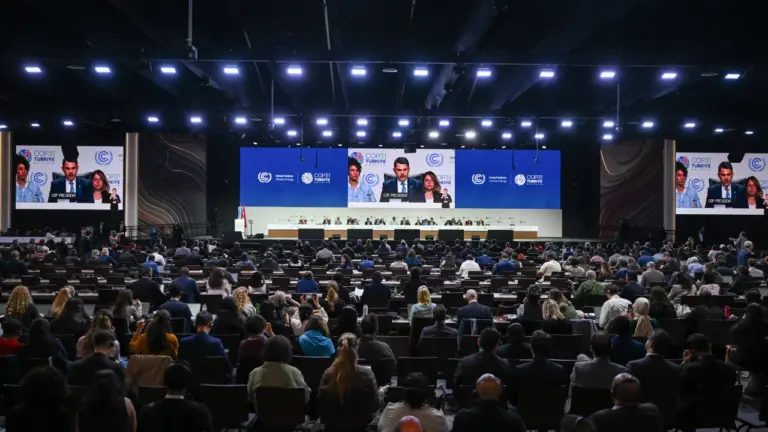
The climate conference in Antália, COP31, officially taking place between the 9th and 20th days but which only ended today, failed to adopt a global political agreement. Understand what led to failure.
© Abdullah Guclu/Anadolu via Getty Images
22/11/2026
by
Lusa
A climate conference in Antália, COP31, officially taking place between 9 and 20 days but which only ended today, failed to adopt a global political agreement.
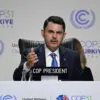
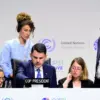
Murat Kurum, the president of COP31, first recalled in the final speech the natural disasters caused by extreme climatic phenomena, and the victims they caused, took stock of the two weeks of work, said that he favored dialogue and consensus, and spoke of the Turkish proposal to reach 2035 with 35% of the world's electrification.
The presidency has even been accused of lack of transparency and dialogue, even secrecy. At the end of his speech, Murat Kurum ensured that “the fight will continue”, and added: “I am sorry to block the negotiations.”.
But what, after all, led to failure? Understand
– Although it has extended, making it the longest summit and record among the 31 UN climate conferences, it has not succeeded in including in the final text of the abandonment of hydrocarbons, as opposed to producer countries, a red line for the European bloc. The abandonment of fossil fuels was still in a first draft agreement but then disappeared.
– Known by the acronym CCUS, Carbon Capture, Storage and Use has brought the European Union (EU) and the Arab countries, led by Saudi Arabia into conflict. They defended in the text the importance of highlighting emerging technology to artificially eliminate emissions and therefore mitigate the impact of global temperature rise above 1.5 degrees. On the other hand, solutions were to reduce emissions and renewable energies.
– For the first time in the history of climate summits, the COP in Antalia had a dual presidency. Turkey was the host and held the presidency of the work, while Australia led the negotiations. Neither Murat Kurum, Turkish Environment Minister nor his Australian counterpart Chris Bowen, managed to conduct the summit in the right direction, either behind closed doors or in public.
– The EU was highlighted and was the face of the opposition to an agreement. It was the first negotiating party to publicly veto the agreement on fossil fuels. The initiative attracted other Europeans, such as Norway and the United Kingdom, as well as Panama and micro-states of the Pacific. The position, applauded by many in the plenary session, was also criticized by powers such as India, the African bloc and several Latin American countries. They reprimanded the EU for avoiding any kind of financial commitment to help developing countries cope with climate change, which they blame on Europeans themselves. In the midst of serious budgetary crises in several of its Member States, the EU has argued that it is useless to provide money if there is no overall political will to reduce emissions. The absence of the largest historical contributor, the United States, put Brussels in the spotlight.
– The COP31 document, which did not reach consensus at the end, maintained the proposal to increase the share of electricity in the global final energy consumption to 35% by 2035. But I did not mean, as the EU wanted, for example, that electricity came from clean sources and it was another reason for the failure of the summit.
– A financing agreement was not generally possible either. Portuguese non-governmental organisations recalled that the initial proposal provided for annual funding of at least USD 120 billion (nearly EUR 110 billion) for adaptation to climate change by 2035, a figure that disappeared from the decision adopted, which maintains the intention to triple the financing of adaptation, but without details.
– The same organizations note the absence in the document of stronger references to human rights, the protection of indigenous peoples and local communities and the international legal responsibilities of states in climate matters.
– The EU has not contributed to new support proposals and has been criticised for this. Moscow accused the EU at its closing session of diverting funds from climate aid by granting loans to countries at market interest rates. And Saudi Arabia at the same time criticized IPCC climate experts — the scientific basis for dealing with global warming — for discarding carbon capture and removal as an important technology.
In a COP31 that will not be remembered for good reasons, it remains for the history of the conference Juan Carlos Navarro, Panama's Environment Minister. Your inflamed speech on Thursday against “the oil mafia” was received with an ovation in Antalia. His threat of vetoing the agreement, which he eventually exercised, and his nimble rhetoric so strongly reflected that on the following day, Friday, several nations sought to establish partnerships with the small country of Central America.