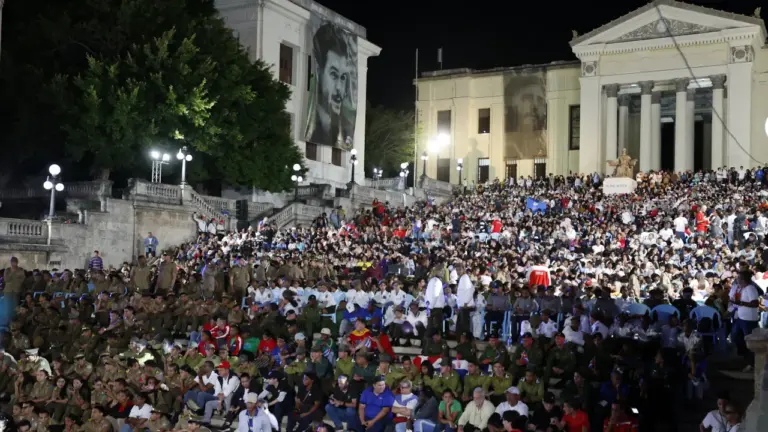
Cuba paid tribute on Thursday to Fidel Castro (1926-2016), with a cultural event on the stairs of the University of Havana and the presence of Cuban President Miguel Díaz-Canel, family members of the revolutionary leader and hundreds of young people.
© Lusa
27/11/2026
by
Lusa
Cuba paid tribute on Thursday to Fidel Castro (1926-2016), with a cultural event on the stairs of the University of Havana and the presence of Cuban President, Miguel Díaz-Canel, relatives of the revolutionary leader and hundreds of young people.
The event had originally been scheduled for Wednesday, November 25, when ten years of the death of the former leader were marked, but it was eventually postponed one day due to weather conditions.
At the time, documentaries dedicated to the life of the man who was president of the Caribbean nation for almost half a century and one of the most well-known and controversial political figures of the 20th century were exhibited.
The stairs at the University of Havana were filled with young students from different levels of education, mainly from the different military academies on the island.
The first ballerina and director of Cuba’s National Ballet, Viengsay Valdés, opened the cultural evening with “La muerte del Swan Negro”, according to the press, while children and young people from various dance companies and children’s choirs performed songs in honor of Castro.
The island’s first secretary of the Communist Youth Union (UJC), Meyvis Estévez, gave the main speech at the celebration, stressing that Cuban youth is “in the forefront” in these “times of struggle” for the island.
“There are genocidal plans and economic strangulation [referring to US pressure with energy blockade and sanctions], campaigns that defame us in a war of ideas (...) and in this battle, we young people are at the forefront,” he said.
This week, several activities focused on Fidel Castro were organized, in a year that also celebrated the centenary of the birth of the former leader, last August.
The Cuban state press dedicated the first pages and reports to honor Castro with articles, photographs and testimonies that exalt the legacy, while the island faces a prolonged economic crisis.
Fidel Castro led the revolution that came to power on January 1, 1959 and placed Cuba at the heart of the international panorama during the Cold War.
While the official Cuban speech strengthens the image of man as a symbol of continuity and resistance, Cuba celebrates these anniversaries in the context of a prolonged economic crisis.