
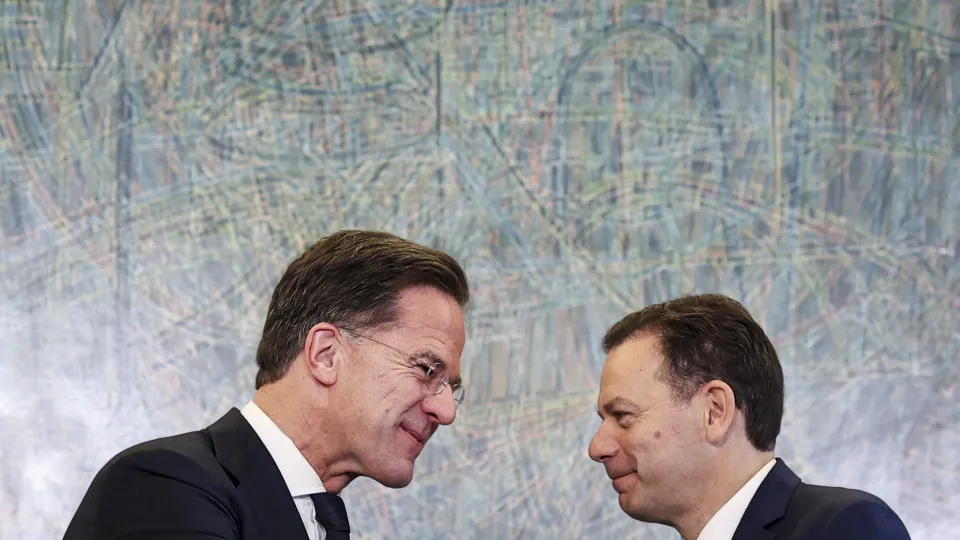
Foreign Minister Paulo Rangel said on Monday that the tension between the Portuguese Government and NATO Secretary-General Mark Rutte is “completely overcome”. But what happened?
© Getty Images
17/11/2026
by
News to Minutes
O minister for Foreign Affairs, Paulo Rangel, assured on Monday that the episode opposing the Portuguese Government to NATO Secretary-General Mark Rutte is “completely overtaken” and “there is no dispute” between the parties. But what was the source of the tension anyway?
Last Tuesday, Mark Rutte accused Portugal and Spain of claiming that the conflict in Ukraine “is far away”, in an interview with a Dutch television station.
“ Sometimes I say to our allies in Spain or Portugal, who say: ‘It’s far away, and what happens in Russia mainly affects Poland’, he said, adding that ‘Russian’s latest missiles take five more minutes to reach Lisbon than Warsaw’.
These statements were criticised by the Ministry of Foreign Affairs, which regretted that the NATO Secretary-General “pronounce so lightly“ on the subject, since “it is an obligation to know which countries and governments are firmly on the side of Ukraine and who are well aware of the Russian threat.”.
“Portugal, its Government and its people have never had doubts about the right side of history. It is regrettable that the Secretary-General of NATO spoke so lightly about a matter of this seriousness”, he concluded, on social network X (Twitter).
Already on Thursday, the Prime Minister, Luís Montenegro, said that not only “all Portuguese authorities [...] have been at the forefront of political, economic and military support for Ukraine”, but also the Portuguese people “are clearly following this position in an overwhelming way”. The Head of Government thus considered that the NATO Secretary-General “was unhappy, was slight, was unaware of a reality that should know with greater proximity“, in saying that in Portugal and Spain some people consider that the war in Ukraine is far away.
“The European average of adherence to these principles [political, economic and military support to Ukraine] is at 76%. In Portugal, this volume of support for Ukraine and rejection of Russia's attitude is 92%. It is, moreover, higher than in the Netherlands, the country of origin of the NATO Secretary-General,” he said, in the margins of the European Political Community Summit in Dublin, Ireland.
Montenegro also considered that Rutte “is completely out of touch with reality in this case”, and could only “sorry deeply.” In this line, he stressed that “in addition to the increase that [Portugal] is making in investment in the area of Defense, in a perspective of the security of our fellow citizens, territories and interests, but also of solidarity in the space of the Atlantic Alliance, we are on a path that has been praised by the Secretary-General himself, Mark Rutte, and our commitment is complete with our allies.”.
Meanwhile, also at the European Political Community Summit, Mark Rutte ensured that he has “any criticism of Portugal or Spain“and the two countries are doing “exactly what is needed: to increase defence spending and to strengthen the production capacity of the defence industry”.
“What I have been saying is that, throughout Europe, and not only in Portugal or Spain, sometimes populations – not politicians, but people within countries – have the perception that there is a difference between the countries of the east, such as Estonia and Poland, and the others,” he explained.
Asked about a possible meeting with the Portuguese Prime Minister, to clarify his position, Mark Rutte was taxing: “I think I have nothing more to explain.”
For his part, Rangel pointed out this Monday that the incident is “completely overtaken” and “there is no dispute” between the parties, although he advanced that he made his position known to the leader of the Atlantic Alliance.
“I have no doubt that he received [the message], because I myself spoke to him on the very day we issued our first position. Therefore, the message, he received,” he said, but stressed that “there is no problem with NATO or with the Secretary-General of NATO.” In fact, in its perspective, only that it is necessary to “put things in their place when there are inaccuracies” and when it comes to “things that require less lightness”.
“ But that, anyway, it's out of date and there's no litigation“, he assured.
However, Rangel reiterated that the Government will not “abdicate putting Portugal’s position where it is”.
“It’s something that obviously shocks us. To say that governments could be less pro-Ukraine obviously made absolutely no sense,” he said, adding that the same applies to saying that the Portuguese population is not aware of the Russian threat.
And he said: “This is then documented in many opinion polls: we are at 92%, more or less in this house, of the recognition of the Russian threat. I am not just talking about supporting Ukraine, I am talking about Russia’s own recognition as a threat to the EU and also to Portugal.”