
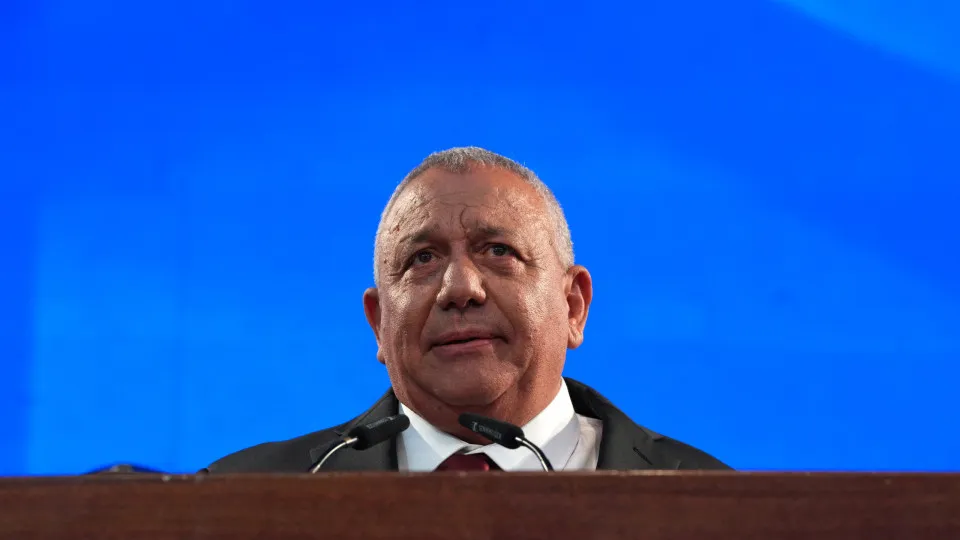
The leader of Yashar!, Gadi Eisenkot, canceled a meeting with Likud, Prime Minister Benjamin Netanyahu, after his speech at the inaugural session of the Israeli parliament.
© Getty Images
10/11/2026
by
Lusa
O leader of Yashar!, Gadi Eisenkot, party in charge of forming government in Israel, cancelled a negotiating meeting scheduled for today with Likud, the outgoing Prime Minister, Benjamin Netanyahu, after the speech he gave at the inaugural session in parliament (Knesset).
The opposing leader and former chief of the armed forces unscheduled the meeting in response to the “divisive speech of the outgoing Prime Minister and his contempt for the ceremony of taking possession in the Knesset and, with it, for what remains of a sense of state”, according to a statement by the Yashar! (Integer!).
“The outgoing Prime Minister attacked the citizens of Israel tonight, in yet another sad warning, for those who still needed proof: Netanyahu does not want unity”, accused the political force in a statement.
For Yashar!, “in the face of the gravity of the moment and strength of Israeli society and its political survival”, Benjamin Netanyahu “will choose, as always, himself at any cost”.
Before the inaugural session of parliament and two weeks after the legislative elections that resulted in a political stalemate, Gadi Eisenkot reiterated the need for an “emergency government”, which he considers “a component of Israel’s national security”, but did not signal the way to make it possible in the Knesset.
The meeting with Likud had been scheduled after Yashar! invite all parliamentary factions to negotiate “sincerely and genuinely” on the basis of the four principles that the party established for the formation of a government.
In his speech in parliament, Netanyahu defended, for his part, the formation of a “government of national unity” against the Iranian threat.
He questioned the opposition's willingness to rule alongside the Arab parties, which he accused of "supporting terrorism" and of acting as a " Troy Horse" of Iran and its affiliated armed groups.
The Prime Minister has reinforced the need for a joint executive, to engage the Jewish opposition parties and exclude the Arabs, and to be headed by himself as leader of the Likud, the most voted party on 27 October, but who failed to gather more recommendations to form government with the Israeli President, Isaac Herzog, than his opponent of Yashar!.
In reaction to Netanyahu’s words, Gadi Eisenkot classified the speech in parliament as “delirant, divisive, hateful and shameful”, in a statement issued by his party.
“ I am even more convinced that he is unable to remain in office for another minute,” said the former chief of the armed forces, adding that Netanyahu’s stay in office “divides Israel and endangers its security.”.
The four Jewish opposition-based parties managed to elect 48 deputies and fell short of the 61 majority to control the Knesset.
The two Arab forces obtained a record result of 19 deputies and endorsed Eisenkot to form government, but their support is rejected by one of the parties of the so-called bloc of change, the Yisrael Beytenu (Israel is Our House), of the former Minister of Right-wing Defense Avigdor Lieberman.
The key to the future government may be the 13 representatives of the ultra-Orthodox parties, who supported Netanyahu in the previous political cycle, or an enlarged majority who group various sensitivities.
On the first day of parliamentary work, the opposition bloc indicated former Minister of Religious Affairs and Mr Matan Kahana, who was in fifth place on Yashar's lists!, as the next president of the Israeli parliament, in place of Mr Ohana of the Likud.
The four opposing parties also presented a series of legislative initiatives setting up an anti-Netanyahu agenda, including the establishment of a state inquiry committee on Hamas-led attacks on October 7, 2023 and the repeal of measures related to the controversial judicial reform initiated by the outgoing government.
Eisenkot has 28 days since Sunday to present a viable government solution in parliament, extended for another 14 days.
If not successful, the decision returns to Israeli President Isaac Herzog, who will indicate another candidate and count back to square one for another 28 days, with no possibility of extension.