
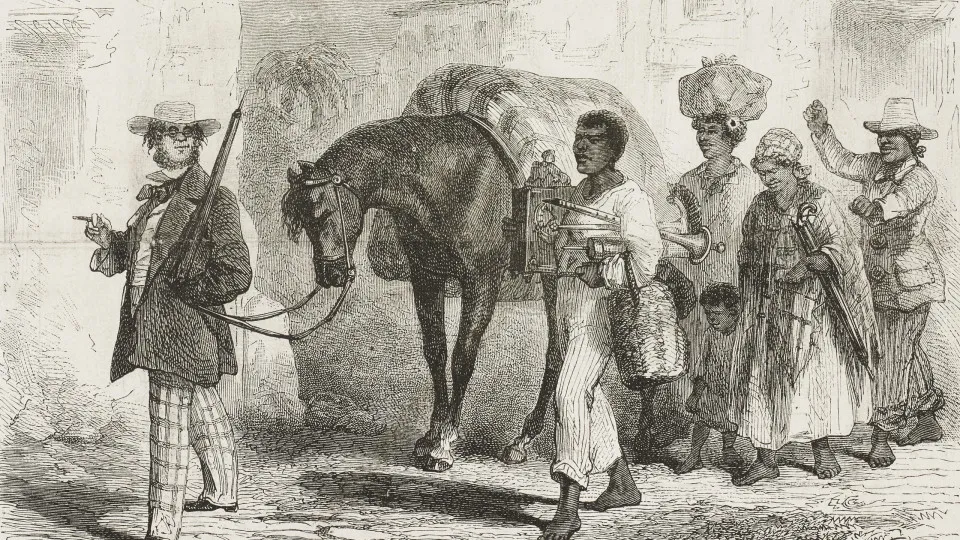
Harvard University returned two skulls of enslaved people to Brazil in the 19th century, the executive secretary of the Ministry of Human Rights and Citizenship, Caroline Reis, reported.
© Getty Images/Ambrosian Library
10/11/2026
by
Lusa
A Harvard University in the United States returned to Brazil two skulls of enslaved people in the 19th century, Lusa today told the Executive Secretary of the Ministry of Human Rights and Citizenship, Caroline Reis.
The delivery of the remaining humans was formalized on Monday, at a signing ceremony of the repatriation documents, at Harvard, and the ceremony of delivery to the Brazilian universities is scheduled for Wednesday, in Salvador and Rio de Janeiro.
In a telephone interview with Lusa, from the airport in the United States, while preparing to return to Brazil with the remaining ones, Caroline Reis explained that the two skulls were at the Peabody Museum, linked to Harvard University, and were removed from Brazil in the 19th century.
The two skulls are being transported to Brazil by diplomatic suitcase, a procedure that provides for transport in closed and sealed volumes, which will only be opened during the ceremonies of delivery to two Brazilian universities on Wednesday.
One of the skulls belongs to a man from the Bay region who participated in the Male Revolt, a rebellion of enslaved and freed Muslims in Salvador in 1835.
According to Kings, available records indicate that the man arrived injured to a place where people were received injured during the revolt, eventually died and had his skull removed and taken to the United States.
It was not possible to identify the man's name or determine whether he played a leading role in the movement, he explained, knowing only that he participated in the revolt and belonged to the Muslim community.
The second skull, said Caroline Reis, belongs to a woman from the Cais do Valongo region in Rio de Janeiro, but it has not yet been possible to determine her identity or the concrete circumstances in which her remains were removed from Brazil.
The two skulls will be delivered to the Federal University of Bahia (UFBA) and the Federal University of Rio de Janeiro (UFRJ), respectively, which will carry out additional studies, conserve the materials and seek information to deepen the knowledge about those people.
Caroline Reis explained that the repatriation process began in 2022, after the Islamic community of the Bay identified the skulls in a report released by Harvard on human remnants existing at the university and sought the Brazilian Government to begin negotiations.
She stated that the process involved about five years of dialogue and negotiation and highlighted Harvard's availability and collaboration during the repatriation contacts.
After university studies, he explained, the skulls will be handed over to the communities of origin, who will be responsible for holding funeral ceremonies and burial according to their religious and cultural traditions.
The executive secretary pointed out that repatriation represents a rescue of historical memory and a measure of recognition of human dignity, since these people were deprived of rights during their lives and had their remains removed from the country without identification.
According to Caroline Reis, recovering these remnants allows us to understand the events of the past and its effects on the present.
“ Memory policies are essential for us to understand what happened in the past, so we also understand the legacy that has been left and all aspects that still live in Brazilian society in the present, of structural racism and all the difficulties of racial equality that we still face, so we can trace a different future ", highlighted.
The secretary added that the Ministry of Human Rights has strengthened, since 2023, the memory policies related to the transatlantic trafficking of enslaved people and the legacy of enslavement in Brazil.
Reis recalled that expeditions by foreign researchers to collect human remnants were frequent in the 19th century, but noted that no other cases have yet been identified that have led to further repatriation negotiations.
The process now completed is considered a pioneer by the Brazilian Government, which intends to use the experience gained to guide future returns of remains to the communities of origin.
“ This one we did will serve as a parameter for the others that will be made in the future ", said Caroline Reis, adding that the Brazilian government will continue to invest in research to locate other human remnants that may have been removed from Brazil during the 19th century.