
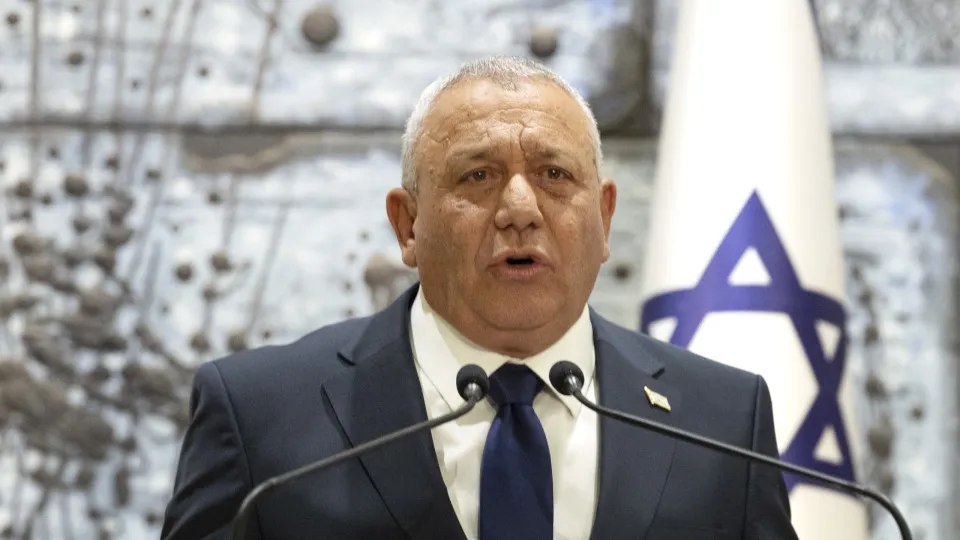
The leader of Yashar!, Gadi Eisenkot, entrusted with forming a government in Israel, will start negotiations with the ultra-Orthodox parties to enable an executive and to overcome differences in his support group, today the Israeli public broadcaster said.
© Kobi Wolf/Bloomberg via Getty Images
09/11/2026
by
Lusa
O leader of Yashar!, Gadi Eisenkot, tasked with forming government in Israel, will start negotiations with the ultra-Orthodox parties in order to enable an executive and overcome disagreements in his support group, today the Israeli public broadcaster said.
According to Kan, negotiations with the two ultra-orthodox forces were agreed at a meeting today between Eisenkot and one of his so-called change bloc partners, the leader of the Yisrael Beytenu (Israel is Our House), Avigdor Lieberman.
The meeting was confirmed by Yashar! in a statement, but without signaling if it was found any way out to the political impasse created by the laws of October 27.
Yashar’s statement only states that “both expressed confidence in their ability to form a stable government for a four-year term”.
Former Chief of Armed Forces Gadi Eisenkot was appointed on Sunday by Israeli President Isaac Herzog to form government as leader with more recommendations in parliament, despite losing the election to Likud, the outgoing Prime Minister, Benjamin Netanyahu.
The Yashar! and three other Jewish base parties of the bloc of change do not however have the majority of 61 deputies to control the parliament (Knesset).
The solution could lie in the two Arab formations, which obtained a record vote of 19 Members, but this support has been refused by Lieberman, a former Defense Minister who, in recent days, has given signs of approaching an understanding with the ultra-Orthodox, who in turn belonged to the pro-Netanyahu group.
According to station Kan, quoted by The Times of Israel, the leaders of the opposition Zionist parties agreed to open negotiations with the ultra-Orthodox Shas parties, which elected six deputies, and United Judaism of the Torah, with seven elected.
The support of the two ultra-Orthodox groups would allow the anti-Netanyahu bloc to add 61 Members in parliament, i.e. the minimum number for an absolute majority.
During Isaac Herzog's consultations over the past week, the latter political force did not support Netanyahu or endorse Eisenkot.
This is the controversial military exemption from the ultra-Orthodox, which the majority of the secular Zionist opposition contests, including Lieberman's party.
Kan indicated that on the basis of negotiations with that religious minority there may be a milder recruitment law and that the rabbis of the United Judaism of the Torah may be open to dialogue, although no meeting has yet taken place.
Channel 12 reported that negotiations are at a preliminary stage, although the possibility of an agreement being real, according to The Times of Israel.
The ultra-Orthodox parties would require a transitional period between 12 and 18 months to achieve a new legal framework for service in the armed forces and prosecutors' guarantees that would not pursue the Haredim community for evasion of military service in that time.
All parties in the opposition bloc defended during the campaign the end of the controversial military exemption from the ultra-Orthodox, but Lieberman was surprised to announce that he was ready to withdraw his veto to an alliance with groups of this minority and reach an agreement on compulsory recruitment for all, including religious students.
Eisenkot gathered the support of 67 deputies in Herzog's consultations before being appointed to form government, including the Arab parties, against 46 of Netanyahu.
Yashar's leader! you will now have 28 days to present a viable solution in parliament, extended for another 14.
If not successful, the decision returns to Herzog, which will indicate another candidate and the count is back to zero for another 28 days, without possibility of extension.
So much for Yashar's leader! as his opponent of the Likud have dramatized the speech, with Eisenkot to reiterate on Sunday the need for “a national emergency government”, facing “a point of no return to the State of Israel” and requiring “creative and unusual policy measures”.
At the same time, it opened the possibility that members of the Likud or even Religious Zionism, the far-right party of Finance Minister Bezalel Smotrich, would join a solution.
The outgoing Prime Minister warned on Saturday that an alliance between the opposition bloc and the Arab parties “will dismantle the State of Israel from within, as is happening in European countries, and much worse.”.
The prospect of a government of “national unity”, claimed by the outgoing Prime Minister and to be led by Likud, as the most voted party, and by himself, generates deep divisions in society, after a highly polarized campaign, despite the fact that the Israeli press realizes that this would be Isaac Herzog’s preferred solution.
This scenario, even if it predicted a rotation in the position of Prime Minister between Netanyahu and Eisenkot, is quite unlikely, since Yashar's leader! it has been quite vocal in the need to remove the current head of government and much of his campaign was built on this basis.
While the viability of a government is negotiated, Parliament has its first session scheduled for Tuesday and parliamentary work should be dominated by an attempt by the opposition to appoint a new president of the Knesset and by the creation of a commission of inquiry to the attacks led by Hamas on October 7, 2023.
This committee has been refused by Netanyahu, among several revelations that call into question his management of the bloodiest day in Israel's history, and was an election promise from Eisenkot.