The polls opened this Saturday in Taiwan for local elections marked by a tight dispute in the capital, Taipei, and Taipei's warnings about alleged attempts to interfere with China's electoral process.
© Lusa
28/11/2026
by
Lusa
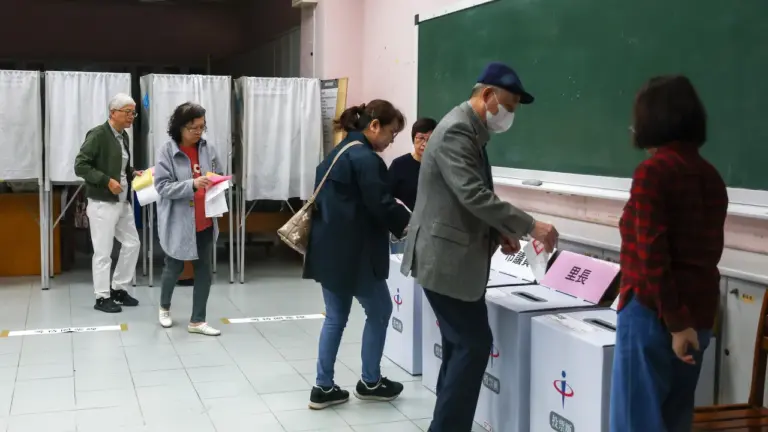
Athe polls opened this Saturday in Taiwan for local elections marked by a close dispute in the capital, Taipei, and Taipei's warnings about alleged attempts to interfere with China's electoral process.
The polls open at 08:00 local (00:00 GMT time) and close at 16:00 (08:00 GMT time). The counting of votes begins immediately and the results should be known today. The elected shall carry out four-year mandates.
The voters of the island will choose mayors, members of local assemblies and other political leaders in the 22 municipalities and counties of Formosa. Around 19.65 million citizens are called upon to vote to fill 11,051 positions in 8,906 districts, according to data from the Central Election Commission.
Known as “nine in one” elections, these votes take place every four years and cover all levels of local administration, from the presidencies of the six special municipalities – Taipei, New Taipei, Taoyuan, Taichung, Tainan and Kaohsiung – to the neighborhood and village heads, passing through the governments and county and city assemblies.
At the same time, there is a referendum on the abandonment of the policy of a “nuclear-free country” one and a half years after the closure of the island’s last operational nuclear reactor.
The electoral race is dominated by the Progressive Democratic Party (PDP), currently in power, and by the Kuomintang (KMT), the main force of the opposition. Traditionally, KMT achieves better results in local elections. In 2022, the PDP won only in five of the 22 local jurisdictions.
Taiwanese President William Lai Ching-te actively participated in the campaign, supporting the PDP candidates.
The attention will be particularly focused on Taipei, KMT's historic bastion, where the current mayor, Chiang Wan-an, faces a close dispute with Puma Shen, PDP deputy sanctioned by Beijing in 2024.
Elected mayor of Taipei in 2022, Chiang Wan-an is the great-grandson of Chiang Kai-shek, the historic leader of the KMT, and is seen as a possible strong candidate for the Taiwanese President of 2028.
Initially seen as a less favorite candidate, Shen managed to reduce the difference and turn the election race into a very balanced contest, attracting crowds to her campaign events.
Known for his critical positions with regard to China, Puma Shen is sought by the Chinese authorities for alleged “separatist activities”, an accusation he rejects.
In comments to the France-Presse agency, Liu Jia-wei, professor of Political Science at the National University of Taipei, the participation of undecided voters and young people may be decisive in determining the winner of this “very tight race”.
Other races considered decisive take place in New Taipei and Kaohsiung. The municipality of New Taipei is governed by the KMT, while Kaohsiung remains under PDP control.
The Taiwan People's Party (TPP), the third political force on the island, presents candidates in some minor local disputes and supports the KMT candidate for the presidency of the Taipei Chamber.
On Friday, the candidates held the last rallies and campaign actions in a final attempt to mobilize voters. In Taipei, posters and campaign tracks cover much of the city's buildings.
In addition to the local elections, voters speak about the future of nuclear energy. The referendum may determine a change in the policy of progressive abandonment of atomic energy, adopted after years of debate on energy and environmental security.
Although the relationship with China did not dominate the campaign, the Taiwanese Government reported in recent weeks alleged attempts at interference by Beijing, including funding from certain candidates and the use of misinformation and “cognitive warfare” campaigns aimed at influencing voters.
Prior to the vote, authorities alerted the population to possible false information disseminated on social media.
According to the Taiwan Defense Ministry, China sent on Friday about 30 military aircraft, including fighters, strategic bombers and drones, to the vicinity of the island within the framework of a “Air Patrol for combat preparation” and long-range naval exercises.
Beijing considers Taiwan is part of the Chinese territory and does not exclude the use of force to take control of the island, governed autonomously since 1949.