
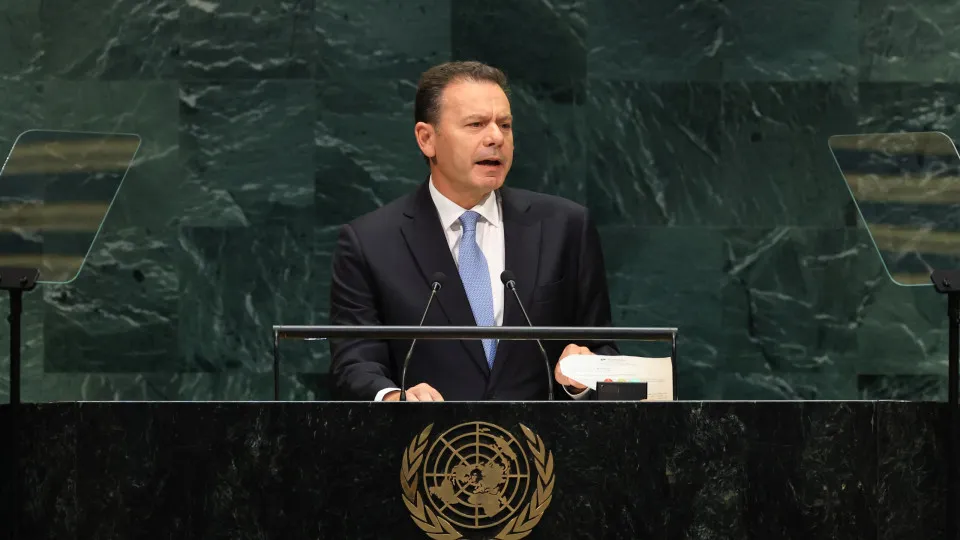
The stages (and allies) are different, but the two speeches of the Prime Minister had some points in common: from the appeal to the end of conflicts to the “absurd reality” of fuel increase. What did Montenegro say in these two spaces in less than a month?
© TIMOTHY A. CLARY / AFP via Getty Images
08/10/2026
by
Tomasia Sousa, Lusa
Nthe last few weeks, the Prime Minister, Luís Montenegro, was at the headquarters of the United Nations, but also at the European Parliament: at the first moment, he spoke at the 81st General Assembly, the last with the Portuguese Secretary-General António Guterres; at the second, he addressed MEPs at a time when movements to the next Community budget begin to intensify.
The two speeches took place in less than a month.
Participation in the United Nations General Assembly in New York took place a few months from Portugal to return to the UN Security Council as a non-permanent member.
The speech in the European Parliament in Strasbourg was at a time when the European Union is in full negotiation of the next Community budget, which will cover the period from 2028 to 2034.
But what did the Portuguese Prime Minister defend on each of these stages?
Increase in fuel and cost of living
The increase in fuel prices and the general cost of living was one of the common points of the two speeches. On both stages, Luís Montenegro insisted on a reflection and possible decision on the oil price formation mechanism in the international market.
Last week, the Portuguese Prime Minister criticised a climate initiative at the United Nations “absurd and foolish reality” the increase in fuel prices, defending the importance of ensuring “greater strategic autonomy” in this area.
“ At a time when we are all being affected by this absurd and foolish reality of all of us paying for the most expensive oil fuels, with undeniable damage to our populations and our economies, the ability to be more autonomous, each of us also more sovereign, more environmentally friendly and we can offer energy sources at a more affordable price is a common goal”, he said.
As early as Tuesday in Strasbourg, Montenegro requested a “coordinated response” at european level to deal with the increase in the cost of living, arguing that “to solve the concrete problems” of people is the “best way” to combat populism and demagogy.
In a speech at the plenary session of the European Parliament in Strasbourg, Luís Montenegro stressed that the “energy crisis due to international conflicts” in which the European Union does not participate “is having a serious impact on the lives of Europeans”.
“The European response capacity can also make a difference. It must make a difference. It will be time for us not to let each Member State act on its own, and it will also be time for us to have a coordinated response at European level,” he said.
The Prime Minister insisted, as he had already done in his speech at the United Nations General Assembly in New York in September, that the energy crisis caused by the war in Iran is a “kind of collective masochism that is causing harm to all”.
“Insensat” crisis and “masochism” act?
This theme of international conflicts and how they negatively affect people's daily lives was another of the points in common in both discourses.
At the UN, Montenegro took advantage of its antenna time to defend that “this is a foolish crisis because it is bad for everyone”.
“ We must end this kind of collective masochism. And we must do so quickly to close this chapter, which harms everyone,” he called, stressing that, on the one hand, “we need to put an end to the ongoing conflicts” and on the other hand, we need to find ways of “mitigating the impact of this energy crisis and preventing its extension”.
“In the Middle East, the humanitarian tragedy must cease and we must move towards a two-state solution – with Israel and Palestine coexisting as two sovereign states in peace and security,” he said.
In his speech, Montenegro argued that “every opportunity for dialogue, diplomacy, peace” should be explored, considering that the geopolitical wars and tensions under way “have had a terrible human impact, questioning this international order and the prospect of prosperity”.
In addition to the Middle East conflict, the Prime Minister also referred to Iran – albeit never to mention the United States –, arguing that it must end “aggressive action” of this country and the blockade of the Strait of Ormuz.
The tribute to Guterres: “Untiring”
In passing by the UN, the Portuguese Prime Minister thanked “the tireless work” of António Guterres at the head of the United Nations, and defended the multilateral response of an organization that he classified as “a masterpiece”.
The head of the government began his speech, about 11 minutes ago, with a thank-you to the current UN Secretary-General, Portuguese Antonio Guterres.
“ I pay tribute to him for the tireless work of ten years in defending the Charter of the United Nations, international law and multilateralism”, he said.
Montenegro considered that “despite everything”, the United Nations “is a political masterpiece of humanity” and expressed confidence in the multilateral response to world conflicts.
“ The magnitude of the challenges we face today requires collective responses. The most collective response is the multilateral response. And the United Nations are, must be, must remain the center of the multilateral system,” he called.
Pedinchices in the EU (and warnings)
On the EU budget, the Prime Minister refused to enter a “pedinching competition”, but he warned that he will be “intransigent” with cuts in cohesion policy and stressed that Portugal contributes more in proportional terms than the ‘frugal’ countries.
In statements to journalists just before the speech in the European Parliament, Luís Montenegro admitted that he is “concerned” with the negotiations on the next EU budget for the period 2028 to 2034, and with the need to “guarantee what is foreseen in the Treaties” with regard to cohesion policy, Common Agricultural Policy (CAP) and support for the outermost regions.
“Europe will only have greater competitiveness if it ensures cohesion: social, territorial and economic cohesion. Therefore, we will be uncompromising in our participation in order to gain respect for what is in the treaties on this aspect”, he warned.
Then, in his speech to MEPs, Luís Montenegro insisted that the next EU budget should finance “new priorities”, but “without questioning the policies that remain essential for the convergence and competitiveness of the whole of Europe”.
“Portugal – I also want to say this in a clear, transparent and forward way – does not view the Multiannual Financial Framework (MFF) as a pedinchice contest. Portugal sees the MFF as an opportunity to deepen a social and economic project that is part of only a possible and viable internal market with innovation and solidarity between all Member States and all regions,” he said.