
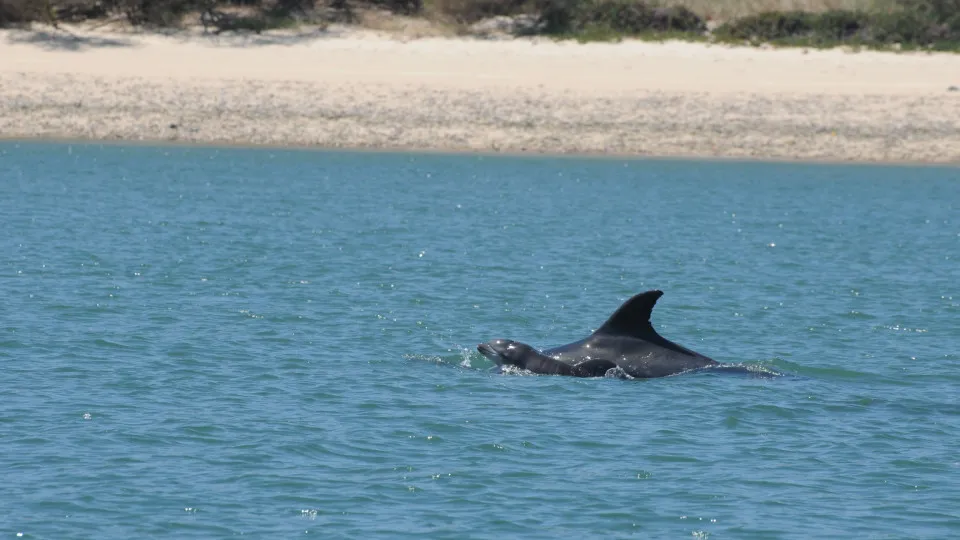
The water temperature of the Sado river estuary is expected to increase by the end of the century, reaching values above two degrees in the most pessimistic scenario, concluded a study of the University of Aveiro.
© ICNF
16/11/2026
by
Lusa
A water temperature of the estuary of the river Sado is expected to increase by the end of the century, reaching values higher than two degrees in the most pessimistic climate scenario, concluded a study of the University of Aveiro (AU) released today.
According to a note from the academy, the study, completed earlier this year and published in September in Earth’s Future magazine, analyzes how climate change can change the temperature and salinity of water in the Sado estuary up to 2100.
For this, the researchers used the mathematical model Delft3D, developed in the AU, reconstructing the evolution of the last decades and projecting two future climate scenarios, associated with different levels of greenhouse gas emissions.
The data collected by the researchers point to a progressive warming of the estuary up to 2100.
In the first scenario, where greenhouse gas emissions remain relatively high for some time but end up stabilising, the water temperature is expected to rise by an average of 0.109 degrees per decade. In a more pessimistic scenario, this increase will be 0.275 degrees per decade.
Unlike temperature, salinity does not present a unique trend for the future, and researchers identified two distinct behaviors, mainly due to the projected differences in the volume of fresh water that will reach the estuary across the river.
In the first scenario an increase in salinity is expected, with the exception of the area of the mouth of the estuary, mainly due to the projected decrease in the river flow.
In the scenario with the highest greenhouse gas emissions, salinity is expected to decrease throughout the estuarine system, especially as a result of increased river flow.
The study conducted by researchers Humberto Pereira and João Miguel Dias, both from the Center for Environmental Studies and the AU Sea, in collaboration with researchers from the universities of Lisbon and Southampton (United Kingdom), shows that the impact of climate change on estuaries will not only depend on the increase in global temperature.
“ The rise in the mean sea level, changes in river flow and other local environmental factors may be decisive in the way each estuarine system will respond to climate changes ", reads the note.
Researchers recall that estuaries are transition zones between terrestrial and marine environments and play a key role in biodiversity and the functioning of coastal ecosystems, in addition to sustaining human activities and communities, pointing out that it is essential to anticipate the evolution of their physical conditions to anticipate the challenges of the coming decades.
The investigation further demonstrates that the methodology used in the Sado estuary can be applied to “mesotid and well-mixed estuarine systems” with similar characteristics, paving the way for its use in assessing the impacts of climate change on other estuaries.