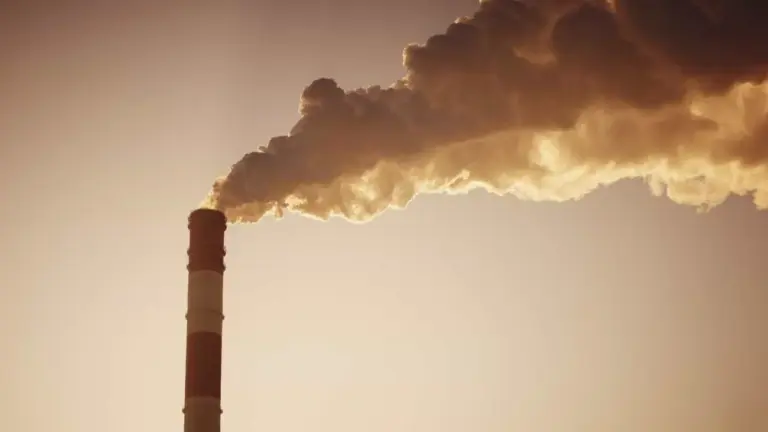
A study revealed that desert dust chemistry varies according to origin and that this variation can influence air quality and air pollution.
© Getty Images
24/11/2026
by
Lusa
Um study revealed the hidden chemistry of desert dust, which is not the same everywhere, and how, throughout its journey, affects air quality.
This study, led by the Barcelona-National Supercomputer Center (BSC-CNS) and the Catalan Research and Advanced Studies Institution (ICREA) and published in Nature Communications, shows that differences in dust chemistry can influence what happens when it comes into contact with contaminated air.
Mineral dust is one of the most abundant types of suspended particles and can travel thousands of miles from the deserts where it originates, path that can affect air quality, ecosystems and climate.
The BSC announced in a statement on Monday that researchers combined observations of the Earth Surface Mineral Dust Source Investigation (EMIT) mission of the US agency NASA, an image spectrometer installed at the International Space Station, with atmospheric computational models to study how different minerals in dust affect atmospheric chemistry and how dust interacts with light.
Among the minerals present in desert dust, calcite proved especially important for atmospheric chemistry.
Thus, when dust particles come into contact with moisture, calcite can neutralize acid gases, acting in a way as an antacid in the atmosphere.
This can influence the formation and distribution of nitrate, sulfate and ammonium particles, altering air quality in populated areas and affecting ecosystems after deposition of these particles.
The EMIT maps of calcite and iron oxide were incorporated into the atmospheric model MONARCH, developed in the BSC and executed in the MareNostrum supercomputer.
The model used satellite observations to estimate where and how much dust was emitted and then the atmospheric concentrations of the minerals were evaluated, comparing them with the observations.
When researchers replaced the commonly used hypothesis that calcite content was similar everywhere, they found substantial differences in acidity resulting from suspended particles.
In some regions, the effect was large enough to significantly alter the chemical conditions of the atmosphere.
The most intense effects occurred where mineral dust came into contact with nitric acid and other contaminants.
The results show that knowing where dust comes from and what minerals it contains can be important for understanding atmospheric chemistry and pollution events.
“ Desert dust is not chemically the same everywhere. A calcite-rich cloud can interact with contaminated air in a very different way from a calcite-poor cloud”, said the first author of the study, Rubén Soussé Villa, researcher of the Atmospheric Composition Group of the Department of Earth Sciences of the BSC.