
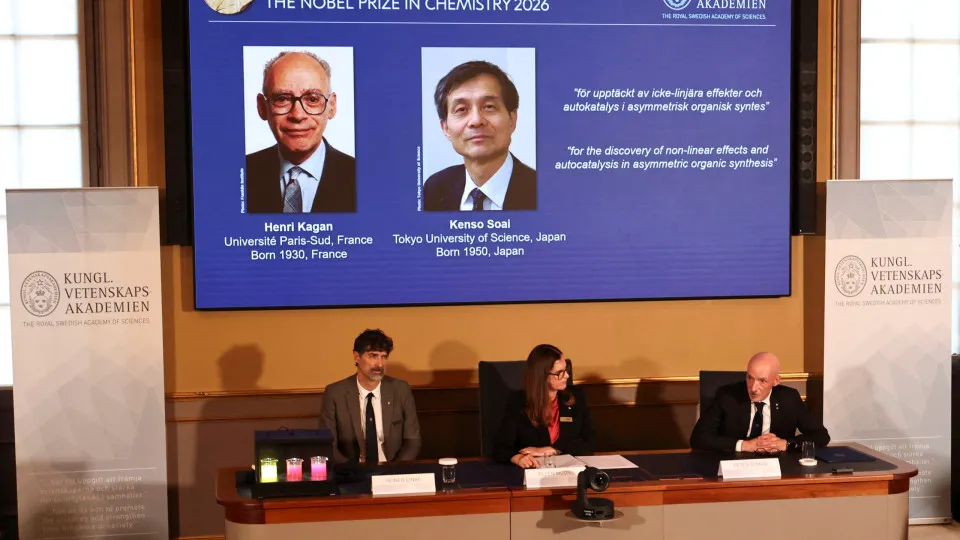
The work of scientists who won the Nobel Prize in Chemistry today was “very pioneering” and contributed so that in the pharmaceutical industry the desired compound could be synthesized more effectively, said to Lusa the chemist Paula Branco.
© REUTERS/ Tom Little
07/10/2026
by
Lusa
“ O what happens to drugs and the importance of asymmetric science in this case of the pharmaceutical industry is that we can synthesize that drug that will interact with that biological sector that we want and not with any other biological receptor in our body ", explained the teacher of the Faculty of Sciences and Technology of the Universidade Nova de Lisboa.
The Nobel Prize in Chemistry of 2026 was awarded today to Henri Kagan and Kenso Soai for a discovery that helps chemists to manufacture molecules that exist in two mirror versions of each other.
“ It is very pioneering because it developed certain links and realized that these links catalyzed, for example, only the formation of a drug ", added the specialist.
According to Paula Branco, the importance of the discovery is that it allows, between two “mirror” molecules, to use “only one particular compound, because the other compound will interact with some receptor”, which may cause “adverse effects”.
Basically, it is to be able to make reactions produce in greater quantity in a precise goal.
“ This is a concern that has existed forever, now what is sought is how we can achieve 100% of the compound we want and all the processes to lead us to this are always very important ", said Paula Branco, who is dedicated to this area of study.
This effect, of achieving an amplification of the signal, was translated “in something that is new”, because “it greatly increases the percentage of what is intended to be synthesized”, justified.
The award was awarded “for the discovery of nonlinear effects and self-catalysis in asymmetric organic synthesis”, according to the Nobel Prize Committee.
Henri B. Kagan, from the University of Paris, and Kenso Soai, from Tokyo University of Science, made an important discovery for the manufacture of medicines by uncovering a puzzle that “for a long time was a mystery to chemists,” the Committee said.