
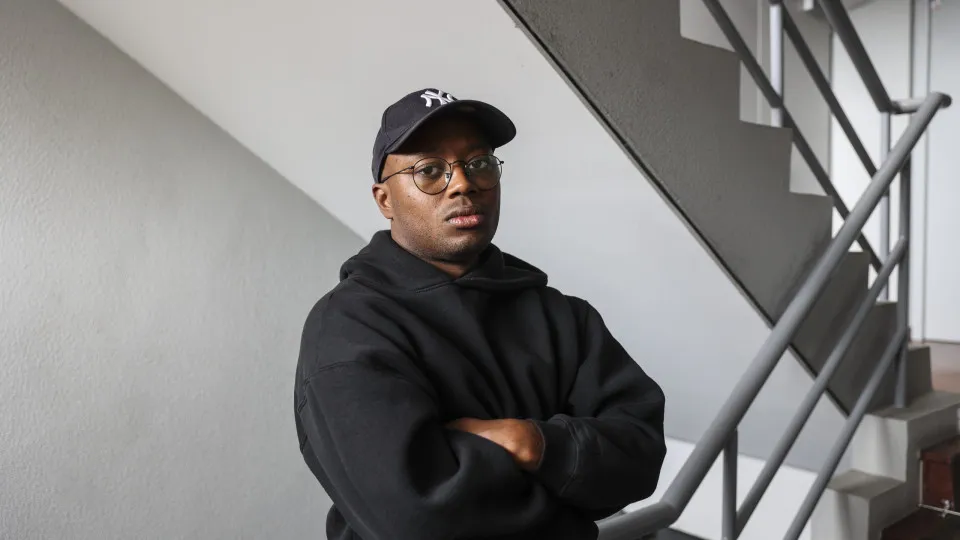
Portuguese director Fábio Silva made cinema the tool to understand family roots and give more visibility to stories of the African diaspora, such as the documentary "The Blood of the Alliance", which premieres on Tuesday in Amsterdam.
© Lusa
15/11/2026
by
Lusa
O portuguese director Fábio Silva made cinema the tool to understand the family roots and to give more visibility to stories of the African diaspora, as the documentary “The Blood of the Alliance”, which premieres on Tuesday in Amsterdam.
“The Blood of the Alliance” is the first documentary feature film by biographical pendor of Fábio Silva, in which it portrays the relationship with the mother, after the separation of the father, both Cape Verdeans rooted in Portugal.
The narrative of this film continues the short film “Fruto do Tus Ventre” (2021), as a letter that the director addresses to his father, full of questions about family dynamics, deeply rooted in Cape Verdean culture, but displaced to another country.
“ When I make movies, it's also to understand me. I am always in this field of ancestry, of the society in which we live and of neocolonial issues, of love relations, to understand who I am”, said Fábio Silva in an interview with the agency Lusa.
Fábio Silva was born in Lisbon in 1992, from Cape Verdean parents who went to live and work for Portugal even before the April 1974 revolution.
He grew up and lives in the outskirts of Lisbon, graduated in Portuguese Studies, because he wanted to be a writer; he graduated in journalism and discovered the camera as a work tool, although he grew up with a father who was interested in cinema and the idea of documenting family life with household appliances.
Fábio Silva then made a master's degree in cinema, which resulted in the short film "Fruto do Teu Ventre", and is currently a doctoral student in Artistic Studies, to study the representation of the Cape Verdean community in Portuguese cinema.
It is self-made, and its roots, a subject of study and research in cinema. In the short film it tells that his birth occurred after two dramatic events in the family, with the death of two brothers by drowning in a pool, and the discovery that his father had two families.
“ It's what sociologists call informal polygamy in Cape Verde. My grandfather had a lot of relationships, too. [...] I realized it was an issue I had to understand, even in order to better understand my father and mother. [...] What's cultural? Is it tradition? Why? ", asked Fábio Silva.
Already in the feature film, which has a world premiere on Tuesday at the International Festival of the Documentary of Amsterdam (IDFA), the mother, Cesaltina Silva, returns to be the protagonist, with Fábio Silva recording his days while reorganizing and recomposing after the separation of his father.
With the premiere of “The Blood of the Alliance” underway, Fábio Silva is in the stage of the assembly of a third documentary, “The Tuas Costas Still Burn”, in which he goes even deeper on family ties, with a more sociological and historical perspective.
“ Who am I? And I'm always trying to situate and I realize more and more that I don't have to be put in a stereotype, I don't have to be put in a drawer, I can be a lot of these worlds, don't I.
And that is why, even from a history of family intimacy, Fabio says he wants to give visibility to stories “of the African diaspora” and fill rooms with women from the Cape Verdean community. “Because they deserve it, they have very troubled life stories and deserve their stories to be seen,” he said.
About the doctorate, Fábio Silva says he is interested in knowing how Portuguese cinema represents the Cape Verdean communities, not only during the New State, but also in democracy, in the eyes of Portuguese and Afrodescendants directors.
Fábio Silva cites Pedro Costa, João Salaviza or João Miller Guerra and Filipa Reis, who have filmed the Cape Verdean reality, but also younger generations, such as Falcão Nhaga, Denise Fernandes and Luís Almeida.
“ One of the things I do is teach. And I have this desire to take cinema to schools, to teach diaspora children, black children and also from the periphery to make movies. [...] I’m always thinking about what Fábio was 10 years old and he didn’t have,” he said.
This will extended to academic research for doctorate. Fábio Silva sought compiled bibliography to talk about blackness, colonialism, diaspora and did not find much. Then he created, a year ago, the project Biblioteca Negra, which gathers information from Portuguese and foreign books about black and African-descendant experiences.
Ideally, I would like this project to reach libraries and cultural spaces, so that they have core books on the subject, available in particular to the younger ones.
“ I'm a big fan of Eça de Queiroz and Saramago and all the literature they advise us or we should read at school. But I never remember any teacher suggesting literature to me to dialogue with these concepts, with these themes. And therefore, once again we do not feel represented”, lamented.
The International Festival of the Amsterdam Documentary (IDFA), where “The Blood of the Alliance” is part of one of the competitive sections, ends on the 22nd.