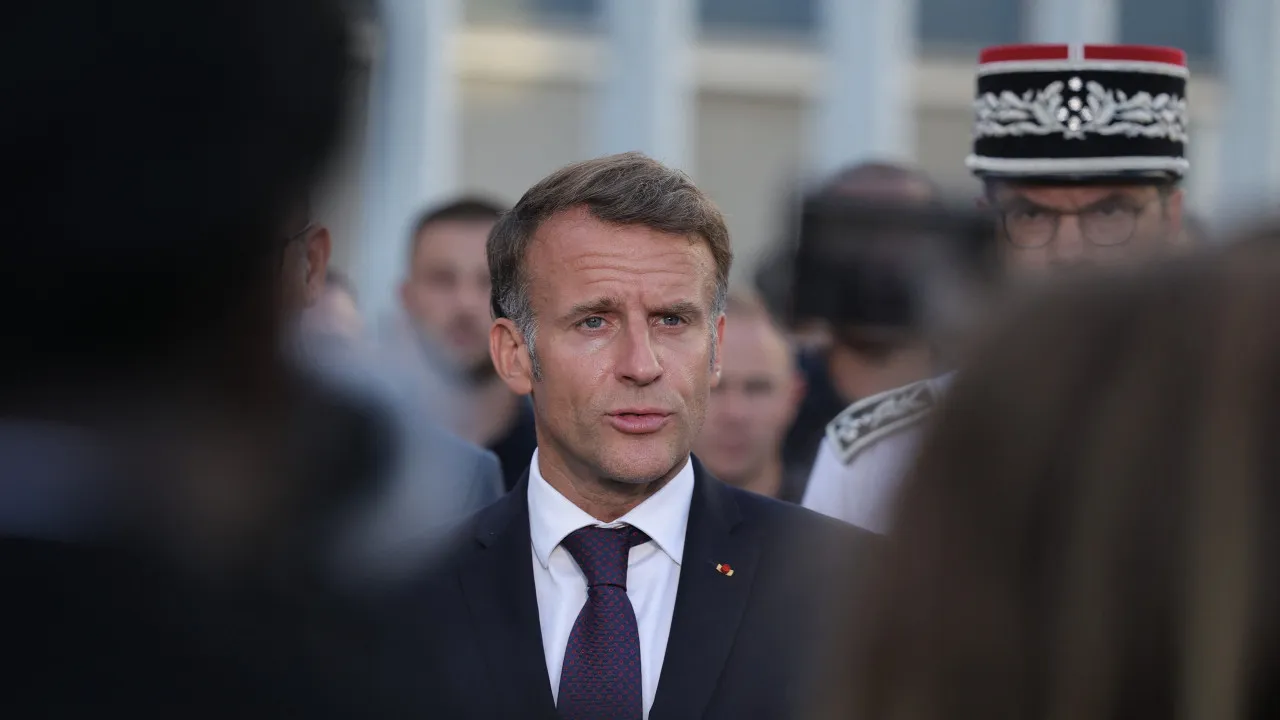
France has today argued that the European representatives invited by the Russian President to negotiate in Moscow are open to doing so only if they are assured that they will play a role in future direct negotiations on Ukraine.
© Kenzo TRIBOUILLARD / POOL / AFP via Getty Images
20/11/2026
by
Lusa
A France has today argued that the European representatives invited by the Russian President to negotiate in Moscow are open to doing so only if they are assured that they will play a role in future direct negotiations on Ukraine.
To confirm talks in Moscow, the French Presidency today considered that European delegates should ensure unity in their views with Washington and Kyiv in order to convey a sound position.
This is the announcement by Russian President Vladimir Putin on Thursday that Russia would have invited European representatives to Moscow to “understand” Europe’s position before further direct negotiations on the conflict in Ukraine.
“ We must ensure the unity of Ukrainians, Americans and Europeans. We have to check this out because, based on experience, we know that it is not always as solid as we would like,” said a French presidential adviser at a conference with journalists, according to the France-Presse news agency.
“ Our demand will be that the opening or formalisation of this dialogue [with Moscow] effectively means that for the Russians, Europeans now have their full weight in the negotiations and actively participate in the next round with the United States and Ukraine,” he added.
The French Presidency (Eliseum) considered it positive that the Russians should ‘propose to formalise’ a dialogue.
The spokesman for the Elisha also indicated that, in addition to the preliminary meetings in the Russian capital, a new round of direct negotiations should take place again in the capital of the United Arab Emirates, Abu Dhabi, still without a confirmed date.
Nevertheless, the French Presidency insisted that “there will not be a new round in Abu Dhabi if this round does not include Europeans”, although it considers a “acquired data” that Europeans should “have their role in the negotiations”.
On Thursday, French President Emmanuel Macron said that the discussion on Ukraine's accession to NATO should be resumed after a meeting in Berlin of the Goodwill Coalition, a group of about 40 countries, including Portugal, which provide military and financial support to Kyiv.
“ In the current situation, given the maximism of Russian positions, I think it is necessary to put the issue of Ukraine’s accession to NATO [North Atlantic Treaty Organization] on the table again,” Macron said at a press conference alongside German Chancellor Friedrich Merz, British Prime Minister Andy Burnham, and the White House special envoys, Steve Witkoff and Jared Kushner.
Following the Berlin summit, the Elisha said that “American negotiators are moving in the right direction.”.
Kushner, at the same press conference on Thursday, stated that Washington is prepared to grant Kyiv security guarantees against future Russian threats similar to Article 5 of the NATO Treaty, which stipulates that an attack on one of the Member States is considered an attack on its own territory.
The Ukrainian President, Volodymur Zelensky, expressed reservations in Berlin about these security guarantees that equated with Article 5 of the Atlantic Alliance that he could receive as an alternative to NATO membership.
“ When it is said that the Ukraine is granted guarantees of the type of Article 5, it is not necessary to complicate things: it means that Ukraine enters NATO,” the French Presidency replied today.
Zelensky also said in Berlin that so far he has not received concrete answers to these questions and insisted that the ideal for the security of the country in the post-war period would be Ukraine joining NATO.
Security guarantees remain one of the main points of disagreement in the negotiations between Moscow and Kyiv.
Moscow insists that the conflict with Kyiv is part of a Western threat to Russia, namely NATO's advance to the Russian borders, and that is why the end of the war against Ukraine is conditional on a new European security architecture.