
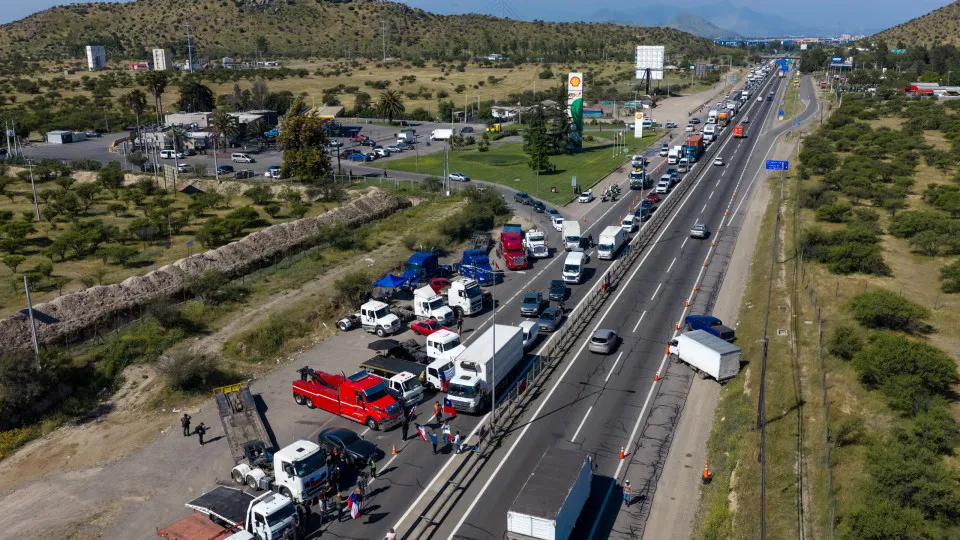
The Chilean government has announced the freezing of fuel prices for three months, a measure that seeks to resolve the stoppage of carriers, which keeps the country's main routes blocked.
© Lusa
12/11/2026
by
Lusa
O Government of Chile announced the freezing of fuel prices for three months, a measure that seeks to resolve the stoppage of carriers, which keeps partially blocked the country's main routes.
“The government decided to freeze the increase in fuel prices until the first days of February,” Interior Minister Claudio Alvarado said on Wednesday in a press statement at La Moneda Palace (executive headquarters).
Several organizations of small and medium-sized truckers and transporters began on Tuesday an undetermined stoppage in almost all regions of the country, in protest against the continuous rise in fuel prices, which has caused significant losses to the sector.
The minister, who throughout the day held several meetings with the representatives of transporters, also indicated that the new fuel adjustment will be reversed through a bill to be processed urgently in parliament next week.
For now, the two main organizations in the sector, the National Confederation of Truck Owners and the National Cargo Transport Confederation, have moved away from the protest, although they have declared that they are solidarizing with the demands of the other groups.
Alvarado explained that the new measures were presented during the last round of negotiations with representatives of the associations leading the standstill. Now, it will be up to these groups to put the proposals to the vote on their bases to decide whether to end the movement, he added.
“From tomorrow [Thursday], there is no excuse to continue to obstruct free traffic on the highways and in the cities of our country,” the minister said.
Chile, one of the most extensive countries in the world, does not have a railway system, and practically all freight transport is carried out by road. For this reason roadblocks cause significant interruptions in supply chains.
The last major stoppage of the truckers took place in February 2022, but lasted only a few days.
The fuel crisis began in March, when President José Antonio Kast decided not to resort to a state mechanism to counteract the impact of the volatility of international oil prices, thus impacting all the increase caused by the war in the Middle East on consumers.
Since the start of the offensive, the international price of diesel has risen by 80%, and that of gasoline by 40%.
The episode generated a chain effect in various economic sectors and brought down the popularity of the far-right head of state, which came to power with the promise to reactivate the economy.
Fuel rising is raising inflation to the highest level by 18 months. The consumer price index rose by 0.5% in October, accumulating an annual variation of 4.5%.