
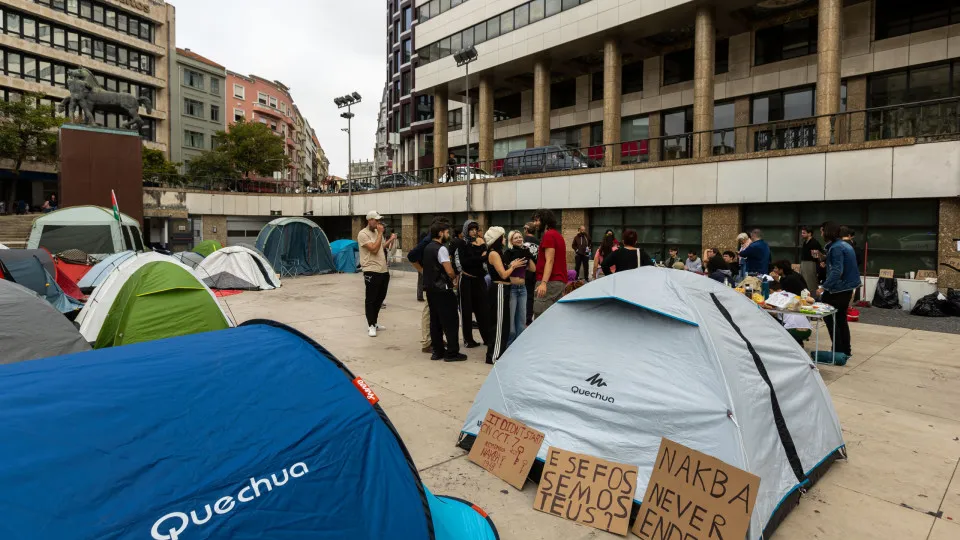
The sociologist Lígia Ferro today considered to Lusa that the camp strategy is “relatively new” in Portugal, even if youth movements occupy the public space since May 68, in France.
© Getty Images
17/10/2026
by
Lusa
A sociologist Lígia Ferro today considered to Lusa that the camp strategy is “relatively new” in Portugal, even if youth movements occupy the public space since May 68, in France.
“ Since May 68 we've had protests of young people in public space. We also had the Occupy Wall Street movement in the United States, which was also an example, and there have already been several camping sites in several countries (...) This strategy is not entirely new, although it is relatively new in Portugal ", defended the teacher at the Faculty of Letters of the University of Porto (PLUP).
The camp that started a week ago in Porto follows the strategy of dozens of cities in Spain, which started with this strategy already weeks ago, in a struggle for the right to housing that has also spread to other European cities.
For today, it is marked not only the return to the tents in Porto, where the protesters have faced cleaning actions and a police charge that caused dozens of wounded, but also in Lisbon, by 17:00.
“ We see more and more tourist projects, real estate, which end up, in a way, diminishing or damaging or affecting somehow the experience of the city. Therefore, young people have this strategy to occupy the public space, to show that they are there claiming their right to the city, as Henri Lefebvre said ", added.
The president of the Portuguese Association of Sociology notes that many of the young people involved with the demonstration belong to the generation “more educated ever”.
“ We know that on the day of police intervention [the dawn of Thursday] we had many students in that camp. We have young people who are in higher education, who have acquired a lot of knowledge, have other notions of organization, of articulation, and think the movement in a more collective and organized way, so to speak, than perhaps in the past in Portugal ", reflected.
This awareness combined with the struggle for housing causes a “more structured form for collective action”, said the expert, who argues that “the government itself should sit at the table with these movements”.
“ Try to hear the claims, what these protests say, and try to find solutions for people. Basically, this is what politics should do,” said the former president of the European Sociology Association.
For Ligio Ferro, police action ended up “inflaming many other people” and transforming a greater challenge than the youth group into the heart of the demonstrations.
“ What happened in Porto [on Thursday night] was the demonstration of an indignation of the general population, of several generations, who realized that there was a peaceful protest, and there was a police charge completely disproportionate ", lamented.
Inviting policy makers to try to “stop to think why people are so upset and protesting”, the context of Portuguese cities over the last few years helps explain the difficult situation that many citizens are experiencing, together with the international environment.
On the one hand, international change to governments “who end up working with extreme right-wing ideologies” has brought wars, such as in Ukraine, Palestine and Iran, which have had economic impacts and social cohesion all over the place, starting with the “rise of hate speech” and polarization in society.
“ People feel the rising cost of living on a daily basis. Combined with old problems that have not been solved in time by public policies, in particular the problem of housing, the phenomenon of tourism and associated gentrification, it ends up generating a number of very unfavorable conditions ", analyzed.
This younger generation, the most educated ever in the country, ends up being “a generation a little condemned to live much worse than their parents”, in the house of which they will also be “condemned” to live without autonomy.
“ These phenomena have generated a youth dispute that takes place in various places, not only in Europe. We have also seen youth protests in India. ... In Porto and Lisbon, we have a rise above the European average of the price of houses, without rising incomes, (...) and all this has generated a wave of indignation and a certain revolt”, added Lígia Ferro.