
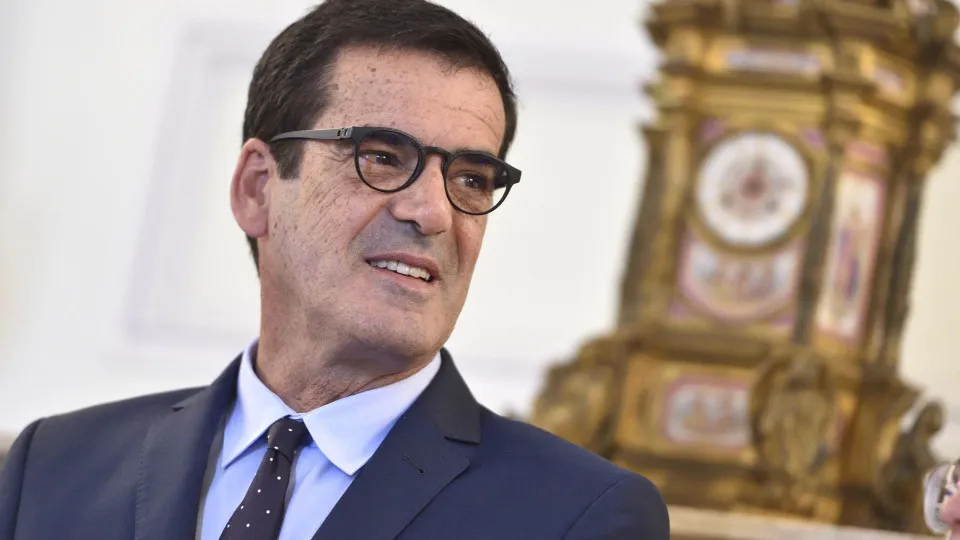
The former mayor of Porto, Rui Moreira, today considered that the demonstrations result from “a situation of distress” and that he understands that people express discontent and “to the few begin to lose patience”.
© Global Images
14/11/2026
by
Lusa
O former mayor of Porto, Rui Moreira, today considered that the demonstrations result from “a situation of distress” and that understands that people express discontent and “to the few begin to lose patience”.
“ The demonstrations never help to accelerate [the resolution of the problem]. The demonstrations result from a situation of distress (...) When we look at OECD statistics [Organization for Economic Cooperation and Development], which is what interests me, I am Ambassador of Portugal to the OECD, when we compare the cost of housing with the average wage, Portugal is the country that is worst situated”, said Rui Moreira who spoke in Porto at the entrance to the presentation of his latest book “The End of Illusions”.
And he continued: “It is natural that people’s discontent should express itself. It is normal that people gradually start to lose patience”.
Asked by journalists to comment on protests for the right to housing that began in Porto more than a month ago, Rui Moreira refused to respond directly to questions related to the city, justifying that “because he was mayor for 12 years it would not be reasonable to make that assessment”.
Still on housing, Rui Moreira argued that “there is no magic wand”, and that “a set of measures” must be taken, reinforcing that it understands “very well” the “affliction of people”.
“And from the generation of my children who cannot find home or when they find it, find a price that does not allow them to live afterwards. And that is also one of the reasons, because much of our most formed youth, better prepared, very available to work, leaves the country looking for exactly the conditions we cannot offer in this period ", said.
Recalling that in the New State period the rents were frozen and that, later on, with Cavaco Silva the tents were eradicated, the now Permanent Representative of Portugal to the OECD said that the housing crisis “has always existed” and that “regularly Portugal sees itself in the need to have public housing policies because the market does not solve everything”.
“ There must be a great commitment, an acceleration, a combination of public, private, cooperative sector wills, because for many years no houses have been built”, he defended.
Invited to look back and analyze what could have been done in Porto, the former mayor said that Porto is better than other areas of the country because “it has about 13% of social housing, while the average of the country is 2% and the European average is 20%”.
“ I think we have done a lot, for example, in income support, which is now being defended even at national level. I remember that we were the first with the [program] ‘Porto Solidário’ [which] we created 14 years ago. At the time they felt that it was not necessary [and] we continue to build housing, some that is no longer of my time (...). The Port of Doctor Fernando Gomes or Doctor Paulo Valada has much more social housing. The problem is that the surrounding municipalities, many surrounding municipalities, do not have this perspective. They have 2 to 3% housing and we have a lot of pressure on social housing in Porto permanently”, he said.
This discrepancy is, however, understandable for Rui Moreira who recalled the different financial capacities of the different Chambers.
“ One city in Porto has financial conditions to do this [household], has a budget that allows it to do this, but the others do not allow it. If it is in a municipality where income is lower and taxes are lower, how can you ask a municipality like that to build a house to then have an income of 50 euros? You can't. So all of this has to be thought of not with measures, there are no miraculous measures, but we must actually build again”, he said.
For Rui Moreira it is clear that Portugal needs social housing “no longer for disadvantaged classes, but also for the middle class, which is what happens in richer countries”.
About the book, which featured presentation of the former President of the Republic Marcelo Rebelo de Sousa in a session where in the front row was the current mayor of Porto, Pedro Duarte, Rui Moreira said it is “an optimistic book” about “a world that has changed”.
“ We lived through a great illusion, in which we thought (...) that our children would live better than we did, that the institutions we had were appropriate to the present time, that there would be no war in Ukraine, that there would be no Covid, that the Social State would continue to give us what we were depositing with our taxes. And what we find is that the world has changed by a set of circumstances ", reflected.
Starting from this conviction, the work “The End of Illusions” has, according to the author, a message about “what is lacking most, trust”.
“It’s not just a Portuguese question, it’s a European issue. I'm living in France and the circumstance is exactly the same. We're going next door, Spain, same thing. European democracies need to be reunited. I am an optimist and I think they will meet again exactly through this trust pact, in which some who are well installed will have to give up some things they have, so that others who are coming, so that the future is not conditioned by the present ", concluded.
Marcelo Rebelo de Sousa praised the author of the book for the “kind of warning” that he makes through this work and refused to comment on other questions above all about political relevance.
“ Now that he is in Paris, he is also in Porto, but he is more in Paris than perhaps in Porto working (...) that is, I told you, I warned you, this year, 2026, that we all have to change because everything is changing around us (...). They want to see if they get a political statement from me, but they don’t have it,” the former president said in a playful way when he said goodbye to journalists.