The European mission Hera confirmed the success of the first mission in history designed to divert an asteroid as a form of planetary defense, but also revealed unexpected changes, including a huge crater and chaotic rotation.
© NASA
26/11/2026
by
Lusa
A european mission Hera confirmed the success of the first mission in history designed to divert an asteroid as a form of planetary defense, but also revealed unexpected changes, including a huge crater and chaotic rotation.
The first detailed images of the asteroid Dimorphos after the deliberate impact, in 2022, of NASA's DART spacecraft, captured within the framework of the European Hera mission of the European Space Agency (ESA), confirmed the success of this planetary defense experience, but also revealed surprising discoveries that experts are now seeking to understand.
In statements to the EFE agency during the presentation on Wednesday of the first images at the Berlin Natural History Museum, Ian Carnelli, director of the Hera mission, stated that the three aspects that most surprised scientists were the crater dimension left by the impact on the asteroid, its chaotic rotation and the discovery of hundreds of rocks hitherto unknown around Dimorphos and the Didymos asteroid, which orbits it.
The Hera probe has reached the binary asteroid system. Didymos at the beginning of this month, after a two-year journey, is currently between 25 and 30 kilometres from Didymos and its moon, Dimorphos. It was from this distance that these unexpected discoveries were observed.
“ When we started this adventure, we thought the crater would be 10 meters in diameter”, Carnelli explained. However, it has been found to have a size comparable to that of a sports stadium, besides containing rocky blocks inside.
It was also “totally unexpected” that Dimorphos, 151 meters in diameter, would no longer present the same face as the main asteroid, Didymos, 730 meters in diameter, turning completely on himself.
“The impact of DART changed the rotation to something completely chaotic. It is currently the object with the most chaotic rotation of the Solar System”, explained to EFE Michael Kueppers, a scientist of the Hera mission.
The third surprise was the discovery that there are not only two asteroids in the system, but hundreds of rocks, some only a few meters in size, orbiting them. These structures are now being examined to determine their origin.
In addition, these rocks constitute an additional risk due to the difficulties they create for the navigation of the probe near it, Carnelli stressed.
“ As we approach, I think we will find many more surprises. We are discovering a new world”, he said.
From mid-December, the probe, with dimensions similar to those of a small automobile, will approach 13 kilometers from the pair of asteroids to capture images of greater resolution. In January, it will also start operating two small satellites, which will perform independent missions around the asteroids, specified Kueppers.
The Juventas nanosatellite, led by Luxembourg, will use a low-frequency radar to first investigate the interior of an asteroid and then attempt to land.
The Milani satellite, led by Italy, will analyze Dimorphos' materials and the dust particles surrounding it.
“ From a broader perspective, I believe we are the first generation that has the ability to divert an asteroid on a collision course with the Earth,” Kueppers said.
“The DART mission has shown that we could alter the orbit of an asteroid. Now, with Hera, we are studying what really happened, what are the physical characteristics of Dimorphos, and we hope that this information can be applied to another asteroid, if ever necessary,” he added.
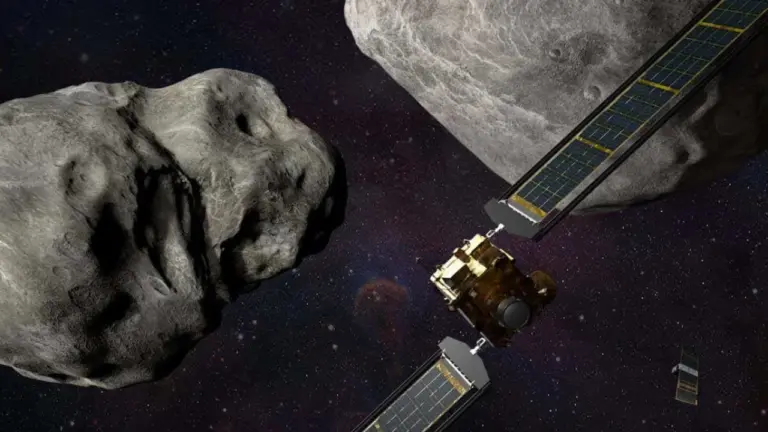
NASA's Double Asteroid Redirection Test (DART) mission has demonstrated that it is possible to modify the orbit of an asteroid beyond the first 33 minutes predicted. However, he remained for clarifying what had happened to Dimorphos himself, a question to which the Hera mission seeks to answer.
The event held this Wednesday at the Berlin Natural History Museum had the title “Double Impact”, in an allusion, according to Carnelli, to the fact that “the dinosaurs understand better than anyone the importance of there being space agencies capable of protecting them”.
The first impact mentioned was what, 66 million years ago, led to dinosaur extinction. The second was the DART mission and the work currently carried out by the Hera mission.