
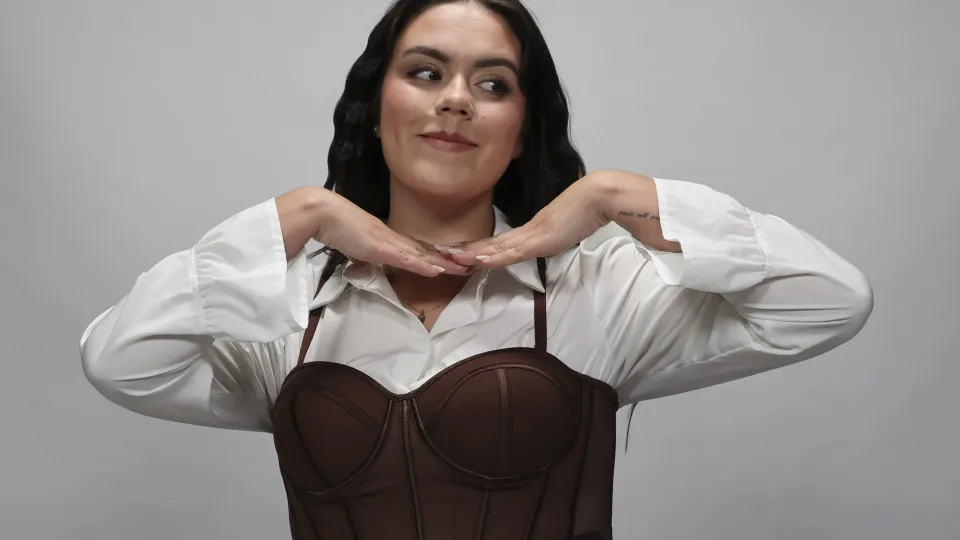
The singer Iolanda launches this Thursday her first album, “Quebranto”, which mixes traditional pop, Portuguese memories and traditions.
© Lusa
08/10/2026
by
Lusa
A singer Iolanda edits this Thursday the first album, “Quebranto”, a work in which presents its “traditional pop”, created in community and made of memories, beliefs and traditions.
The debut album reached the age of 31, but Iolanda's way to make a career in music began well before.
Originally from São Pedro, in the municipality of Figueira da Foz, but with his childhood in Pombal, Iolanda moved to Lisbon at the age of 17 to follow the dream of music, beginning by acting in bars and having tried luck in television talent contests. He later moved to the UK to study composition at the University of Sussex.
In 2023, he edited the debut EP, “Cura”, and the following year became known to the general public by winning the 56th Song Festival with the theme “Grito”. The victory made him represent Portugal at the 68th Festival Eurovision of Song that same year, in Sweden, having won 10th place.
More than Eurovision, the Song Festival was “the turning point” for the career I was looking for, “because the festival continues to be something people consume a lot in Portugal, and it is a specific milestone of Portuguese music,” he told Lusa in an interview.
Two years later it arrives “Quebranto”, an album that shows who is artistically: a traditional pop artist.
“I like this expression, this search, no doubt, for tradition, but also associating with the things I hear,” he said, sharing that he grew up with the music of Avril Lavigne and Alanis Morissette, because it was the records that his mother had at home, but also with traditional Portuguese music, which his father loves, having even integrated a group of cavaquinhos.
In “Quebranto”, these two worlds coexist. “Let’s go to Fausto, the Vitor Jara Brigade and also to more recent pop references, such as Rosalia and Judeline,” he said.
Although he did not write it alone, “Quebranto” is a biographical album, such as the EPs “Cura” and “Look at the bass” (2024).
Iolanda tends “to work more and more as a team”, but in the first album “it was so crazy”: “Break” created and produced “in community”.
The process began with a first musical composition meeting in the studio of the Bateu Matas, in Lisbon, and included a two-week artistic residence in the Ourém area, which brought together a team of 20 people, including the rapper Xtinto, singers Bia Maria and Carolina Deslandes, the second to make lyrics from Lisbon, and producer Luar.
“Several artists gathered there, all of them of different means. I am a lucky girl because I was able to work with all these people”, she shared.
At a later stage, Iolanda was recording the voices in the studio of musician and producer João Só, “who was also a super special person on this record”.
In “Quebranto” one can also hear the voices of several relatives of Iolanda, including one of the grandparents, whose voice the singer “wanted much to eternalize”.
Besides the voices, the family is also at the base of the album, in the will that Iolanda had to “approach the field, have field sounds”, from where it comes, or in the word that gave title to the album.
“ I have always known the word "bringing", it was a word that has always lived in my life and in my family in a very present way ", shared.
In the two EPs he edited, the title came after having the songs made, in the album “the name came soon”.
“I thought straight away and ‘Break’ and then: ‘What does that mean? Why do I want to talk about this? So I went to do a lot of research, because I knew the usual things about the village, I knew that my mother had taken me to Maria do Sacristano, a lady from our area, who did this thing of turning the bush to the children, when they didn't eat much. I went there, turned the bush, which was a prayer with olive oil and stir my belly, I went back and ate everything. Whether that had any influence, we don't know. But the truth is that it helped me and I got out of there eating”, he recalled.
Later on, his mother said to pray to him: “My mother always sends other people to do it and then these people sometimes even send others. This is a chain that no one knows for sure who did, because besides mysticism, I think there is still a certain taboo, and it is things we have always had”.
At one point he realized that the theme had sleeve cloth, and began to think how he could turn it into a disc.
Iolanda didn't want it to be hard work: “I wanted to have fun, to take me home, to be also, in a way, at times prick a little bit with my finger in the wound, in mine and in that of others. There are many songs I write there that are for me, clearly, that are things I do not have the courage to say to myself or to say to others”.
The singer feels that the new work is almost like “going to a village party and living all night, with several things going on”, but admits that whoever hears “maybe won’t find any of this”.
With the album almost ready, Iolanda wanted to add a fado to the alignment. After some research came to “Bloody”, a Fado Cravo de Alfredo Marceneiro, who “made all the sense in the alignment of ‘Break’”.
In the version that he recorded, instead of Portuguese guitar, Iolanda opted for viola braguesa, an instrument very similar only, “which in a way is disruptive but without destroying what the fado is in its genesis”, and which maintains the connection to the other 12 themes of the album.
“I don’t know if it’s a 100% fado. I don't think so. My goal is to create this Portuguese sound, this ‘traditional pop’, and, if possible, take it further”, he said.
After the adventure of “Quebranto”, Iolanda and the team are already immersed in another: the concert of presentation of the album, scheduled for December 7 at Coliseum dos Recreios, in Lisbon.
“ We are preparing a show in which the disc is completely reflected, almost putting the Colosseum in a community perspective also ", told.
Therefore, the show will have the 360o concept, with the stage in the middle of the audience, “the easiest way to have everyone join, almost hand in hand, to see exactly the same thing and to work together to reach a place”.
“Quebranto” is available on digital platforms and will later have physical edition.