
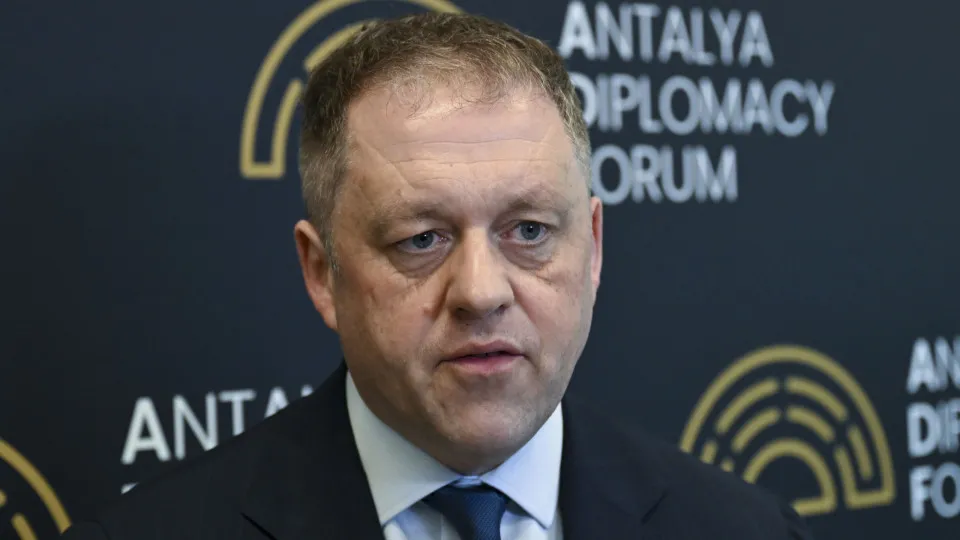
The Irish Government, which holds the rotating presidency of the Council of the European Union, has today promised to try to reconcile positions in the negotiating proposal that it will present on the next Community budget, but has warned that it is impossible to ‘please everyone’.
© Utku Ucrak/Anadolu via Getty Images
07/10/2026
by
Lusa
Na debate at the plenary session of the European Parliament in Strasbourg, Irish Minister for European Affairs, Thomas Byrne, promised to present this Saturday in Brussels the so-called ‘negobox’, the EU budget negotiating proposal which will then be discussed by the Heads of State and Government at the European Council summit next week in Brussels.
“Our goal is to advance the negotiations and bring them closer to an agreement. We will try to reflect, as far as possible, the balance between the different positions on the table, from agriculture to cohesion, through competitiveness, security, defense and external action”, he said.
However, the Irish ruler stressed that “achieving this balance means making difficult decisions”, recalling that the negotiations involve “27 Member States, each with their own positions”, but also the European Parliament (EP), which will have to give its full support to the final proposal to enter into force.
“It is therefore a considerable challenge to come up with a solution that brings everyone together. We cannot naturally please all parties. We still hope that everyone will be able to recognise in this compromise elements that respond to their concerns and priorities”, he said.
Ireland’s objective, he continued, “is to achieve a balanced result that consistently translates the EU’s “collective level of ambition” and allows for a “in good time” agreement that is “in everyone’s interest”.
Then Thomas Byrne stressed that Ireland believes that it is necessary to create new own revenues – such as new taxes on tobacco or non-recycled plastics – to finance the budget, a claim that has so far faced the opposition of the so-called ‘fruit’ countries (Germany, Denmark, the Netherlands, Austria, Finland and Sweden).
“ The creation of new own resources will be key to achieving this objective, along with an adequate volume of funding. Any package of new own resources will have to ensure significant revenue, bring together the unanimity of the Member States and can be applied from 2028 onwards. Only then can we build an ambitious, credible and sustainable budget,” he said.
In turn, the European Commissioner with the budget portfolio, Piotr Serafin, pointed out that the European Commission has put forward a proposal to respond to challenges that “often no Member State can face alone” before leaving criticism of the frugal countries.
“There are still capitals looking at the EU budget as an accountant looks at a balance sheet: ‘how much do I put in and how much do I get in return?’. This way of looking at the budget was already wrong in the past, but, in the light of the budget we have today, it is completely inappropriate”, he criticized.
The Commissioner argued that this type of accounting logic cannot be applied in this case, because the EU budget “serves to respond to common challenges”.
“If each Member State tried to bear alone the costs associated with these challenges, most likely the invoice would be much higher. By confronting them together, we managed to take advantage of economies of scale and create synergies ", highlighted.
The PS MEP Carla Tavares, who drafted the European Parliament’s position on the next budget, also criticised the position of the frugals in this debate, regretting that there is at the European Council “anyone asking for a smaller budget” and “refuse new own resources”.
“ This is to want a first-class Europe with a second-line budget. The spending ambition requires a credible revenue response”, he said.