
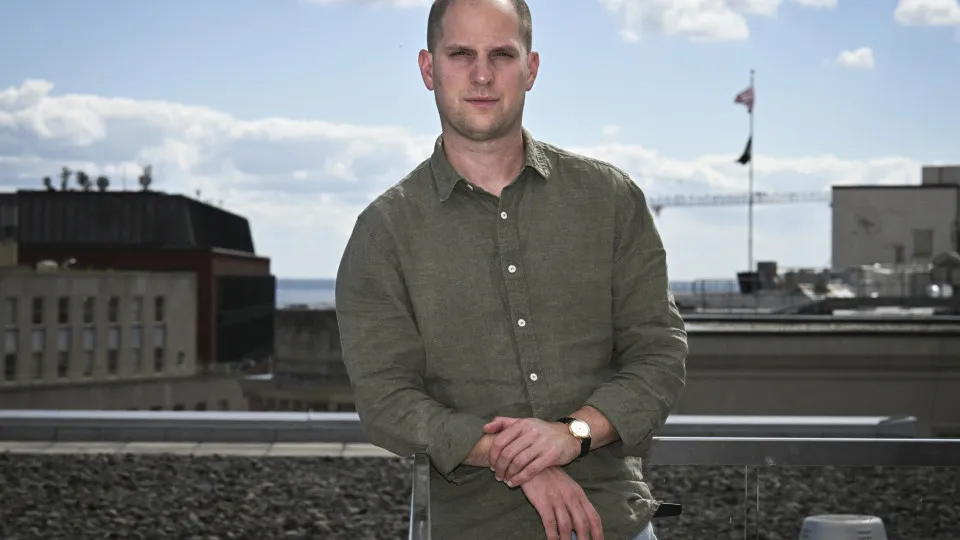
Journalist Evan Gershkovich recalled the nearly 500 days of detention in a Russian prison and the traumas experienced after the release in a prisoner exchange. “For me, my arrest was the work of the FSB, with Putin’s permission,” he said.
© Oliver Contreras / AFP via Getty Images
01/10/2026
by
ANDvan Gershkovich, a journalist from the Wall Street Journal who was arrested for more than a year and was convicted of “spionage” in Russia, recalled the about 500 days he was in a small cell in a Russian prison and what he lived after liberation.
In an interview with france-Presse news agency (AFP), on Wednesday, before the release of his memoir “This Cursed Beautiful Land”, the journalist said he had “panic attacks” in which he was “paralyzed in the midst of crowds”.
“ I went through prison with a kind of stoic mentality, thinking that I had to keep my emotions under control, but, clearly, it all got accumulated and started to come up after leaving ", he said.
Gershkovich revealed that he never cried during the days he was imprisoned, but after being released, he began to cry regularly and to have nightmares in which he was still behind bars. Besides, he confessed, had the feeling he wanted to go back to life in prison, which he had used to.
“ In the first few weeks, I had this very strange feeling of wanting to come back. Because it was something I knew,” Gershkovich reminded AFP.
The journalist, the son of immigrants from the former Soviet Union, grew up in the suburbs of New Jersey, United States. He spoke Russian at home with his parents and his sister and grew up with Russian culture.
He arrived in Russia in 2017 and worked as an AFP correspondent in Moscow before moving to the Wall Street Journal. When the Russian invasion of Ukraine began in February 2022, it was of the few journalists who continued in the country to report abroad.
He was arrested in March 2023 in the industrial city of Ecaterimburg, in the Ural Mountains, while preparing a report on Russian military production.
He said that about half a dozen Russian Federal Security Service (FSB) agents broke into the restaurant where he was sitting and handcuffed him. That's because the source he was meeting was actually an agent who was meant to frame him.
“ Immediately it was an immense fear, a kind of animal fear”, he recalled. “They, you know, put a hood over my head again and punched me in the abdominal zone,” he said.
However, Gershkovich told us that he no longer suffered any physical abuse during his time in prison and that the goal was already to use him in a future prisoner exchange – which came to be confirmed in the summer of 2024.
“ They chose not to destroy me as a person, not to torture me, not to deprive me of food and hot water”, said Gershkovich.
GERSHKOVICH: RUSSIA’S HOSTAGE SYSTEM IS CALCULATED
Wall Street Journal reporter Evan Gershkovich say the fact that Russian Moscow considered him valid for a future prisoner exchange.
He contrasted his.. pic.twitter. with/kqasXQ2pUz
— WW3finalboss (@WW3finalboss) October 1, 2026
The journalist lives in Berlin, Germany, where he works as a journalist for the Wall Street Journal. He revealed that he will not go to Russia as long as Vladimir Putin is president, but assumes that he is not prepared to turn his back on the country.
“In terms of forgiving Russia... what is that, you know? Are 145 million people living there? Is Putin and the FSB?”, questioned.
“ For me, my detention was the work of the FSB, with the permission of Putin ", considered. “But I would like to come back one day, of course. Russia meant a lot to me.”
Evan Gershkovich was sentenced to 16 years in prison for the crime of “spionage” for the United States – the accusation that the journalist, Wall Street Journal and the US government always denied – and ended up being released in a prisoner exchange between Russia and the West on August 1, 2024.