
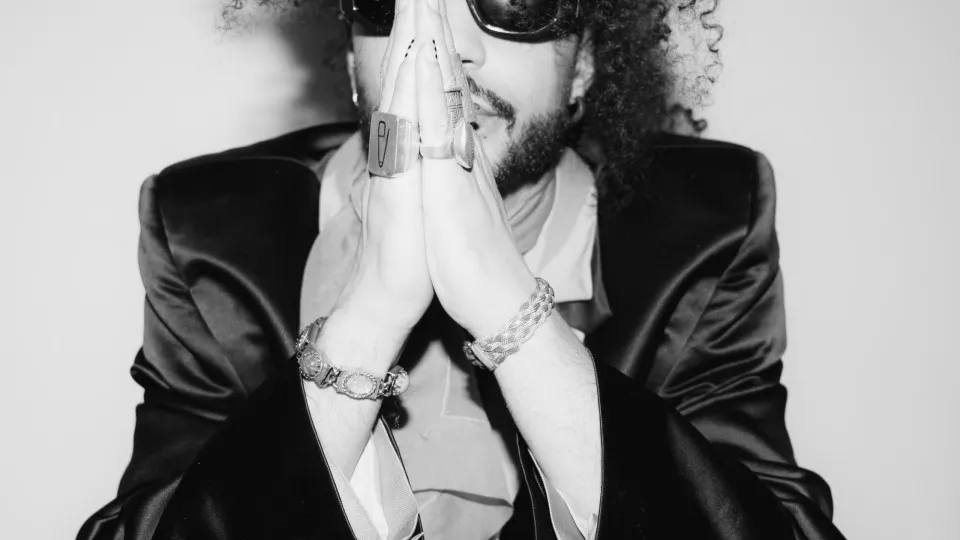
The lukewarm and colladeiras that he heard and sang in childhood, at his mother's restaurant on the island of Fogo, are at the base of the music of June Freedom, Cape Verdean-American artist who today crosses these roots with R&B, pop and other influences.
© June Freedom/ Instagram
04/10/2026
by
Lusa
“ Ser Cape Verde is to be a bit of everything”, says June Freedom, who was born in the United States, grew between the two countries and sees in this mixture of cultures the very definition of Cape Verdean identity: “He’s a half-breed from the world,” he says in an interview with Lusa.
Today, June Freedom is the Cape Verdean artist with the highest number of monthly listeners at Spotify, about 794 thousand, while its catalog exceeds 233 million reproductions on the platform. The theme “YSL” exceeds 80 million ‘streams’.
But before the numbers, there was the Tropical Club, a restaurant that Mom has been holding for 26 years on the island of Fogo and where, between the ages of 10 and 15, June Freedom sang on weekends with live bands.
“ All my choices of a ‘beat’, of a theme or of how to sing in a sound come from the warm and colliders of my mother’s restaurant”, says the musician, who considers these experiences the “foundation” of his style.
The passage through Cape Verdean music also began with the admiration of singer Ildo Lobo, an “idolo” he met when he acted near his mother’s restaurant. June Freedom then became an assumed admirer of the artist, even using the same beret and playing his songs.
“ I was, like, obsessed, wanted to sing like him, wanted to dress like him, the beret he wore, I wore as well, and I started singing his songs”, he says.
It was in this context that, at the age of 12, he represented Cape Verde in Fátima and Ourém, Portugal, in an experience he considers decisive for the beginning of his career. Years later, in the United States, he opened Lobo's last concerts in that country.
Cape Verdean identity remains present in the way it composes and produces, although music has incorporated the influences it has been encountering in the United States.
The artistic name itself contains a family history and freedom. “June” comes from Junior: the musician is called Pedro Paulo and is Pedro’s son, having been treated by Junior for ever. Already “Freedom” was born from a conversation with a cousin, after he told him that when he took the guitar, he seemed to feel freer.
The idea of freedom has now gained a deeper meaning. “Freedom for me is really making music,” says June Freedom, who says he sometimes feels “in prison, mentally”, in the face of what is happening in the world.
The musician, who has lived for over a decade in Los Angeles, speaks of an increasingly heavy environment in the United States, but also in the different places he goes.
June Freedom also relates this change to technological evolution and social networks. It recalls adolescence, when digital platforms with the current dimension did not yet exist, and considers that technology has brought new forms of anxiety and fear, a contemporary world about which it intends to speak in some of the next projects.
June Freedom sings in Creole, English, Portuguese and Spanish and rejects the idea of producing according to a formula for a given market.
He argues that the songs should be born of real experiences and stories, an idea present in the new single, “Dance Again”, collaboration with Spanish singer Eva Ruiz, from the Canary Islands. The coincidence of the two island experiments was one of the reasons that brought artists together.
The musician prepares, however, a sequence of new releases.
Among the collaborations in preparation is a new song with Nelson Freitas, another with Dino D’Santiago, while Mayra Andrade, Tito Paris and Portuguese Slow J are among the artists with whom I would like to return to work or collaborate.
“To feel Cape Verde and to feel the world,” he summarizes, in a relationship with the roots he says he has changed over the years. When I was younger, I wanted to get off the island of Fire and get to know the world; today, after living in the United States and travelling through Europe, I feel more and more like returning.
“ Now I am always at this age when I want to go home, back to the roots and things that do me good in the soul ", says.
The 38-year-old musician also maintains a regular connection to Portugal. And he comes back soon to work on new projects and leaves his promise to return to the Portuguese stage in 2027.
“Nu Bai”, Creole expression that translates Portuguese “come on”, is its motto of life, reinforced since the last Football World Cup.
“ When I saw Cape Verde playing with Spain, everyone was ‘Nu Bai’, it was go, go with everything”, recalls June Freedom, who personally followed the games of the selection in the World.
“Nu Bai” is like this, one of the expressions that most uses the Creole — a kind of ‘afrobeat’ that, for the musician, joins the Cape Verdean identity, music and feeling of belonging to a community scattered around the world.