
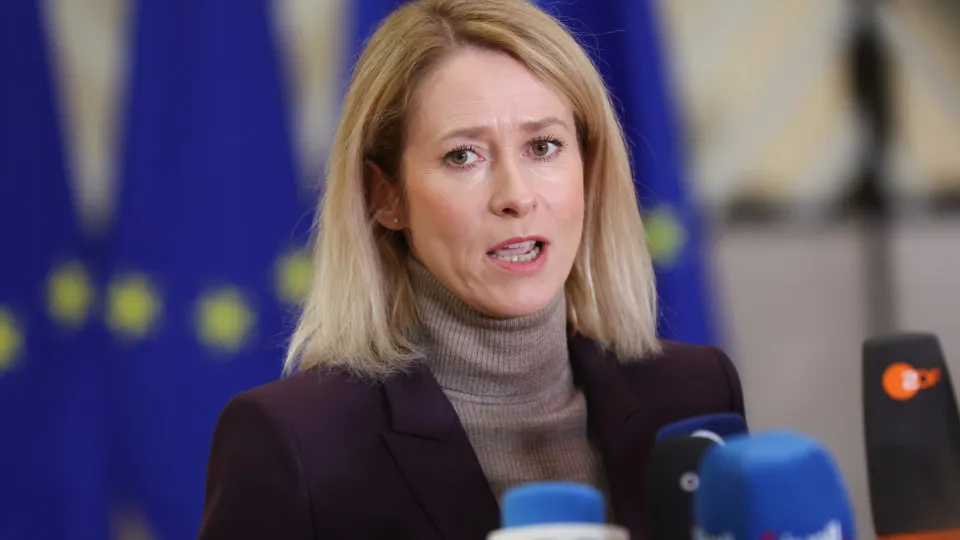
The European Union's head of diplomacy said today that the bloc does not want to negotiate with Russia a new security architecture, but to restore that which exists, and it considered that Moscow's demands are unacceptable.
© Lusa
16/11/2026
by
Lusa
A head of diplomacy of the European Union today said that the bloc does not want to negotiate with Russia a new security architecture, but to restore what exists, and considered that Moscow's demands are unacceptable.
“ The ministers today have been very clear: we do not need a new security architecture. We need to restore the one that already exists. Russia has violated all the treaties on which it is based,” Kaja Kallas said at a press conference at the end of a meeting of the European Union Foreign Ministers (EU) in Brussels.
The EU's head of diplomacy referred to the fact that in the negotiations between Europe, Ukraine and Russia, mediated by the United States, Moscow demanded that a new European security architecture be discussed while negotiating the end of the war.
To journalists, Kallas again argued that, before any discussion about Europe’s security architecture, there must be a ceasefire and a peace agreement must be reached, and accused Russia of presenting “maximalist demands”.
“Moscovo wants to dismember Ukraine, turn NATO back and gain veto power over European security. All of this is unacceptable and out of the question,” he stressed, stressing that these demands served Russia “as a pretext for starting the war” in 2022 and now “serve as a pretext for perpetuating it”.
Russia insists that the conflict with Kiev is part of a Western threat against Russia, namely NATO's advance to the Russian borders, and that is why the end of the war against Ukraine is conditional on a new European security architecture.
The EU’s head of diplomacy recalled that the EU also has its “clear demands on Moscow” and listed some.
“The sovereignty, independence and territorial integrity of Ukraine and its right to choose its own alliances. There can be no legal recognition of the occupied Ukrainian territories,” he listed.
The EU High Representative for Foreign Affairs and Security Policy also added that the bloc requires Russia to be “responsible for war crimes and to pay for the destruction it has caused,” and also to want the children deported from Ukraine to return home and Moscow to stop “the acts of sabotage and Russian cyberattacks throughout Europe”.
Asked what place Ukraine occupies in the EU's security architecture, Kallas replied that this architecture is based on agreements with decades, which included Russia's signature, such as the Paris Charter for a New Europe of 1990, or the Budapest Memorandum of 1994.
“ The issue is neither the agreements nor the position of Ukraine on this matter. The point is that Russia continues to violate these agreements or, rather, does not effectively comply with them,” he insisted.
Questioned whether he regrets being offered to be the EU negotiator in talks with Russia, which the EU leaders later refused, Kallas reiterated that the treaties establish that it is itself that it should represent the bloc at foreign policy level.
“ We always say to our partners ‘ah, the rule of law, the rule of law’. And in Europe the rule of law is actually based on the treaties, and that is exactly what the high representative represents the EU externally, which is enshrined in them,” he said, expressing itself, however, relieved, that it is finally possible to talk about content rather than the form of negotiations.
In these statements, the EU's Chief of Diplomacy also said that work is ongoing to prevent former Russian combatants from entering European territory, suggesting that it is an easy measure to implement at technical level because it is easy to access internal documents from the Russian State.
“ Nowadays, there are ways to do it. We all have excellent information services. I am no expert, but, according to experts, it is relatively easy to get this information,” he said.