
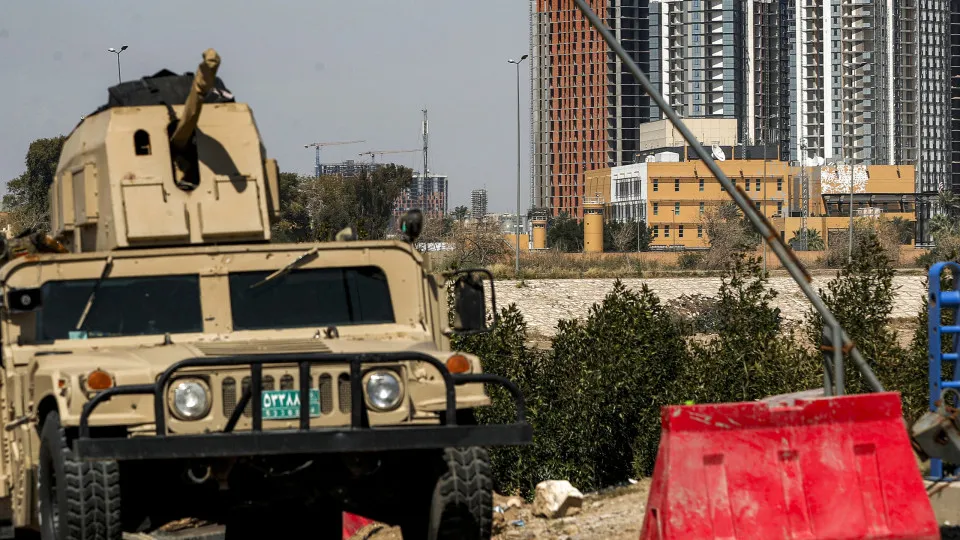
The pro-Iranian armed faction Kataeb Hezbollah will not abandon its bastion south of Baghdad, today assured AFP the leader of the movement, Abu Taleb al-Saidi.
© AHMAD AL-RUBAYE / AFP via Getty Images
17/11/2026
by
Lusa
A an armed pro-Iranian faction Kataeb Hezbollah (Hezbollah Brigades) will not abandon its bastion south of Iraq's capital, Baghdad, today assured the news agency France-Presse (AFP) the leader of the movement, Abu Taleb al-Saidi.
The announcement of the refusal came the day after the Iraqi authorities asked the group to withdraw from the site, allowing the Iraqi army to take control of the region.
“This will not happen, even if they go over us,” said al-Saidi, during a media visit to the group bastion in Jurf al-Sakher – also known as Jurf al-Nasr – south of Baghdad.
On Monday, the Iraqi Prime Minister, Ali al-Zaidi, ordered the armed forces to enter Jurf al-Sakher and established a “time” for the powerful faction to “leave the zone”, according to a government spokesman, quoted by the official news agency INA.
A security source needed AFP that the deadline expires on Friday.
Baghdad authorities are facing increasing pressure from the United States to contain the armed groups supported by Tehran in the country and limit Iran's influence, which is in conflict with Washington.
Tensions between the faction and Ali al-Zaidi have increased since the Iraqi Prime Minister undertook to ensure that these groups surrender their weapons by 30 June 2027, a requirement that Kataeb Hezbollah has so far refused to comply with.
“ There have never been, in our history, major clashes between Kataeb Hezbollah and the Iraqi Government or security forces, and both they and we want to avoid a bloodbath,” Al-Zaidi said.
The Iraqi Government recently accused the faction of smuggling oil into its bastion, an accusation that the group denied, denouncing the executive's lies and claiming to be the victim of a "blackmail operation" to force him to disarm himself.
Iraq has long been a stage of indirect confrontation between Iran and the United States.
After the start of the Middle East war, triggered by an Israeli-North American offensive against Iran in late February, some pro-Iranian factions intensified attacks on US infrastructure in Iraq.