
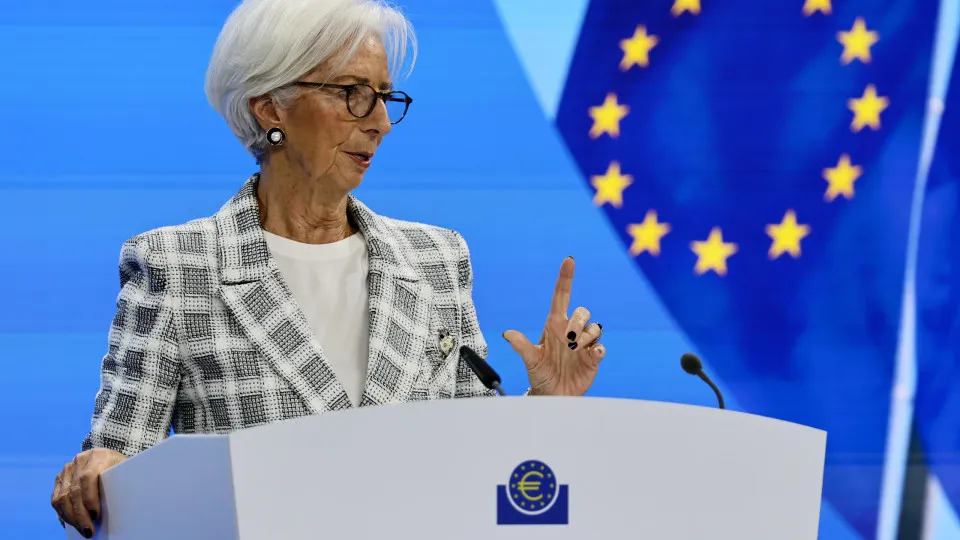
The President of the European Central Bank today asked to speed up the integration of capital markets and the strengthening of Europe's technological and energy capacities to reduce external dependencies and protect economic sovereignty.
© Lusa
11/11/2026
by
Lusa
A president of the Central Bank The European Union has called today to speed up the integration of capital markets and to strengthen Europe's technological and energy capacities to reduce external dependencies and protect economic sovereignty.
In the panel opening speech “How far should European sovereignty go?” on the second and final day of the Paris Forum for Peace, the President of the European Central Bank (ECB) insisted on the need to move forward in the Capital Markets Union to facilitate companies to capture funding in Europe and develop their projects within the continent.
“ For me, as president of the ECB, it is extremely important to have a capital market here in Europe. It is extremely urgent”, said Christine Lagarde, who will leave office on February 7th to have freedom of expression in relation to the election campaign of the French presidential elections that will take place in April and May, but refusing to clarify whether he will be a candidate.
She regretted that companies in need of funding would end up looking for capital outside Europe, especially in the US, because they cannot get it on European markets.
“ We must ensure that people with talent who drive projects in Europe can develop them here,” he said.
It therefore advocated greater financial integration, but also strengthening energy and technological infrastructure as conditions for reducing external vulnerabilities without compromising economic growth.
French policy has argued that the European Union (EU) must strike a balance between economic openness and greater strategic autonomy without giving up growth or innovation.
“ Economic sovereignty is the capacity of a State to provide stable economic growth,” Lagarde said, who also stressed that growth is the basis for improving living standards and financing priorities such as defence, climate transition and social protection.
The ECB's manager warned of the risks of excessive dependence on foreign suppliers and cited Russia's European energy dependence and China's restrictions on exports of critical raw materials, especially rare earth, as examples of the vulnerabilities of the European economic model.
“ We must reduce our exposure to these external risks and move from a total opening to an intermediate position,” he said.
Lagarde considered artificial intelligence (AI) to be another strategic challenge for Europe. In his opinion, it is necessary to adopt this technology to increase productivity, but also avoid relying on external suppliers who could restrict access to essential services.
During the debate, Lagarde defended the development of the digital euro, whose pilot project is planned for next year, and the strengthening of European payment infrastructures as tools to strengthen the international projection of the single currency and reduce dependence on foreign systems.
“ The digital euro will not replace the banknotes, but it will be a tool adapted to an increasingly digital world,” he said.
The President of the ECB pointed out that the institution that heads is finalising the political agreements needed to advance the project and stressed that it is also working on modernising payment infrastructure to prevent Europe from relying on external suppliers who can restrict access to its systems.
“ We cannot allow someone to tell us suddenly that we can no longer use their system to transfer money,” he warned.
Lagarde has ensured that Europe is at the forefront in this field, ahead of the United States and the United Kingdom, and has maintained that the development of new instruments and a wider exchange network will contribute to strengthening the international role of the euro, currently the second world reference currency after the dollar.