
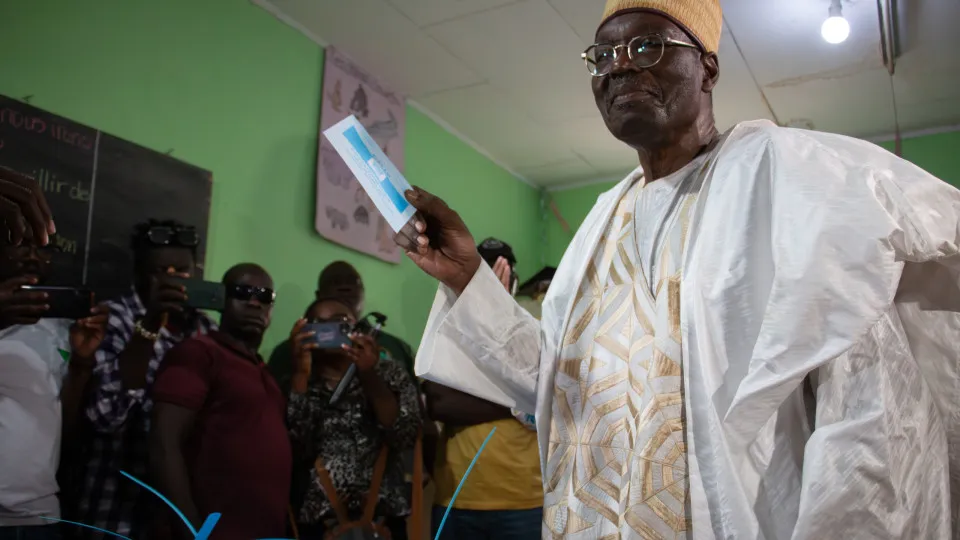
The opposition leader in Cameroon, Issa Tchiroma Bakary, exiled in the Gambia, appealed to the boycott of legislative and local elections, scheduled for February 7, classifying the vote as illegal.
© Lusa
14/11/2026
by
Lusa
O opposition leader in the Cameroons, Issa Tchiroma Bakary, exiled in the Gambia, appealed to the boycott of the legislative and local elections, scheduled for February 7 and classified as illegal the vote decreed by President Paul Biya.
In a statement released by the news portal ‘Actu Cameroun’, the President of the Front for the National Salvation of Cameroon said that Cameroon has been in a political crisis since the presidential elections in October 2025.
Paul Biya, 93 years old and in power since 1982, was declared a winner of the elections, a result contested by the opposition and by the population, whose protests were violently repressed.
Issa Tchiroma Bakary proclaimed himself a winner, did not recognize the outcome favorable to Biya and went into exile in the Gambia, the day after the release of the election results.
At the end of last October, the Front for the National Salvation of Cameroon was suspended and banned from exercising activity for three months.
The opposition leader warned that the realization of a new ballot “cannot be considered a solution” without first facing the consequences of what he describes as a political order that does not respect the institutions themselves.
“ I make a solemn appeal to the political parties of the Cameroonian opposition: do not participate in this electoral farce or support another usurpation of popular sovereignty,” said Bakary.
“ Your participation, in the current circumstances, would legitimize a new injustice and make them politically responsible for its consequences”, said the former minister.
Bakary said that he is taking measures to try to prevent the elections and declared himself “decided to act” together with political and social forces critical of the Yaoundé Government, in order to put an end to what he calls the “interminable cycle of electoral fraud”.
However, the boycott strategy creates differences within the opposition. The Union leader for Change, Djeukam Tchameni, recently demarcated Bakary's stance and questioned the effectiveness of the electoral boycott.
Cameroon's President Paul Biya announced on November 9 the holding of legislative and municipal elections on February 7, 2027.
The ballots have already been postponed twice, leading to the extension of the mandates of the deputies and municipal elected representatives.
The political context in which the Cameroonian voters are called to the polls is particularly tense, marked by the repression of the opposition and the inertia of the power of the highest level of the state.
The country is awaiting a government refurbishment announced by the head of state almost a year ago, as well as the appointment of a vice president, reintroduced by a constitutional review in April, which should succeed Paul Biya in the event of death during the mandate.
The nonagenarian's frequent visits abroad have fuelled debates about his state of health and his ability to govern the country.
By the end of August, Biya returned to Yaoundé after spending more than two months in Geneva, Switzerland, raising strong opposition criticism, whose members have unsuccessfully asked for the vacancy of power to be declared.