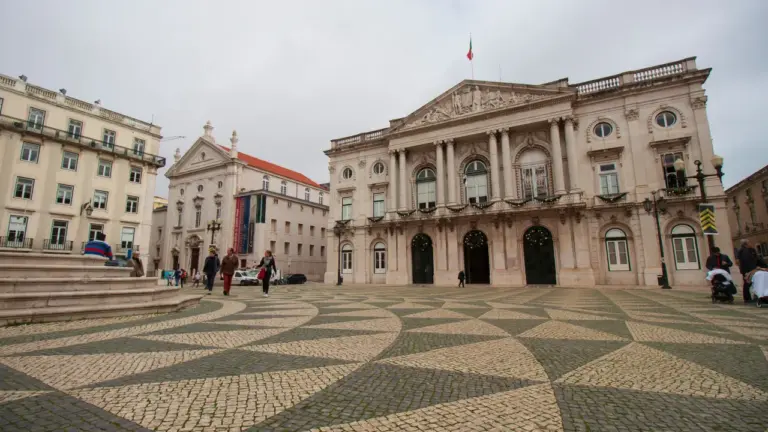
The Lisbon Municipal Assembly urged the Government and the Metropolitan to transform the Line in Line into Laço, to improve the city's mobility.
© Shutterstock
24/11/2026
by
Lusa
Circular Line
A Lisbon City Assembly decided today to urge the Government and the Metropolitan to ensure the transformation of the Circular Line into a Line in Lace, operating throughout the period of exploitation, to safeguard the mobility of populations.
The motion was proposed by the CFP and approved with votes against the CDS-PP and the abstention of PS, Livre and Aquira, in the context of the current debate “Circular Line or Line in Lace: what best serves the city of Lisbon?”, required by the ENP.
“ The solution must pass through the Line in Laço, to ensure the continuity of the routes between Odivelas, Ameixoeira, Lumiar, Telheiras and the city center, without forcing passengers to change composition in Campo Grande ", defended the MP of ENP Cláudia Madeira.
She stressed that, according to studies commissioned by the Lisbon Metropolitan, an increase of 319% of transhipments in Campo Grande with the Circular Line is expected, while it is estimated that the Line in Laço may capture “more than 5,000 passengers per day than the Circular Line”.
“ A transport network should facilitate travel and reduce travel times, not create new obstacles for passengers. This alternative [Linha em Lasso] deserves a serious assessment, which is not limited to the costs of adapting the infrastructure, but also consider the social and environmental costs and the risk of making public transport less attractive”, said the elected ENP.
From the CFP, Sofia Lisbon reinforced the position that the Circular Line is “a wrong option”, which does not respond to the mobility needs of the city and the Lisbon Metropolitan Area and which, on the contrary, will “injure thousands of users” who move daily from the peripheral areas to the center of the capital.
“The PCP was, from the outset, frontally against this option, when the decision was taken by the PS government,” the Communist pointed out, arguing that it is still in time to correct this error, calling for the approval of the motion by the Line in Lace, to be “an unequivocal political signal” addressed to the PSD/CDS-PP Government that the Circular Line “cannot advance”.
Against the motion, Martim Borges de Freitas, of the CDS-PP, stated that the Circular Line project is born of “a political design error”, after “political imposition” of the previous PS governments, and stressed that now it is required “a pragmatic and responsible response”, defending a hybrid solution, reconciling the Circular Line with the Line in Lace, a proposal that the PCP rejected to include in the document.
From the PS, Luís Coelho defended the completion of the work and the entry into operation “without unjustified delays”, which is foreseen in the first quarter of 2027, stating that “defending the infrastructure does not mean considering that there is only one possible way to operate it”.
“ It is not acceptable to present the circular option as if its benefits were universal or as if the costs for passengers in neighboring municipalities were insignificant”, said the socialist, considering that the impact on Campo Grande “cannot be supported” and, therefore, it is necessary to evaluate the options and compare costs with benefits, asking the Government and the Metropolitan to disclose the studies.
Also with a vote of abstention, João Monteiro do Livre stressed the need for a transparent assessment of the costs and benefits of each solution, while Edgar Vaz do Cávez criticized the lack of study of the various options “before moving forward with the work”.
From PSD, Ricardo Mexia, who is also president of the Lumiar Freguesia Board, defended the Line in Laço and recalled that the metro users already experienced the expected impact with the Circular Line, when, in 2024, the works in the Campo Grande terminal, forced the interruption of the direct link to the city center, which caused “chaos” on mobility.
“ We are very aware that there are many temporary solutions that have become definitive. That is not what we want and will, of course, try to resolve the situation quickly so that we can return to a solution that protects the peoples of the north of the city,” said the Social Democrat, intending to transform the Circular Line into a Line in Lace and not to mention that it is not against the government or against the subway, but rather “in favour of the people”.
Also Pedro Bugarín, from IL, reinforced that he has always been against the Circular Line and criticized the “dances of positions of political parties”, beginning with the PS and ending in the Government of AD – Democratic Alliance (PSD/CDS-PP coalition), which last week, in parliament, did not follow the PCP’s proposal in defense of the Line in Lace.
Rodrigo Machado, from BE, stressed that “the Circular Line is a mistake”, while António Morgado Valente, from PAN, argued that the central issue is to ensure that public transport responds to people’s needs and contributes to reduce the use of the car.
At the end of the debate, the vice president of the Lisbon Chamber, Gonçalo Reis (PSD), said that “it is very good” the opening foreseen in the first quarter of 2027 of the metro stations of Estrela and Santos, and that the city “can’t afford to waste the opportunity to quickly complete the Circular Line”.
However, he continued, this “is not the best solution” and, therefore, should be considered the Line in Lace, which “costs about 5% of the total” invested in this work.
With an estimated investment of around 380 million euros, the Circular Line intends to link the station of the Rat to the Cais do Sodré, with two new stations – Estrela and Santos – to an extension of two kilometres, as well as create a circular ring on the Green Line, implying with the route in the Yellow Line from Campo Grande.
The Government provides for the entry into operation of the Circular Line in the first quarter of 2027, as indicated on November 2, in parliament, Secretary of State for Mobility, Cristina Pinto Dias, who said that the possibility of reconciling it later with a Line in Lace, which would require another 18 months of work and “an additional cost in the order of EUR 18 million” is open.