
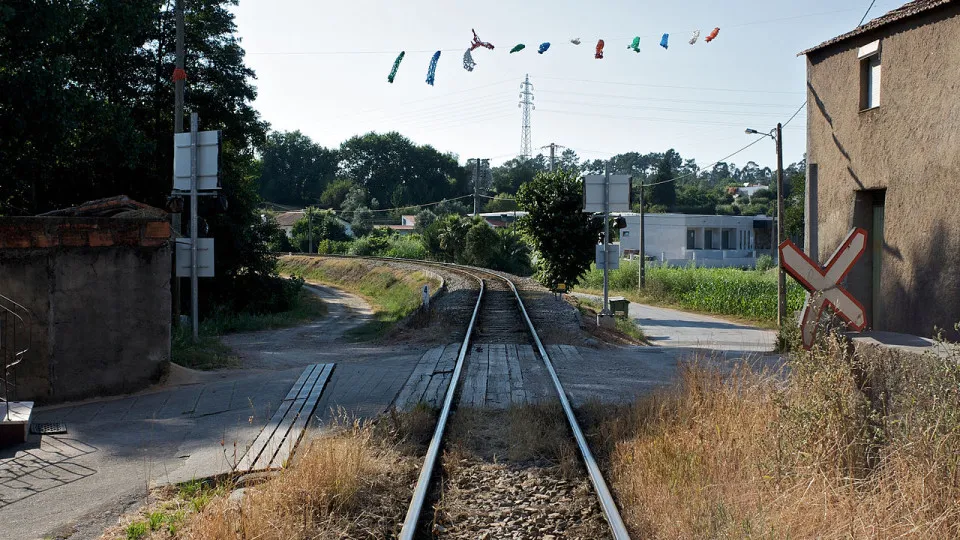
The PCP argues that the rehabilitation of the Vouga Line cannot wait 15 to 20 years and requires the inclusion of Sernada do Vouga in the project.
© Wikimedia Commons
13/10/2026
by
Lusa
A director of Aveiro do PCP argues that the rehabilitation of the Ferea Line of Vouga “can not wait 15 to 20 years” nor limit itself to the Espinho/Oliveira de Azeméis section without including Sernada do Vouga, in the municipality of Águeda.
In a statement this Monday, the district structure of the Communists requires “the full revision” of the project, following a recent fire in a carriage called “Vogue” and public statements by officials of the Port Metropolitan Transport company stating that the government was only considering the conversion of the line to Iberian gauge or the implementation of a system ‘BRT – Bus Rapid Transit’, also known as subways.
“Face the danger that constitutes the current view of the Government, the Metropolitan Area of Porto and the Metropolitan Transport of Porto in relation to the Vouga Line, the CFP remains uncompromising in its defense and (...) affirms the need to carry out a full review of the railway, the opening of the Line between Azeméis and Sernada, the rehabilitation and modernization of the stations, and the improvement of efficiency and security in the level crossings”, the statement lists.
With regard to the execution deadlines, the PCP says that “the ‘most important and impacting project in the south of the Metropolitan Area’ cannot wait 15 to 20 years to be completed” and argues: “It does not serve the interests of the food populations solutions that, apart from now leading to the destruction of the line, sometimes to investments of great scale and of doubtful applicability, push its conclusion to two decades’ time.”.
As for the geographical extension of the work, the communists explain that the undertaking cannot be restricted to the section between Espinho and Azeméis, because “the Vouga Line and the Aveiro Rail Branch form a network of 96 kilometers between Espinho and Aveiro, and formed a network of 177 kilometers between Espinho, Aveiro and Viseu”, which is of “a strategic importance for regional mobility”. Thus, this railway may “have differentiated solutions for different sections”, but “it should not be amputated in an exclusively metropolitan logic of connection to the city of Porto”.
The Communists also recommend the relocation of some sidecars along the Line, the automation of their ticket system, the improvement of carriages, the increase in train frequency, the electrification of the track to its full extent and the guarantee of the transshipment of passengers in Espinho to the North Line “in comfort and safety”.
The regional leadership of the CFP admits that the National Railway Plan provides for an investment of EUR 100 million to re-qualify and electrify the Vouga Line by 2030, but, in the face of everything that needs to be done, it states that “it is increasingly doubtful that the Government will actually implement this project in terms that best serve the people”.
To justify this perspective, the direction of Aveiro mentions other aspects that remain unclear, starting with the hypothesis that the line will be used as a subway. This would be, “in reality, a bus on a dedicated channel and, in practice, corresponds to the destruction of the Vouga line, compromising the mobility between the municipalities crossed and the connections to Porto and Aveiro”, which “would contradict any logic of valuing collective transportation and has long been perceived as a mistake”.
Another two misexplained questions are those relating to the width between rails and the loading of carriages.
In the first case, the PCP warns that “a project in Iberian gauge – wider than the current metric gauge – would imply a very significant investment in the complete change in the profile of the Vouga Line, with substantial impacts on the populations of the municipalities of Espinho, Santa Maria da Feira, São João da Madeira and Oliveira de Azeméis”. It would require to demolish houses and to change the location of stations and level crossings, for example, with the “earn in the duration of the trip [to be] very reduced”, when, alternatively, there are already conditions for “to electrify the line in metric gauge, ensuring a service with greater frequency and quality”.
As for the allocation, the statement states that any project aimed at forwarding more passengers to the Northern Line should consider “the absolute saturation” of this railway today, with “overcrowded trains, insufficient frequency, constant delays due to the already high traffic, lack of conditions in many stations and aircraft, and the criminal postponement of the construction of the Porto-Lisboa High Speed Line” – which has been “deep for more than 30 years” and “insistes” in a form of public-private partnership.