
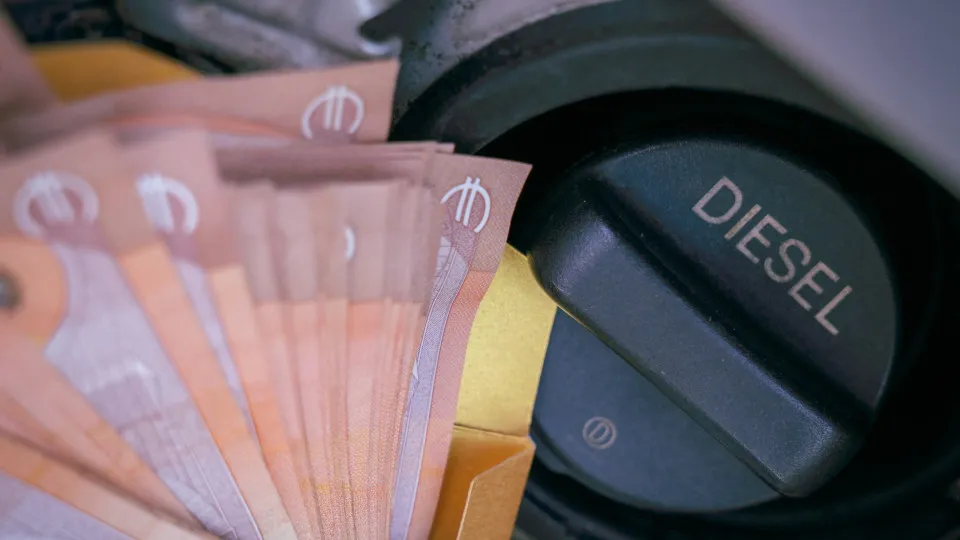
The government maintained the continuity of the additional IUC for diesel cars in 2027, as proposed by the State Budget. The measure applies to vehicles of categories A and B.
© Shutterstock
13/10/2026
by
Beatriz Vasconcelos, Lusa
Sif you have a diesel car, know that you should continue to pay the additional to the Single Circulation Tax (IUC) in 2027, as the Government has maintained its continuity in the proposal of the State Budget for 2027 (OE2027).
The measure applies to vehicles to diesel category A and B.
“The additional single movement tax shall remain in force for the duration of this law (IUC) provided for in Article 216 of Law 82b/2014 of 31 December 2014, applicable to diesel vehicles in categories A and B provided for in Article 2(1)(a) and (b) of the Single Circulation Tax Code (IUC Code), approved in an annex to Law No 22-A/2007 of 29 June” document presented by the government last week.
This extra fee, remember, was introduced in 2014 and varies according to the cylinder and age of the vehicle.
IUC payment calendar will change in 2027
Also from next year, remember, the IUC payment schedule will change and the Fisco has already opened contest until the end of October to hire an external company to adapt IT systems to the new IUC collection rules from 2027, for 225,000 euros without VAT.
The announcement of the tender procedure was published today in Diário da República and is also published in the Official Journal of the European Union because it is an international competition. The deadline for submission of applications runs until 5 p.m. on 30 October, the notice states.
The tender is addressed to companies providing consultancy and software programming services, for the applicational development of “corrective and procedural management” of the settlement and collection of the new Single Circulation Tax (IUC) regime next year.
The Fisco needs to adjust the internal IT systems for collecting the tax required each year to the new payment rules, which will have a new schedule from 2028 and a transitional regime in 2027.
When will IUC be paid in 2027?
From 1 January next year, car owners will pay the IUC in fixed dates, instead of doing so in the month of registration of the vehicle, as is usually the case today.
In the final version, which will apply definitively from 2028, the IUC will be settled by the end of April of each year if the amount to be paid to the State by an owner is up to EUR 100.
If the amount exceeds EUR 100 and equal to or less than EUR 500, it shall be paid in two instalments, one April and the other in October.
If the value exceeds EUR 500, the IUC is delivered in three instalments, one in April, the other in July and the other in October.
Taxpayers may choose to pay the tax in a single instalment, as early as April, according to the government’s decree, Decree-Law No 161/2026 of August 4.
In the year of registration or registration of the vehicle in Portugal, the IUC shall be paid within 30 days of the expiry of the period legally laid down for registration.
By 2027 the logic of payment will already apply on fixed dates, but with a different timetable.
If the value of the IUC to be delivered to the State is EUR 500 or less, the amount shall be paid in a single instalment in October.
In other cases, it is delivered in two instalments, one in July and the other in October, without prejudice to the option of full payment in July.
The transitional standard was created by the Government to avoid situations where taxpayers would have to pay the IUC for 2026 and 2027 within a short period of time.
The transitional standard also provides for the possibility, in 2027, for an owner to “require the cancellation of the liquidation of the IUC” if “the cancellation of the registration of vehicles of categories” occurs next year. A, B, C, D or E before their anniversary date of registration”.
In the text of the decree-law, the government states that changes to the IUC payment model aim to promote “voluntary compliance with tax obligations, speeding up procedures and strengthening trust and transparency in the tax relationship” and “preventing situations that could penalize the taxpayer”.
The new rules were adopted in parliament in final vote on 17 April, through a legislative authorization that allowed the government to adjust the timetable by decree-law, published on 4 August.