
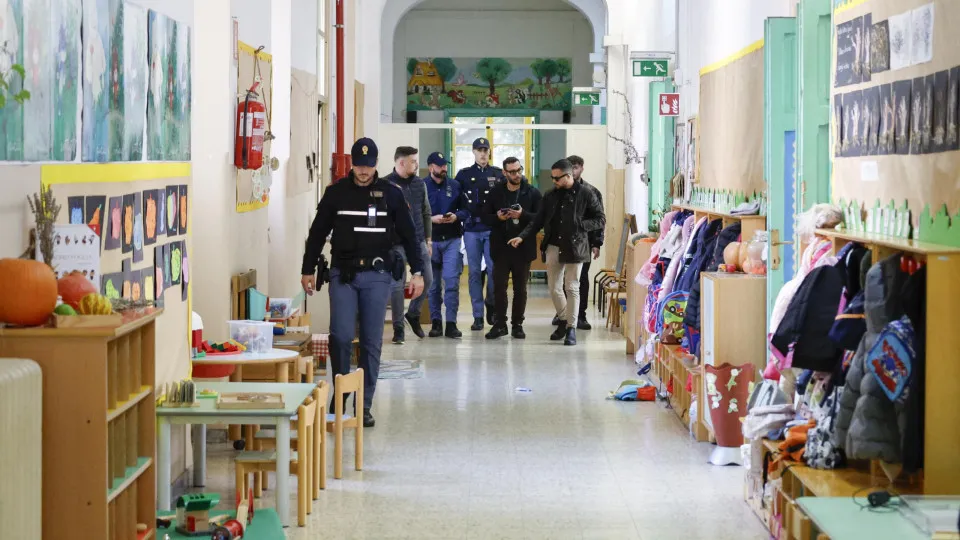
More than 1,700 schools in Scotland, Northern Ireland and Ireland received false bomb threats, similar to those received by 6,000 schools in Italy, according to local authorities.
© Lusa
12/11/2026
by
Lusa
Ma thousand schools in Scotland, at least 300 in Northern Ireland and hundreds more in Ireland, received false bomb threats, similar to those received by 6,000 schools in Italy.
In Scotland, educational institutions in various regions, including the capital, Edinburgh, and Glasgow, were targeted on Wednesday by “threatful messages,” which were classified as false alarms, said a spokesman for the Scottish Police.
“ Our investigations have determined that there is nothing to suggest that they represent a real threat or that there is a greater danger to the public,” said the police representative, quoted by the public broadcaster STV.
He added that the corporation assessed that “there is no need to evacuate schools or prevent children from attending classes based only on the content of emails”.
The Scottish Police Cybercrime and Fraud Unit is conducting “a thorough investigation into the origin of messages,” said the spokesman, adding that agents are “cooperating with security forces across the UK and other countries.”.
In Northern Ireland, the situation was similar, with “more than 300 schools” receiving threats, the local police reported in a statement, mentioning “e-mails similar to those registered in Scotland.
“ Based on the investigations and information obtained so far, the police consider that this e-mail from outside the United Kingdom is a false alarm,” the corporation said, stressing that “investigations continue.”.
Similarly, hundreds of schools on the rest of Ireland, including the Republic capital Dublin, received e-mails with false bomb threats.
Most of the cases occurred in the historic province of Munster, which covers the southwest of the island, which recorded more than 400 such messages.
The Irish police said that “he is aware of a generic communication sent to various educational institutions,” said a spokesman for the corporation.
He stressed that “this threat is not credible and it is not recommended to evacuate any educational institution,” the Irish news portal The Journal said, adding that intelligence service agents are participating in the investigation.
The Irish Ministry of Education, in turn, reported that it is “aware” of threats and is in contact with security forces “at a high level regarding this incident”.
Reinforcing the guidance that “there is no need to evacuate”, the folder asked the educational institutions that received the email with the threat that “contact emergency services through the number 999 and follow the guidelines” of the police.
About 6,000 Italian schools received on Wednesday a bomb threat by e-mail that generated alarm throughout Italy, indicated sources from the Ministry of Education.
Not all schools were evacuated, but several hundred of them were, while the police were conducting searches for explosives until they concluded that the threat was false.
The Prime Minister, Giorgia Meloni, said Italian researchers are working with European counterparts to identify the authors of these ‘e-mails’ and also recalled the false bomb threats that recently led to the diversion of dozens of flights in Europe.
According to the Italian media, the bomb threat was contained in an ‘e-mail’ signed by “Mikhail Andropov, head of the Vilayat (district) of the Misoginistan”.
Already in October, hundreds of schools in Northern Ireland, Scotland, Hungary and Serbia were subjected to false bomb threats.
These attacks generate growing concern in Europe about the possibility of an escalation of the hybrid war.